Review the Episodes, Refine the Lessons: Simple Memory Evolution for Embodied Agents
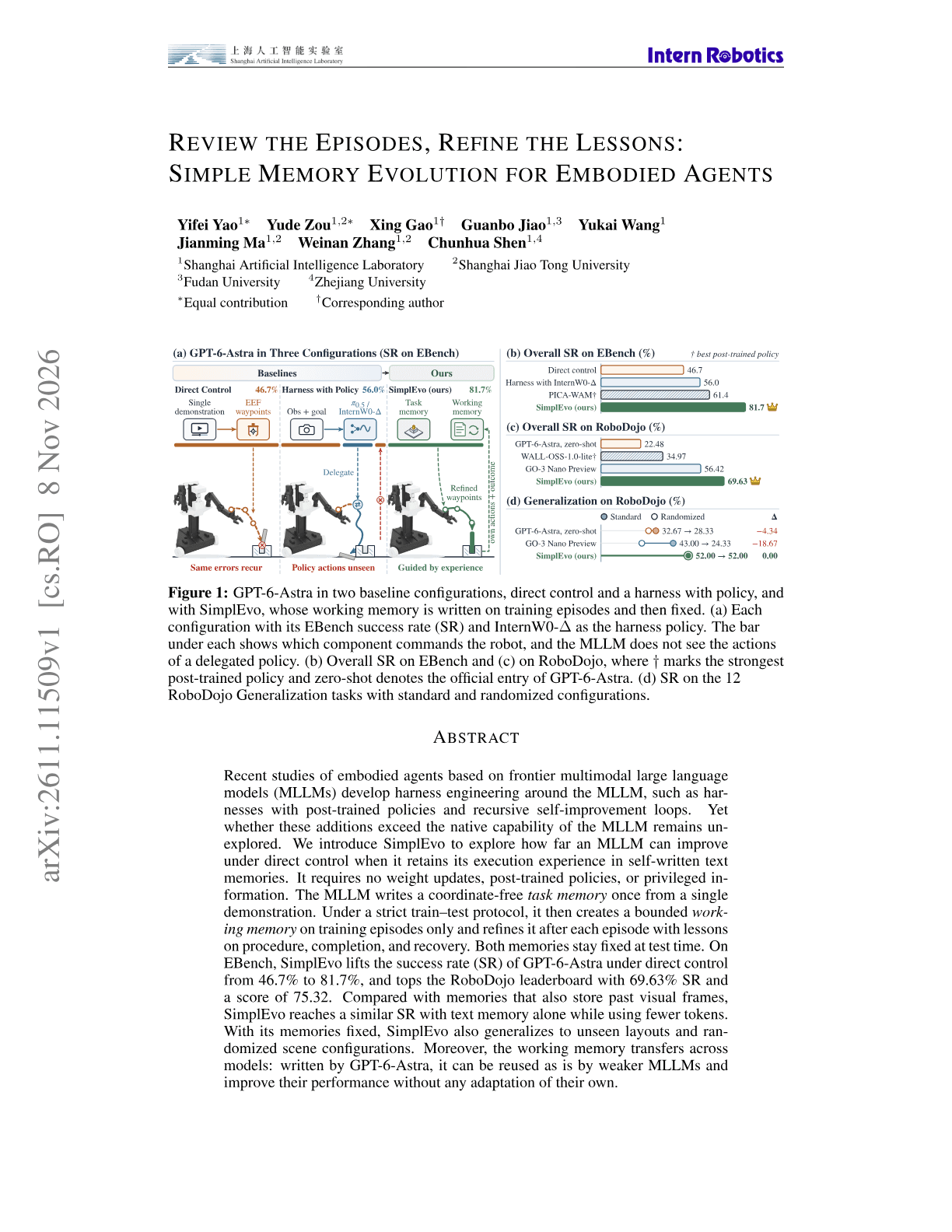
Yifei Yao and colleagues at Shanghai AI Laboratory and Shanghai Jiao Tong University introduce SimplEvo, which tests how far a multimodal model can go under direct control with only self-written text memories, no weight updates and no post-trained policies.
Ask this paper
Two memories. The model writes a task memory once from a single demonstration, then refines a bounded working memory after each training episode with lessons on procedure, completion and recovery. Both are frozen at test time.
Results. On EBench, SimplEvo lifts GPT-6-Astra under direct control from 46.7% to 81.7% success and tops the RoboDojo leaderboard at 69.63% success and a 75.32 score.
Text is enough. It matches memories that also store past visual frames on success while using fewer tokens, and generalizes to unseen layouts and randomized scenes.
Transfer. A working memory written by GPT-6-Astra can be reused as is by weaker models and improves them with no adaptation.
Abstract
Recent studies of embodied agents based on frontier multimodal large language models (MLLMs) develop harness engineering around the MLLM, such as harnesses with post-trained policies and recursive self-improvement loops. Yet whether these additions exceed the native capability of the MLLM remains unexplored. We introduce SimplEvo to explore how far an MLLM can improve under direct control when it retains its execution experience in self-written text memories. It requires no weight updates, post-trained policies, or privileged information. The MLLM writes a coordinate-free task memory once from a single demonstration. Under a strict train-test protocol, it then creates a bounded working memory on training episodes only and refines it after each episode with lessons on procedure, completion, and recovery. Both memories stay fixed at test time. On EBench, SimplEvo lifts the success rate (SR) of GPT-6-Astra under direct control from 46.7% to 81.7%, and tops the RoboDojo leaderboard with 69.63% SR and a score of 75.32. Compared with memories that also store past visual frames, SimplEvo reaches a similar SR with text memory alone while using fewer tokens. With its memories fixed, SimplEvo also generalizes to unseen layouts and randomized scene configurations. Moreover, the working memory transfers across models: written by GPT-6-Astra, it can be reused as is by weaker MLLMs and improve their performance without any adaptation of their own.