Sage-Evolve-Preview:Adaptive Observation for Post-Training Self-Improvement
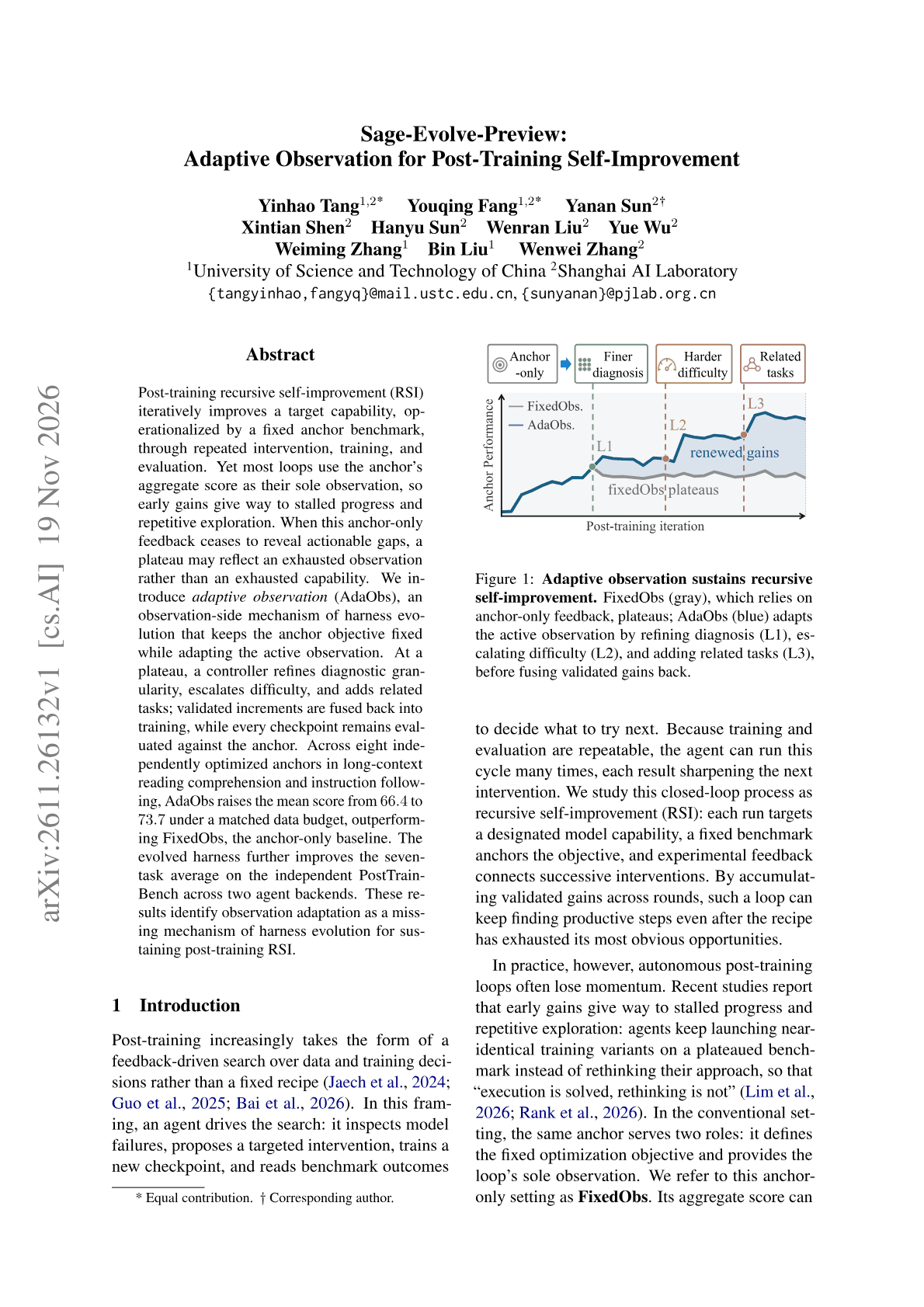
Yinhao Tang, Youqing Fang and colleagues at USTC and Shanghai AI Laboratory argue that post-training self-improvement loops stall because they observe only the anchor benchmark's aggregate score, and introduce adaptive observation (AdaObs) to change what the loop observes at a plateau.
Ask this paper
Diagnosis. When the anchor score stops revealing actionable gaps, a plateau may reflect exhausted feedback rather than an exhausted capability.
Method. At a plateau, a controller refines diagnostic granularity, raises difficulty and adds related tasks. Validated increments go back into training, and every checkpoint is still scored on the fixed anchor.
Results. Across eight anchors in long-context reading comprehension and instruction following, AdaObs raises the mean score from 66.4 to 73.7 under a matched data budget, beating the anchor-only loop.
Transfer. The evolved harness also improves the seven-task average on the independent PostTrainBench with two different agent backends.
Abstract
Post-training recursive self-improvement (RSI) iteratively improves a target capability, operationalized by a fixed anchor benchmark, through repeated intervention, training, and evaluation. Yet most loops use the anchor's aggregate score as their sole observation, so early gains give way to stalled progress and repetitive exploration. When this anchor-only feedback ceases to reveal actionable gaps, a plateau may reflect an exhausted observation rather than an exhausted capability. We introduce adaptive observation (AdaObs), an observation-side mechanism of harness evolution that keeps the anchor objective fixed while adapting the active observation. At a plateau, a controller refines diagnostic granularity, escalates difficulty, and adds related tasks; validated increments are fused back into training, while every checkpoint remains evaluated against the anchor. Across eight independently optimized anchors in long-context reading comprehension and instruction following, AdaObs raises the mean score from $66.4$ to $73.7$ under a matched data budget, outperforming FixedObs, the anchor-only baseline. The evolved harness further improves the seven-task average on the independent PostTrainBench across two agent backends. These results identify observation adaptation as a missing mechanism of harness evolution for sustaining post-training RSI.