Scaling public input on AI policy with pluralistic agents
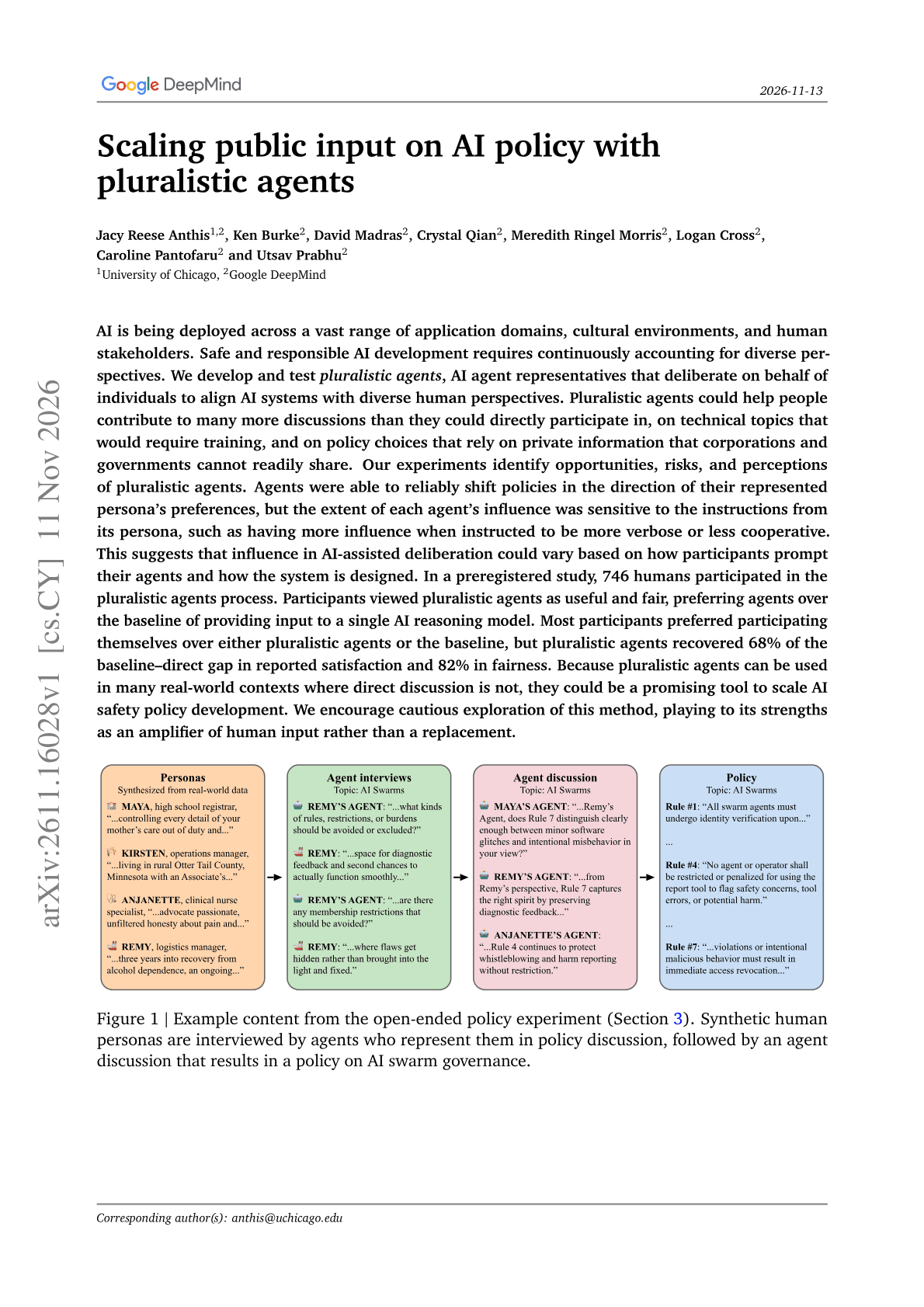
Jacy Reese Anthis, Ken Burke, Meredith Ringel Morris and colleagues at Google DeepMind and the University of Chicago build pluralistic agents, AI representatives that deliberate on AI policy for individual people, and test them with simulated personas and 746 human participants.
Ask this paper
Idea. Each person is represented by an agent that argues for their preferences in a multi-agent deliberation, so people can give input on more policy questions than they could join directly.
Influence. Agents reliably move group budget policies toward their persona preferences. How much they move it depends on instructions: agents told to be more verbose or less cooperative gain more influence.
Human study. In a preregistered study with 746 people, participants rated pluralistic agents as useful and fair and preferred them over input to a single reasoning model.
Gap closed. Most participants still preferred taking part themselves, but pluralistic agents recovered 68% of the satisfaction gap and 82% of the fairness gap between the single-model baseline and direct participation.
Abstract
AI is being deployed across a vast range of application domains, cultural environments, and human stakeholders. Safe and responsible AI development requires continuously accounting for diverse perspectives. We develop and test pluralistic agents, AI agent representatives that deliberate on behalf of individuals to align AI systems with diverse human perspectives. Pluralistic agents could help people contribute to many more discussions than they could directly participate in, on technical topics that would require training, and on policy choices that rely on private information that corporations and governments cannot readily share. Our experiments identify opportunities, risks, and perceptions of pluralistic agents. Agents were able to reliably shift policies in the direction of their represented persona's preferences, but the extent of each agent's influence was sensitive to the instructions from its persona, such as having more influence when instructed to be more verbose or less cooperative. This suggests that influence in AI-assisted deliberation could vary based on how participants prompt their agents and how the system is designed. In a preregistered study, 746 humans participated in the pluralistic agents process. Participants viewed pluralistic agents as useful and fair, preferring agents over the baseline of providing input to a single AI reasoning model. Most participants preferred participating themselves over either pluralistic agents or the baseline, but pluralistic agents recovered 68% of the baseline-direct gap in reported satisfaction and 82% in fairness. Because pluralistic agents can be used in many real-world contexts where direct discussion is not, they could be a promising tool to scale AI safety policy development. We encourage cautious exploration of this method, playing to its strengths as an amplifier of human input rather than a replacement.