Scaling up Test-Time Compute with Latent Reasoning
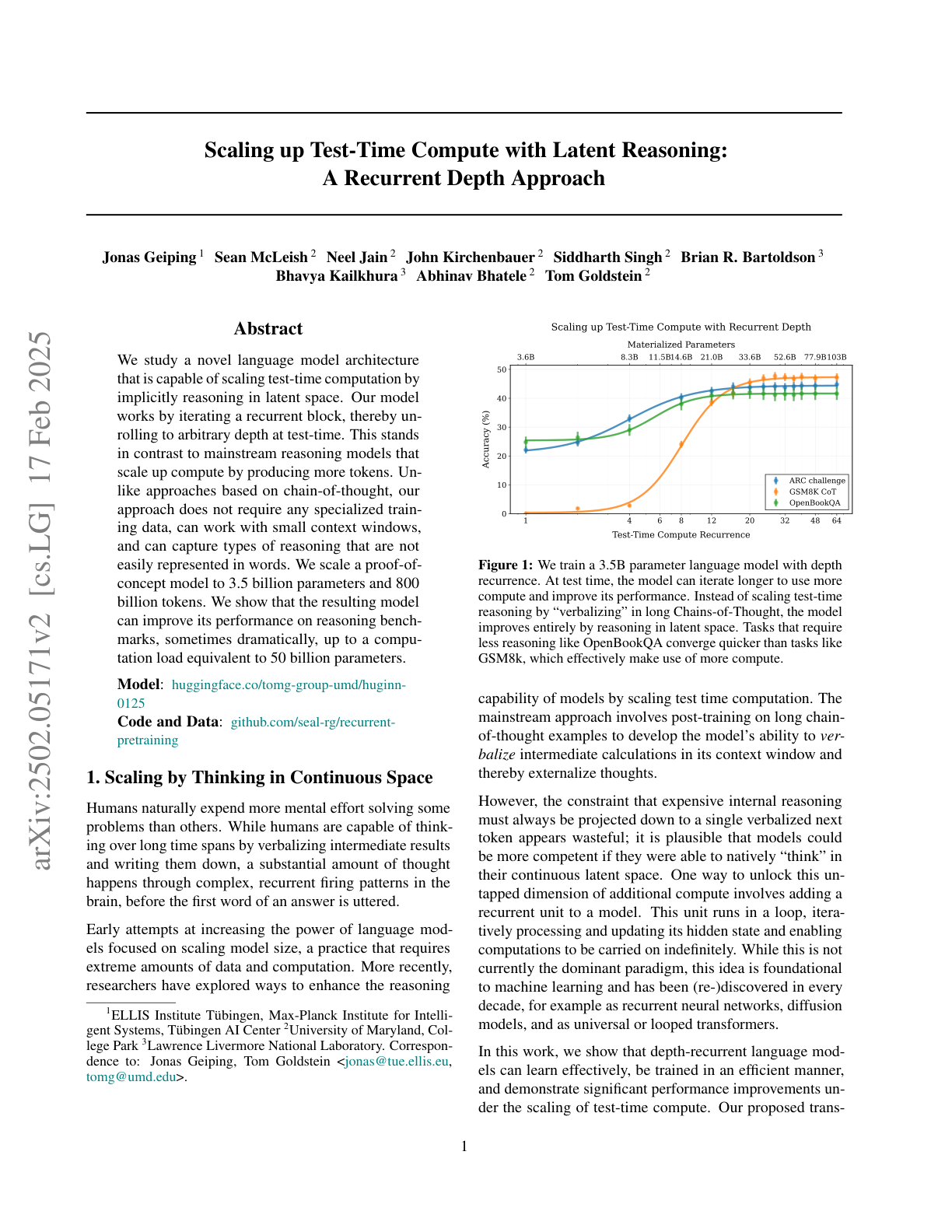
This work introduces a latent recurrent-depth transformer, a model that scales test-time reasoning without relying on additional token generation. Instead of increasing the context window or fine-tuning for Chain-of-Thought (CoT), this approach enables iterative latent space reasoning at inference, achieving improvements comparable to a 50B parameter model despite having only 3.5B parameters. Key insights include:
Ask this paper
Recurrent test-time computation – The model unrolls a recurrent block at inference, running for an arbitrary number of steps, allowing more computational depth without modifying the input sequence. Unlike standard CoT methods, which externalize reasoning via tokens, this technique keeps reasoning in latent space, making it more efficient.
No need for CoT-specific training – Unlike CoT prompting or fine-tuning, this method doesn’t require specialized datasets. It works with standard pretraining corpora and generalizes across reasoning tasks.
Improved memory & compute efficiency – Latent reasoning allows the model to scale without increasing parameter count, requiring less memory than long-context transformers. Additionally, this method improves per-token adaptive compute, speculative decoding, and KV-cache sharing, making it highly efficient.
Scales like a 50B parameter model – Benchmarks show that with sufficient test-time recurrence, the model matches or surpasses much larger LLMs on complex reasoning tasks (ARC, GSM8K, OpenBookQA).
Emergent behaviors in latent space – Analysis reveals self-organizing computation patterns, such as latent-space orbits for numerical tasks and context-dependent “deliberation” on difficult queries, suggesting the model learns non-verbal cognitive strategies. This approach adds a third axis to LLM scaling—beyond model size and context length—by focusing on test-time compute. It suggests that future models may reason in continuous latent space rather than rely solely on token-based reasoning, potentially unlocking new AI reasoning and efficiency frontiers.