SciMARS: Multi-Agent Recursive Self-Improvement for Closed-Loop Scientific Discovery
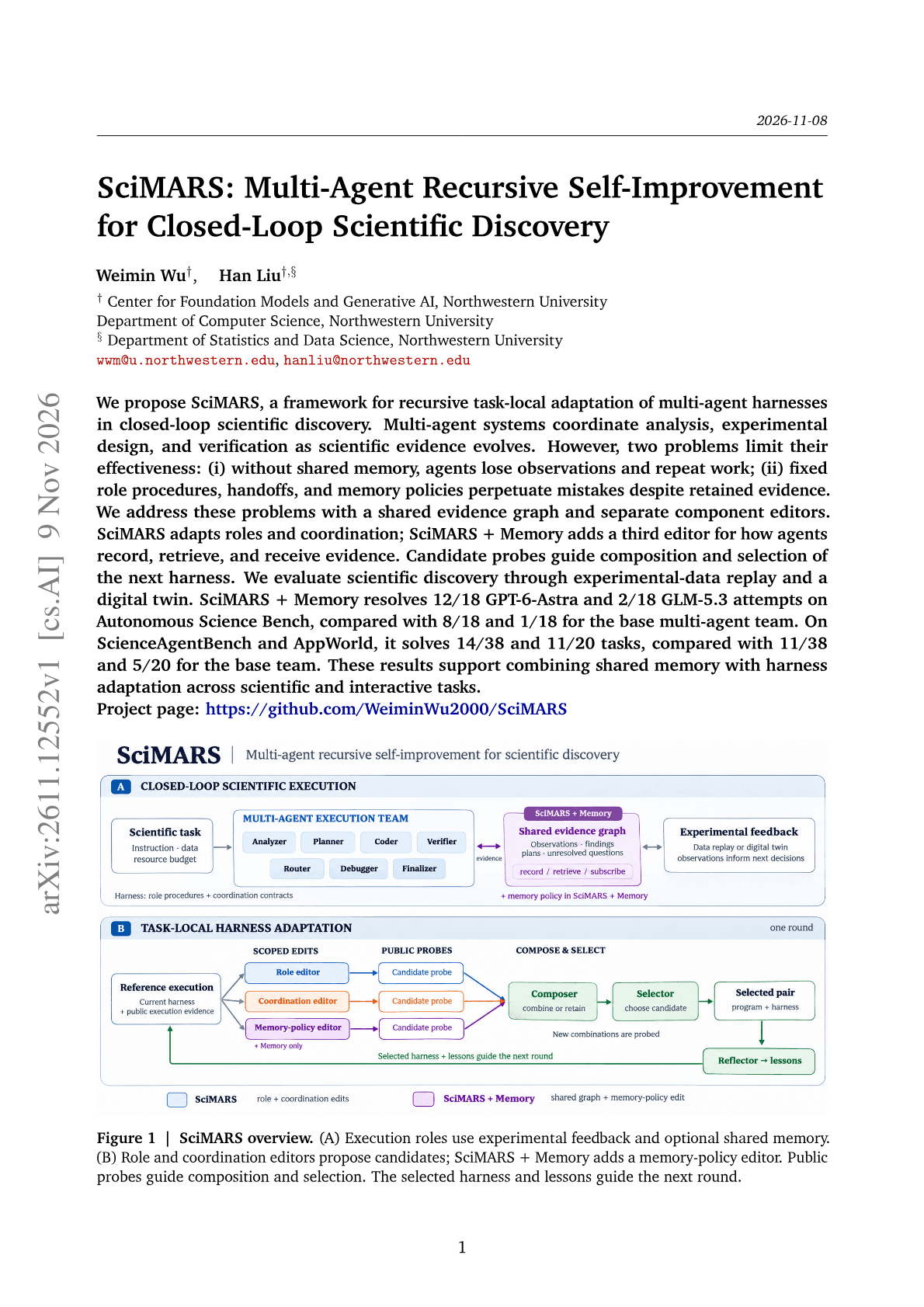
Weimin Wu, Han Liu and colleagues at Northwestern University introduce SciMARS, which lets a multi-agent science team adapt its own harness during a task using a shared evidence graph and separate editors for roles, coordination and memory policy.
Ask this paper
Two failures. Without shared memory, agents lose observations and repeat work. With fixed role procedures, handoffs and memory policies, they repeat mistakes even when the evidence is recorded.
Method. A shared evidence graph stores observations. Separate editors propose changes to roles, coordination and (in SciMARS + Memory) how agents record and retrieve evidence. Candidate probes test edits before the next harness is chosen.
Results. SciMARS + Memory resolves 12 of 18 GPT-6-Astra attempts on Autonomous Science Bench against 8 for the base team, and 2 of 18 against 1 with GLM-5.3.
Transfer. On ScienceAgentBench it solves 14 of 38 tasks against 11, and on AppWorld 11 of 20 against 5.
Abstract
We propose SciMARS, a framework for recursive task-local adaptation of multi-agent harnesses in closed-loop scientific discovery. Multi-agent systems coordinate analysis, experimental design, and verification as scientific evidence evolves. However, two problems limit their effectiveness: (i) without shared memory, agents lose observations and repeat work; (ii) fixed role procedures, handoffs, and memory policies perpetuate mistakes despite retained evidence. We address these problems with a shared evidence graph and separate component editors. SciMARS adapts roles and coordination; SciMARS + Memory adds a third editor for how agents record, retrieve, and receive evidence. Candidate probes guide composition and selection of the next harness. We evaluate scientific discovery through experimental-data replay and a digital twin. SciMARS + Memory resolves 12/18 GPT-6-Astra and 2/18 GLM-5.3 attempts on Autonomous Science Bench, compared with 8/18 and 1/18 for the base multi-agent team. On ScienceAgentBench and AppWorld, it solves 14/38 and 11/20 tasks, compared with 11/38 and 5/20 for the base team. These results support combining shared memory with harness adaptation across scientific and interactive tasks.