Self-Organizing Agent Teams Learn to Reason Together
Aneesh Pappu, Mirac Suzgun, James Zou and colleagues at Stanford University, Together AI and Emory's Goizueta Business School introduce Self-Organizing Agent Teams (SAT), fixed teams of models that learn from their own past collaborations how to divide roles, order conversational phases and combine partial reasoning.
Ask this paper
Learned teamwork strategies. One member reviews the team's earlier exchanges and outcomes and proposes a revised strategy covering roles, phases, participation, information flow and synthesis. Candidates are tested on training problems, and a complementary set is frozen into a strategy bank before evaluation.
Small training sets, unchanged transfer. The math-and-physics team (o3-mini, Claude Sonnet 4, DeepSeek-V3) learns from 15 AIME 2024 problems, and the knowledge-and-logic team (Gemini-2.5-Flash, Llama-4-Maverick, GPT-4.1) learns from 25 GPQA Diamond problems; both banks are applied without changes to unseen benchmarks.
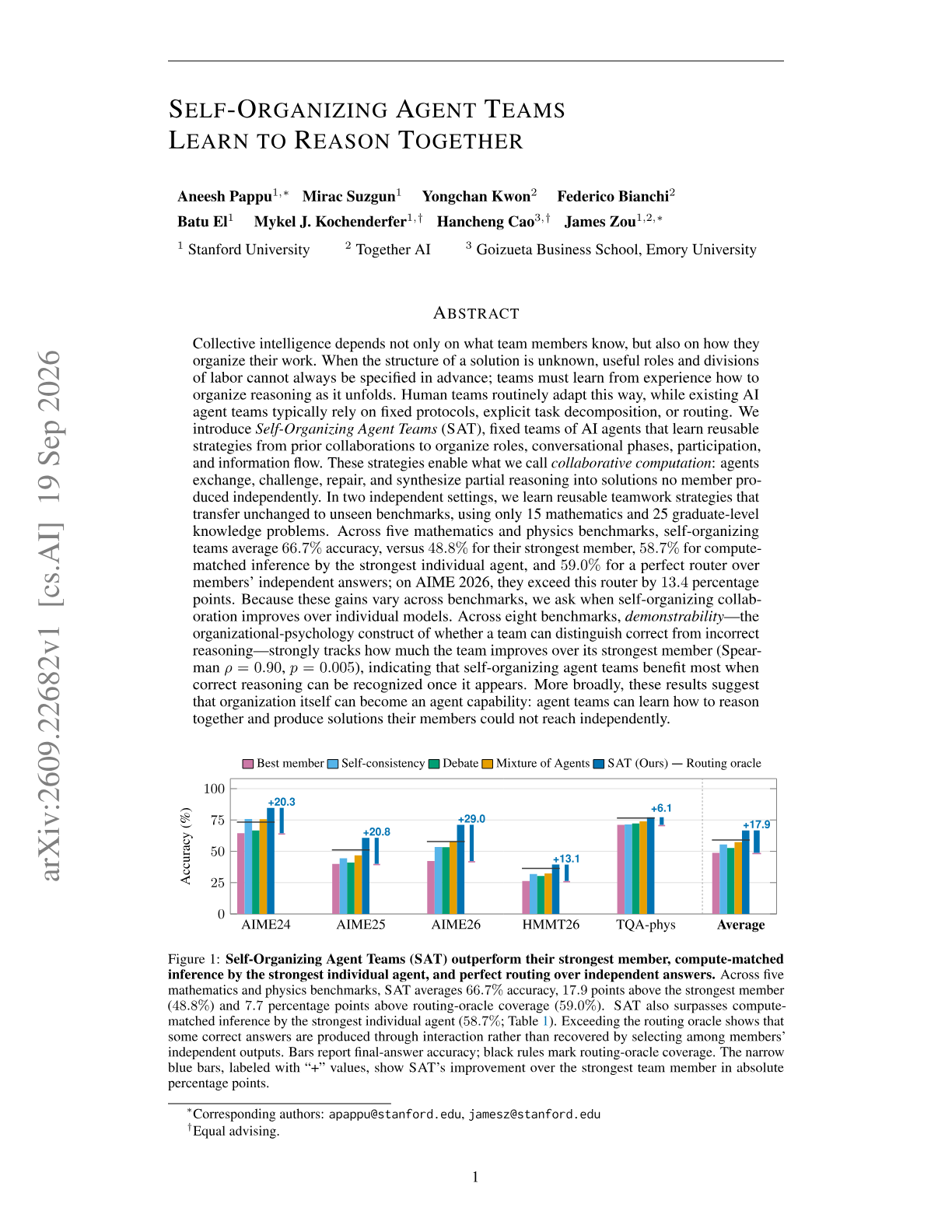
Beyond picking the best answer. Across five math and physics benchmarks the team averages 66.7%, against 48.8% for its strongest member, 58.7% for compute-matched inference by that member, and 59.0% for a perfect router over members' independent answers. On AIME 2026 it reaches 71.2%, 13.4 points above the router.
Certificates and a single judge. At test time every strategy in the bank produces a candidate with a short step-checkable reasoning certificate, and one judge audits the whole pool in a single prompt.
When teams help. Across eight benchmarks, demonstrability, whether a team can tell correct from incorrect reasoning once it appears, tracks the gain over the strongest member with Spearman rho 0.90 (p = 0.005); gains are largest on AIME 2026 (29.0 points) and smallest on MMLU-Pro (2.7).
Abstract
Collective intelligence depends not only on what team members know, but also on how they organize their work. When the structure of a solution is unknown, useful roles and divisions of labor cannot be specified in advance; teams must learn from experience how to organize reasoning as it unfolds. Human teams routinely adapt this way, while existing AI agent teams rely on fixed protocols, explicit task decomposition, or routing. We introduce Self-Organizing Agent Teams (SAT), fixed teams of AI agents that learn reusable strategies from prior collaborations to organize roles, conversational phases, participation, and information flow. These strategies enable what we call collaborative computation: agents exchange, challenge, repair, and synthesize partial reasoning into solutions no member produced independently. In two independent settings, we learn teamwork strategies that transfer unchanged to unseen benchmarks, using only 15 mathematics and 25 graduate-level knowledge problems. Across five mathematics and physics benchmarks, self-organizing teams average 66.7% accuracy, versus 48.8% for their strongest member, 58.7% for compute-matched inference by that agent, and 59.0% for a perfect router over members' independent answers; on AIME 2026, they exceed this router by 13.4 points. Because gains vary across benchmarks, we ask when self-organizing collaboration helps. Across eight benchmarks, demonstrability (the organizational-psychology construct of whether a team can distinguish correct from incorrect reasoning) strongly tracks improvement over the strongest member (Spearman $ρ=0.90$, $p=0.005$): teams benefit most when correct reasoning can be recognized once it appears. More broadly, these results suggest that organization itself can become an agent capability: agent teams can learn how to reason together and produce solutions their members could not reach independently.