Self-Tuning with LLMs
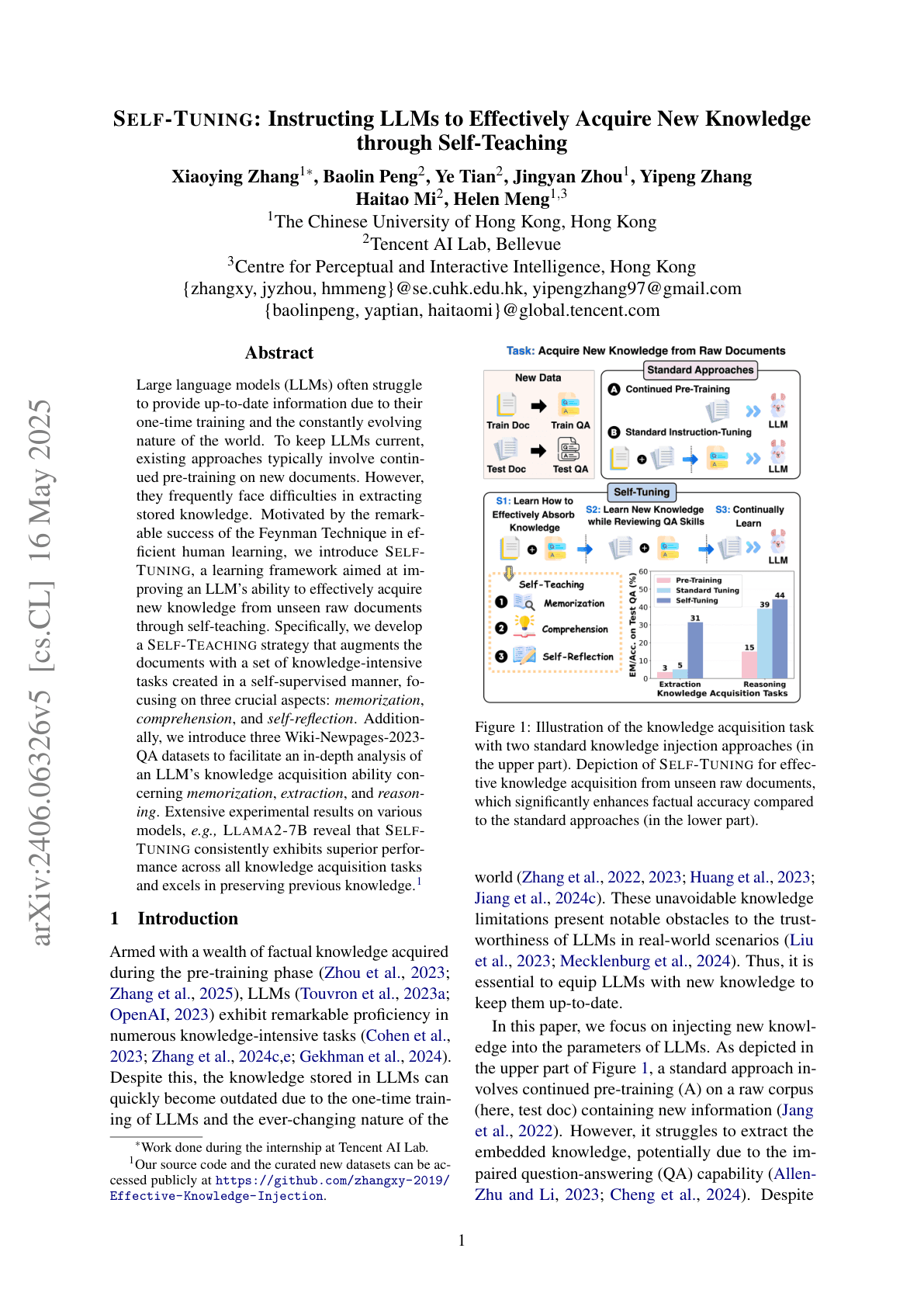
improves an LLM’s ability to effectively acquire new knowledge from raw documents through self-teaching; the three steps involved are 1) a self-teaching component that augments documents with a set of knowledge-intensive tasks focusing on memorization, comprehension, and self-reflection, 2) uses the deployed model to acquire knowledge from new documents while reviewing its QA skills, and 3) the model is configured to continually learn using only the new documents which helps with thorough acquisition of new knowledge.
Ask this paper
Abstract
Large language models (LLMs) often struggle to provide up-to-date information due to their one-time training and the constantly evolving nature of the world. To keep LLMs current, existing approaches typically involve continued pre-training on new documents. However, they frequently face difficulties in extracting stored knowledge. Motivated by the remarkable success of the Feynman Technique in efficient human learning, we introduce Self-Tuning, a learning framework aimed at improving an LLM's ability to effectively acquire new knowledge from unseen raw documents through self-teaching. Specifically, we develop a Self-Teaching strategy that augments the documents with a set of knowledge-intensive tasks created in a self-supervised manner, focusing on three crucial aspects: memorization, comprehension, and self-reflection. Additionally, we introduce three Wiki-Newpages-2023-QA datasets to facilitate an in-depth analysis of an LLM's knowledge acquisition ability concerning memorization, extraction, and reasoning. Extensive experimental results on various models, e.g., Llama2-7B reveal that Self-Tuning consistently exhibits superior performance across all knowledge acquisition tasks and excels in preserving previous knowledge.