Separation of Skilling Context for Standard Operating Procedure-based Agents
Mitsuhiro Nakayama, Toshiaki Sota, Takehiko Yamaguchi and Michiaki Tatsubori (IBM Japan) study agents that generate executable skills from standard operating procedures and propose keeping the SOP and its contextual knowledge separate.
Ask this paper
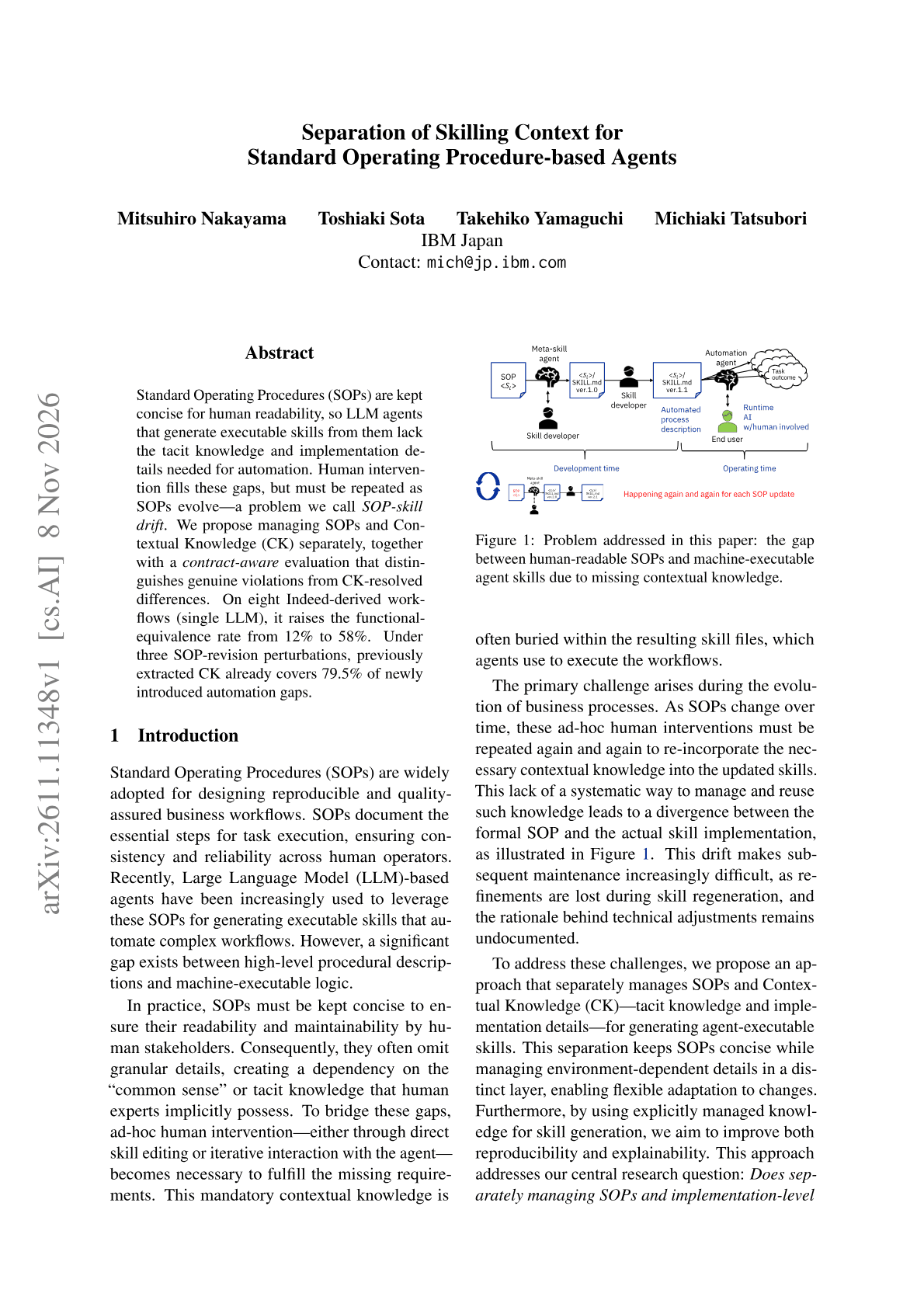
SOP-skill drift. SOPs are written short for humans, so skills generated from them miss tacit details. Humans fill the gaps, and must do it again every time the SOP changes.
Separation. Contextual knowledge (CK) is managed apart from the SOP, and a contract-aware evaluation distinguishes real violations from differences that CK explains.
Results. On eight Indeed-derived workflows with a single LLM, functional equivalence rises from 12% to 58%.
Under revisions. Across three kinds of SOP revision, previously extracted CK already covers 79.5% of newly introduced automation gaps.
Abstract
Standard Operating Procedures (SOPs) are kept concise for human readability, so LLM agents that generate executable skills from them lack the tacit knowledge and implementation details needed for automation. Human intervention fills these gaps, but must be repeated as SOPs evolve---a problem we call \textit{SOP-skill drift}. We propose managing SOPs and Contextual Knowledge (CK) separately, together with a \textit{contract-aware} evaluation that distinguishes genuine violations from CK-resolved differences. On eight Indeed-derived workflows (single LLM), it raises the functional-equivalence rate from 12\% to 58\%. Under three SOP-revision perturbations, previously extracted CK already covers 79.5\% of newly introduced automation gaps.