SiliconGym: A Versatile Reinforcement Learning Environment for Agentic EDA
Hejia Zhang, Jishen Zhao and colleagues at UC San Diego, with Georgia Tech and NVIDIA, release SiliconGym, a reinforcement learning environment for hardware-engineering agents that spans RTL, testbench, PPA, repository repair and full SoC flows.
Ask this paper
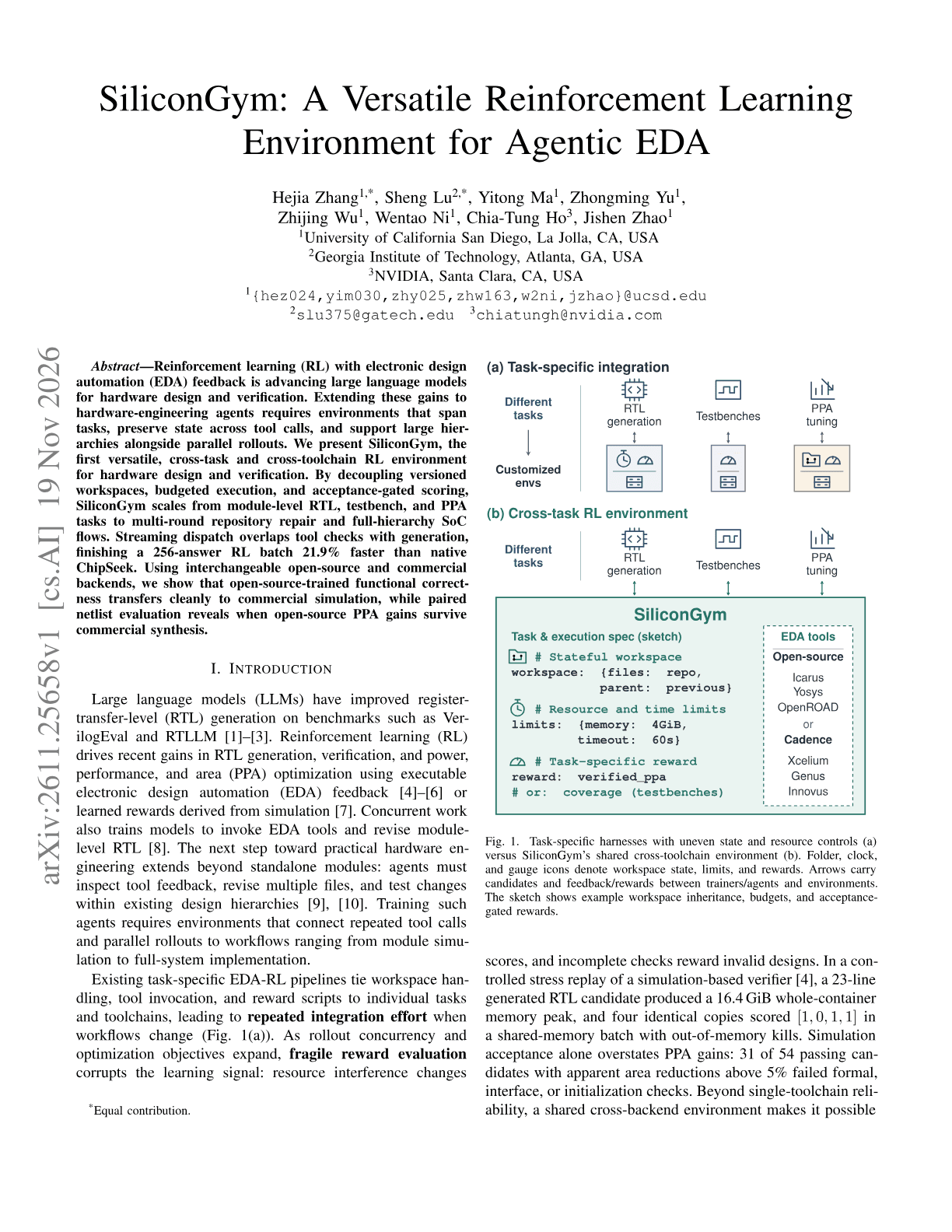
Design. Versioned workspaces, budgeted execution and acceptance-gated scoring are separated, so the same environment covers single modules and full-hierarchy SoC flows with state kept across tool calls.
Throughput. Streaming dispatch overlaps tool checks with generation and finishes a 256-answer RL batch 21.9% faster than native ChipSeek.
Toolchains. Open-source and commercial backends are interchangeable. Functional correctness learned with open-source tools transfers cleanly to commercial simulation.
PPA caveat. Paired netlist evaluation shows when PPA gains from open-source synthesis survive commercial synthesis and when they do not.
Abstract
Reinforcement learning (RL) with electronic design automation (EDA) feedback is advancing large language models for hardware design and verification. Extending these gains to hardware-engineering agents requires environments that span tasks, preserve state across tool calls, and support large hierarchies alongside parallel rollouts. We present SiliconGym, the first versatile, cross-task and cross-toolchain RL environment for hardware design and verification. By decoupling versioned workspaces, budgeted execution, and acceptance-gated scoring, SiliconGym scales from module-level RTL, testbench, and PPA tasks to multi-round repository repair and full-hierarchy SoC flows. Streaming dispatch overlaps tool checks with generation, finishing a 256-answer RL batch 21.9% faster than native ChipSeek. Using interchangeable open-source and commercial backends, we show that open-source-trained functional correctness transfers cleanly to commercial simulation, while paired netlist evaluation reveals when open-source PPA gains survive commercial synthesis.