SIRIS: Can LLMs Tell When Simulation Errors Matter in AI-Driven Systems Research
Jinwoo Hwang, Peng Cheng and colleagues at Microsoft Research Asia and KAIST introduce Siris, which tests whether LLMs can tell when a simulator limitation changes the correct design choice in systems research.
Ask this paper
Setup. Siris perturbs a simulator to build pairs of LLM-serving design problems with the same candidates, limitation and recommendation, where a reference simulator supports the recommendation in only one.
Finding. Across thirteen frontier LLMs, identifying the limitation does not ensure a correct choice, and the strongest models sometimes abandon valid recommendations.
Cost of errors. For eight models, 151 of 162 identified but incorrect choices had p95 latency at least 5% above the best design, with median losses of 14% to 47%.
Review turn. A review turn corrected 31 choices and introduced 10 new errors for GPT-5.6 Sol, and for GPT-5.6 Terra 17 corrections were offset by 15 new errors.
Abstract
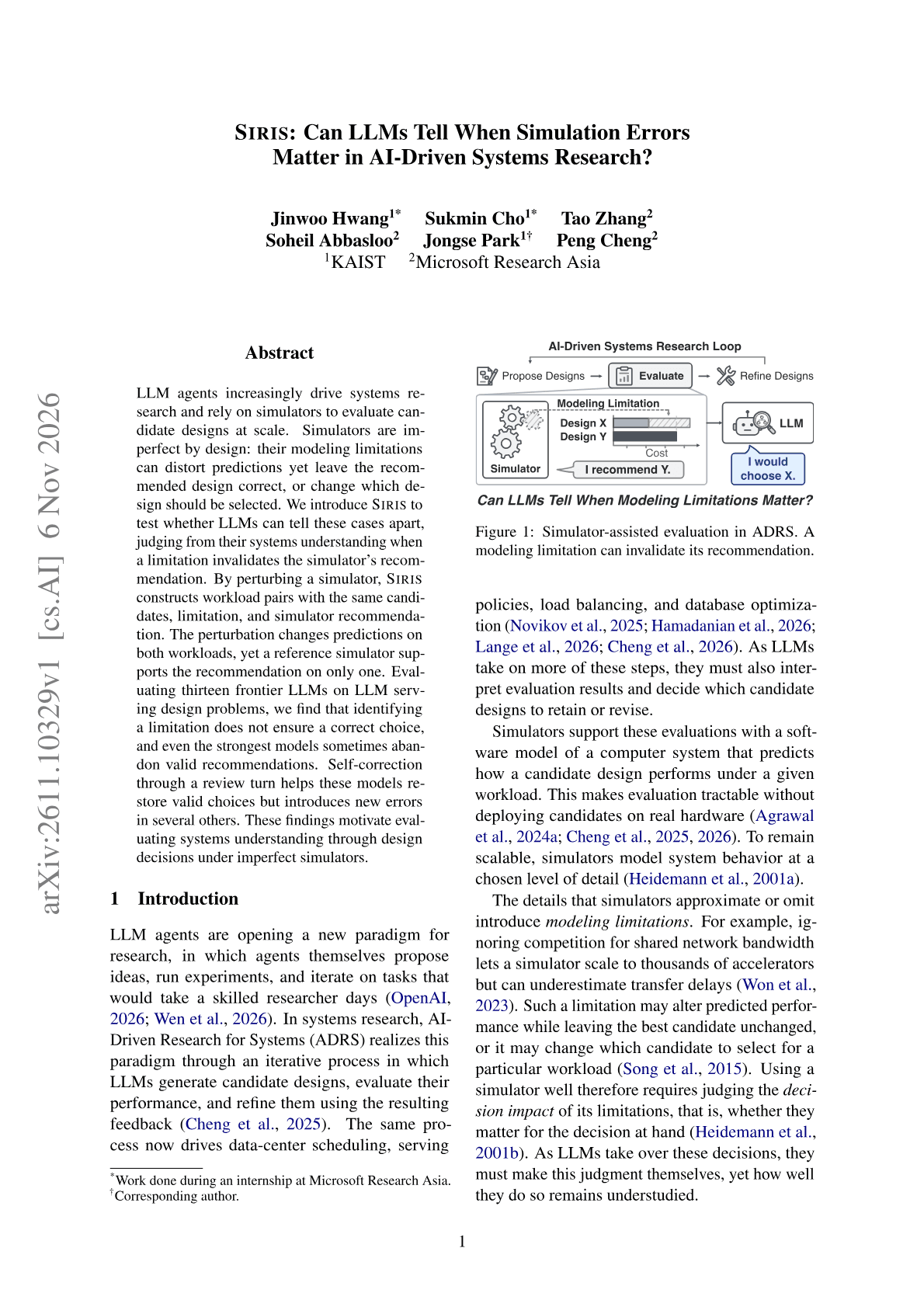
LLM agents increasingly drive systems research and rely on simulators to evaluate candidate designs at scale. Simulators are imperfect by design: their modeling limitations can distort predictions yet leave the recommended design correct, or change which design should be selected. We introduce Siris to test whether LLMs can tell these cases apart, judging from their systems understanding when a limitation invalidates the simulator's recommendation. By perturbing a simulator, Siris constructs workload pairs with the same candidates, limitation, and simulator recommendation. The perturbation changes predictions on both workloads, yet a reference simulator supports the recommendation on only one. Evaluating thirteen frontier LLMs on LLM serving design problems, we find that identifying a limitation does not ensure a correct choice, and even the strongest models sometimes abandon valid recommendations. Self-correction through a review turn helps these models restore valid choices but introduces new errors in several others. These findings motivate evaluating systems understanding through design decisions under imperfect simulators.