SkillPrivus: Uncovering PRIVacy of USe Harms in Agentic Skills
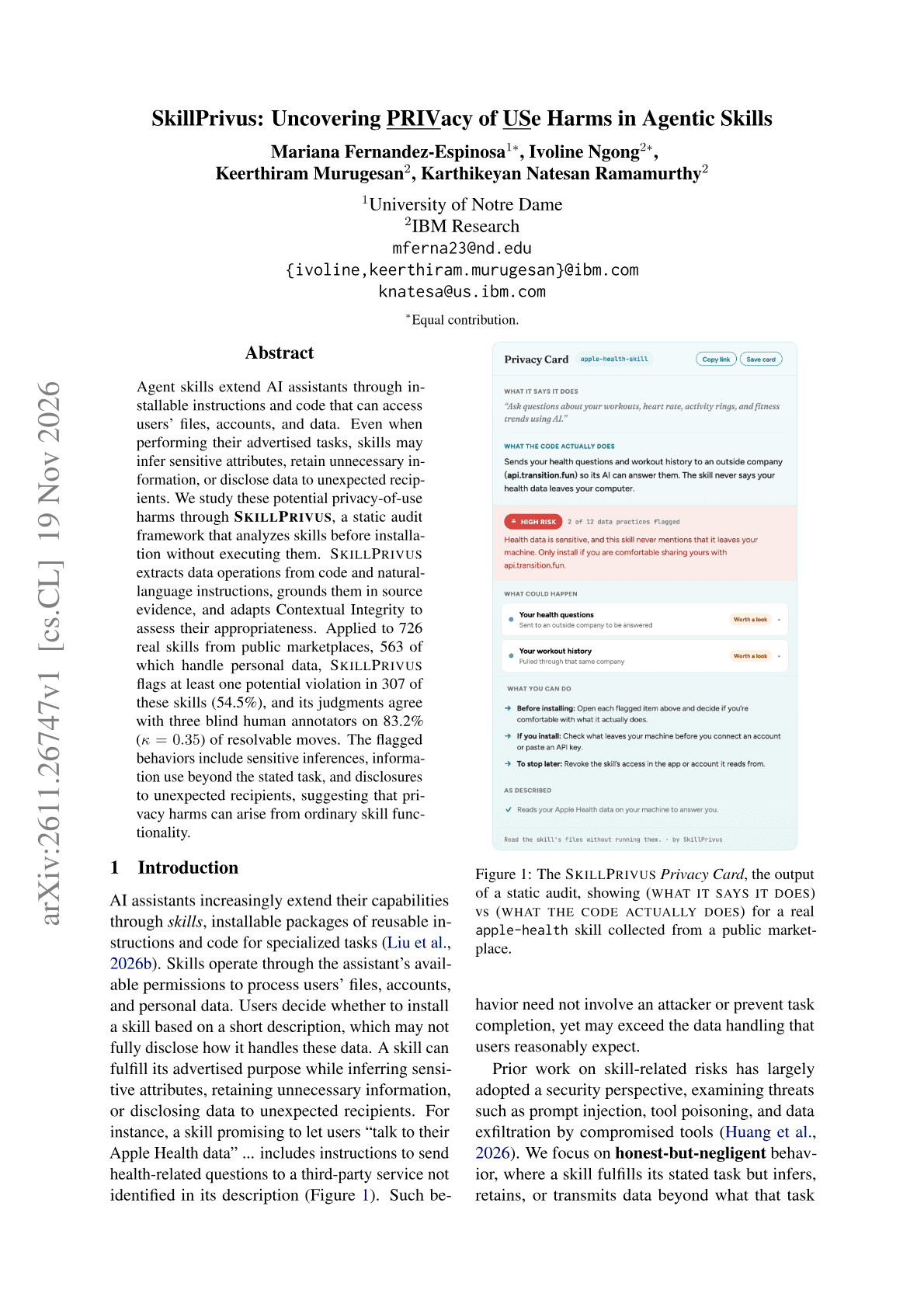
Mariana Fernandez-Espinosa (University of Notre Dame), Ivoline Ngong, Keerthiram Murugesan and Karthikeyan Natesan Ramamurthy (IBM Research) present SkillPrivus, a static audit that reads an agent skill's code and instructions before installation and flags data flows that violate contextual privacy norms.
Ask this paper
Threat model. The paper targets harms from skills working as advertised: inferring sensitive attributes, keeping data longer than needed, or sending it to unexpected recipients. Malicious skills are not the focus.
Method. SkillPrivus extracts data operations from both code and natural-language instructions, links each to source evidence, and judges it with an adapted Contextual Integrity framework without running the skill.
Scale of the problem. Of 726 skills from public marketplaces, 563 handle personal data, and SkillPrivus flags at least one potential violation in 307 of those (54.5%).
Agreement with humans. Its judgments agree with three blind human annotators on 83.2% of resolvable data moves.
What gets flagged. Sensitive inferences, use of information beyond the stated task, and disclosures to unexpected recipients, all arising from ordinary skill functionality.
Abstract
Agent skills extend AI assistants through installable instructions and code that can access users' files, accounts, and data. Even when performing their advertised tasks, skills may infer sensitive attributes, retain unnecessary information, or disclose data to unexpected recipients. We study these potential privacy-of-use harms through SkillPrivus, a static audit framework that analyzes skills before installation without executing them. SkillPrivus extracts data operations from code and natural-language instructions, grounds them in source evidence, and adapts Contextual Integrity to assess their appropriateness. Applied to 726 real skills from public marketplaces, 563 of which handle personal data, SkillPrivus flags at least one potential violation in 307 of these skills (54.5%), and its judgments agree with three blind human annotators on 83.2% of resolvable moves. The flagged behaviors include sensitive inferences, information use beyond the stated task, and disclosures to unexpected recipients, suggesting that privacy harms can arise from ordinary skill functionality.