SoL-Pi: Recursively Scaling Auto-Research Loops for Efficient Agent Harness
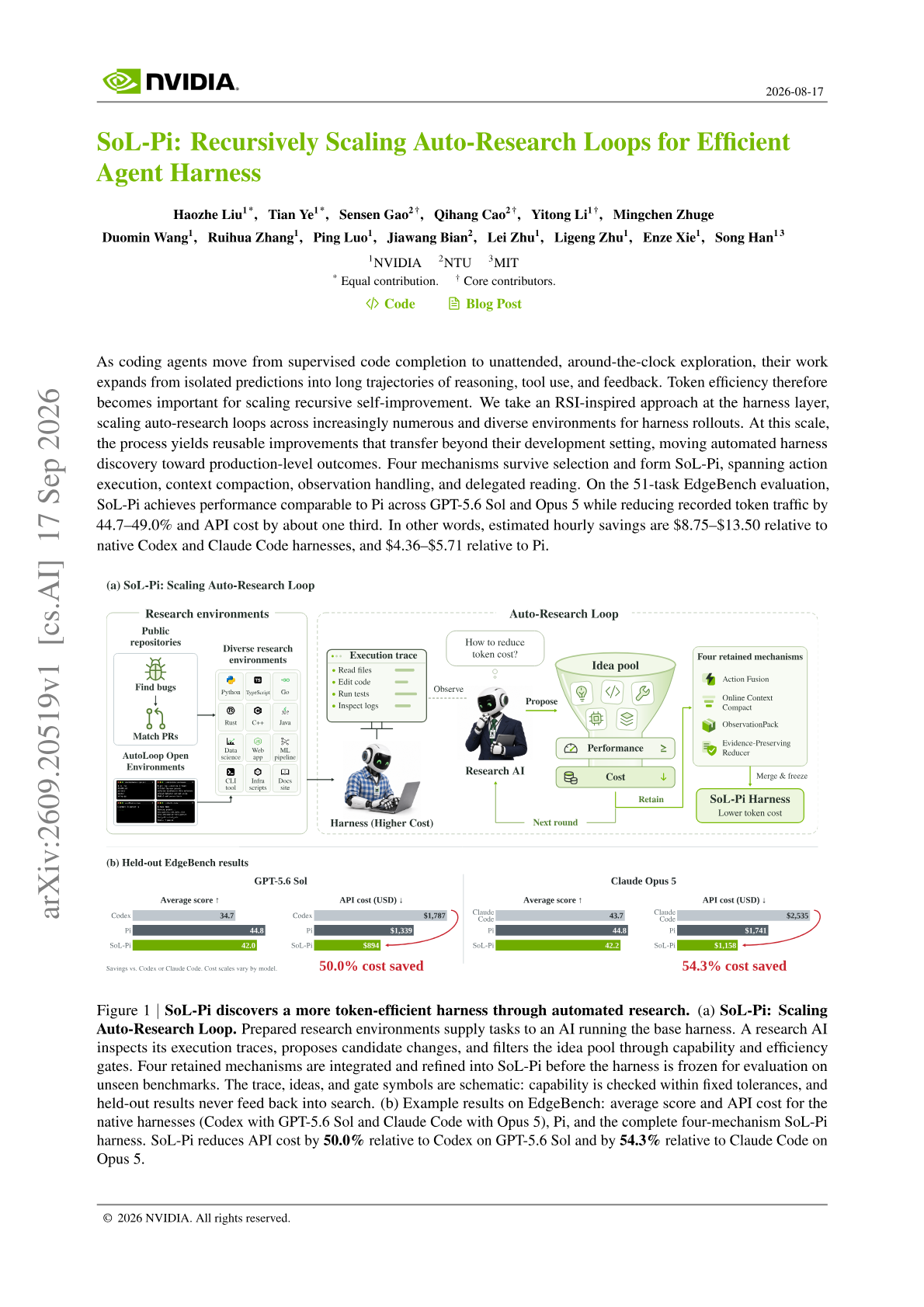
Haozhe Liu and colleagues at NVIDIA, NTU and MIT run auto-research loops at the harness layer across many environments and keep the four mechanisms that survive selection, producing SoL-Pi.
Ask this paper
Four mechanisms survive the search. Action Fusion, Online Context Compact, ObservationPack and an Evidence-Preserving Reducer, covering action execution, context compaction, observation handling and delegated reading.
Token traffic falls 44.7 to 49.0 percent. On the 51-task EdgeBench evaluation SoL-Pi matches Pi across GPT-5.6 Sol and Opus 5 while cutting recorded token traffic by that range and API cost by roughly one third.
Savings are reported in dollars per hour. Estimated hourly savings are $8.75 to $13.50 against native Codex and Claude Code harnesses, and $4.36 to $5.71 against Pi, which is the unit that matters for around-the-clock agents.
Discovered mechanisms transfer. Because the search runs across numerous and diverse repository-derived and verifier-driven environments, the retained improvements work outside the setting that produced them.
The search is broad-to-deep. Wide exploration first, then deeper refinement on surviving candidates, which is what makes the loop affordable enough to run recursively.
Abstract
As coding agents move from supervised code completion to unattended, around-the-clock exploration, their work expands from isolated predictions into long trajectories of reasoning, tool use, and feedback. Token efficiency therefore becomes important for scaling recursive self-improvement. We take an RSI-inspired approach at the harness layer, scaling auto-research loops across increasingly numerous and diverse environments for harness rollouts. At this scale, the process yields reusable improvements that transfer beyond their development setting, moving automated harness discovery toward production-level outcomes. Four mechanisms survive selection and form SoL-Pi, spanning action execution, context compaction, observation handling, and delegated reading. On the 51-task EdgeBench evaluation, SoL-Pi achieves performance comparable to Pi across GPT-5.6 Sol and Opus 5 while reducing recorded token traffic by 44.7-49.0% and API cost by about one third. In other words, estimated hourly savings are \$8.75-\$13.50 relative to native Codex and Claude Code harnesses, and \$4.36-\$5.71 relative to Pi.