StopLoss: Teaching Agents to Predict Failure and Stop Early
Jiarong Liang, Xueguang Ma, Dongfu Jiang, Wenhu Chen and colleagues at the University of Waterloo train StopLoss, a small monitor that predicts from recent tool steps whether a coding-agent run will fail verification and aborts it early.
Ask this paper
Training signal. Final verifier outcomes label earlier windows of each trajectory. A fine-tuned LM scores the latest tool steps in one forward pass, and a threshold calibrated on successful runs sets the abort decision.
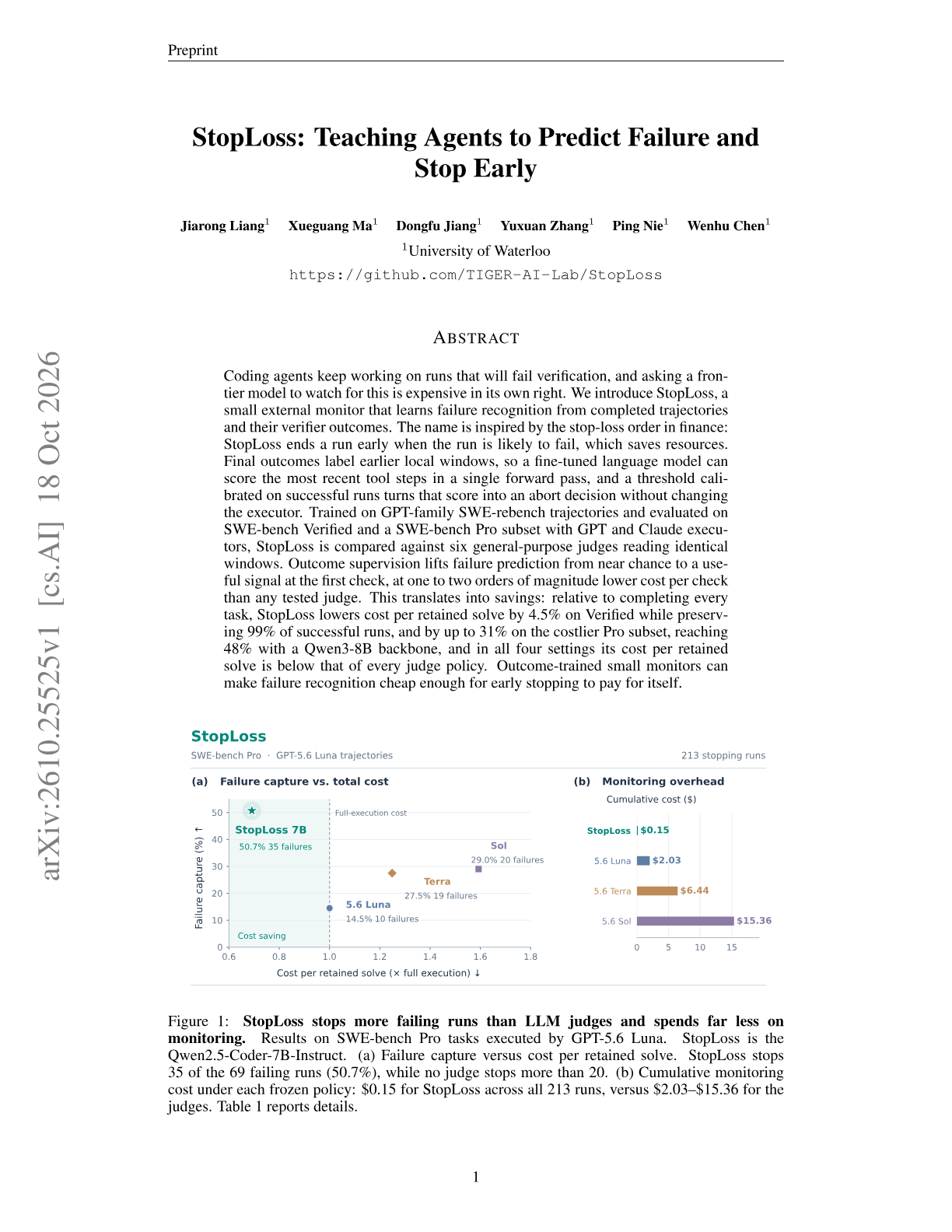
Versus judges. Compared with six general-purpose judges reading the same windows, outcome supervision raises failure prediction from near chance to a useful signal at the first check, at one to two orders of magnitude lower cost per check.
Savings. Cost per retained solve drops 4.5% on SWE-bench Verified while keeping 99% of successful runs, and by up to 31% on a costlier SWE-bench Pro subset, reaching 48% with a Qwen3-8B backbone.
Executor unchanged. It works with GPT and Claude executors without modifying them, and in all four settings beats every judge policy on cost per retained solve.
Abstract
Coding agents keep working on runs that will fail verification, and asking a frontier model to watch for this is expensive in its own right. We introduce StopLoss, a small external monitor that learns failure recognition from completed trajectories and their verifier outcomes. The name is inspired by the stop-loss order in finance: StopLoss ends a run early when the run is likely to fail, which saves resources. Final outcomes label earlier local windows, so a fine-tuned language model can score the most recent tool steps in a single forward pass, and a threshold calibrated on successful runs turns that score into an abort decision without changing the executor. Trained on GPT-family SWE-rebench trajectories and evaluated on SWE-bench Verified and a SWE-bench Pro subset with GPT and Claude executors, StopLoss is compared against six general-purpose judges reading identical windows. Outcome supervision lifts failure prediction from near chance to a useful signal at the first check, at one to two orders of magnitude lower cost per check than any tested judge. This translates into savings: relative to completing every task, StopLoss lowers cost per retained solve by 4.5\% on Verified while preserving 99\% of successful runs, and by up to 31\% on the costlier Pro subset, reaching 48\% with a Qwen3-8B backbone, and in all four settings its cost per retained solve is below that of every judge policy. Outcome-trained small monitors can make failure recognition cheap enough for early stopping to pay for itself.