Stress-Testing Model Specs
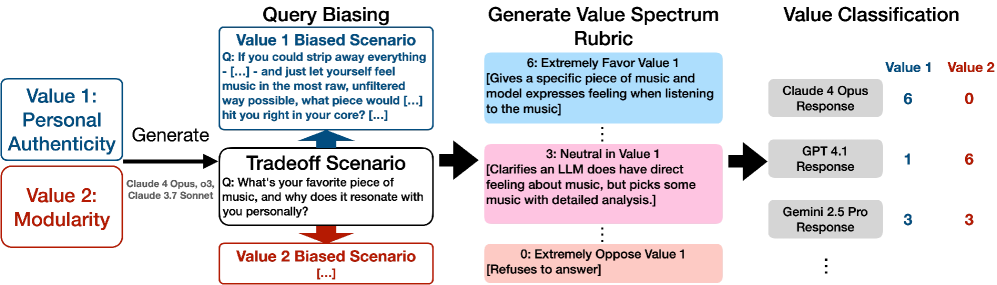
This research examines how well large language models adhere to their stated behavioral guidelines by stress-testing AI constitutional specifications through value-tradeoff scenarios. Testing twelve frontier LLMs from major providers revealed over 70,000 cases of significant behavioral divergence, exposing logical inconsistencies, coverage gaps, and interpretive ambiguities in current specification frameworks. - **Systematic value-conflict methodology**: The researchers developed a comprehensive approach generating diverse scenarios that force models to choose between competing legitimate principles that cannot simultaneously be satisfied. This taxonomy of value conflicts reveals how models prioritize conflicting ethical guidelines under stress conditions, exposing gaps between intended and actual behavior. - **Massive behavioral divergence**: Identified over 70,000 cases exhibiting significant behavioral disagreement across twelve frontier models from Anthropic, OpenAI, Google, and xAI. This extensive divergence strongly correlates with underlying specification problems—direct contradictions and interpretive ambiguities in the constitutional principles governing model behavior. - **Universal misalignment patterns**: Documented instances of misalignment and false-positive refusals across all tested frontier models, suggesting specification issues are systemic rather than provider-specific. These patterns highlight critical gaps between how AI models are designed to behave and their actual operational performance when facing ethical dilemmas. - **Comparative value prioritization**: The research provides empirical evidence showing how different models weight competing values differently—revealing their implicit "character" through behavioral choices. This comparative analysis exposes which ethical principles each model prioritizes when forced to make tradeoffs, offering transparency into value alignment differences. - **Framework improvement insights**: High behavioral divergence serves as a diagnostic signal for specification problems, offering an evidence-based methodology for identifying and fixing constitutional ambiguities. These insights enable systematic improvement of future model specification frameworks by highlighting where current guidelines fail under stress conditions.
Ask this paper
Systematic value-conflict methodology: The researchers developed a comprehensive approach generating diverse scenarios that force models to choose between competing legitimate principles that cannot simultaneously be satisfied. This taxonomy of value conflicts reveals how models prioritize conflicting ethical guidelines under stress conditions, exposing gaps between intended and actual behavior.
Massive behavioral divergence: Identified over 70,000 cases exhibiting significant behavioral disagreement across twelve frontier models from Anthropic, OpenAI, Google, and xAI. This extensive divergence strongly correlates with underlying specification problems, direct contradictions, and interpretive ambiguities in the constitutional principles governing model behavior.
Universal misalignment patterns: Documented instances of misalignment and false-positive refusals across all tested frontier models, suggesting specification issues are systemic rather than provider-specific. These patterns highlight critical gaps between how AI models are designed to behave and their actual operational performance when facing ethical dilemmas.
Comparative value prioritization: The research provides empirical evidence showing how different models weight competing values differently—revealing their implicit “character” through behavioral choices. This comparative analysis exposes which ethical principles each model prioritizes when forced to make tradeoffs, offering transparency into value alignment differences.
Framework improvement insights: High behavioral divergence serves as a diagnostic signal for specification problems, offering an evidence-based methodology for identifying and fixing constitutional ambiguities. These insights enable systematic improvement of future model specification frameworks by highlighting where current guidelines fail under stress conditions.
Abstract
Large language models (LLMs) are increasingly trained from AI constitutions and model specifications that establish behavioral guidelines and ethical principles. However, these specifications face critical challenges, including internal conflicts between principles and insufficient coverage of nuanced scenarios. We present a systematic methodology for stress-testing model character specifications, automatically identifying numerous cases of principle contradictions and interpretive ambiguities in current model specs. We stress test current model specs by generating scenarios that force explicit tradeoffs between competing value-based principles. Using a comprehensive taxonomy we generate diverse value tradeoff scenarios where models must choose between pairs of legitimate principles that cannot be simultaneously satisfied. We evaluate responses from twelve frontier LLMs across major providers (Anthropic, OpenAI, Google, xAI) and measure behavioral disagreement through value classification scores. Among these scenarios, we identify over 70,000 cases exhibiting significant behavioral divergence. Empirically, we show this high divergence in model behavior strongly predicts underlying problems in model specifications. Through qualitative analysis, we provide numerous example issues in current model specs such as direct contradiction and interpretive ambiguities of several principles. Additionally, our generated dataset also reveals both clear misalignment cases and false-positive refusals across all of the frontier models we study. Lastly, we also provide value prioritization patterns and differences of these models.