TeamGym: A Gym for Team Decision-Making by AI Agents with Distributed Information
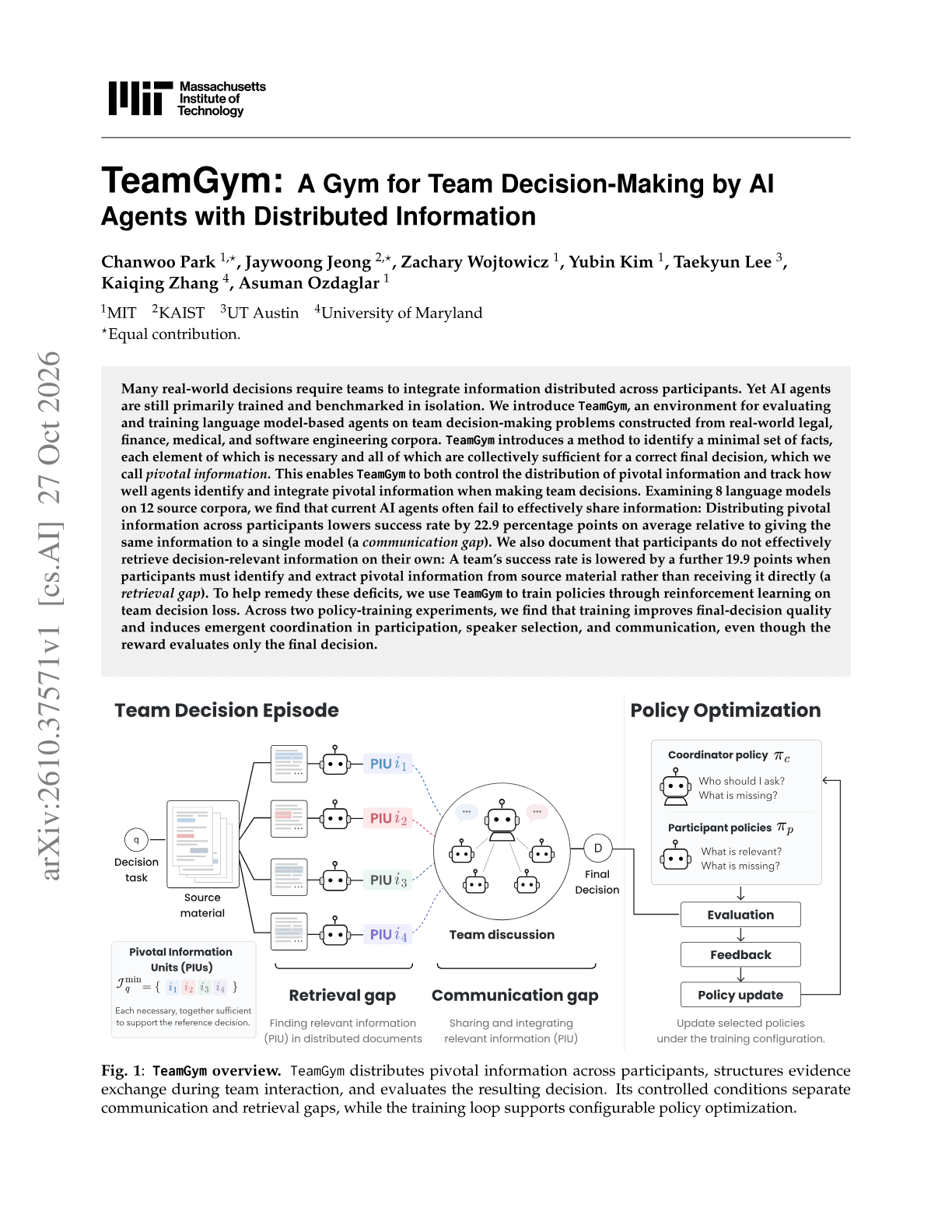
Chanwoo Park, Kaiqing Zhang, Asuman Ozdaglar and colleagues (MIT, KAIST, UT Austin, University of Maryland) introduce TeamGym, an environment for evaluating and training LLM agent teams on decisions whose required facts are split across members, built from legal, finance, medical and software corpora.
Ask this paper
Pivotal information. TeamGym identifies a minimal set of facts that are each necessary and together sufficient for the correct decision. This lets it control how those facts are distributed and track whether agents find and combine them.
Communication gap. Across 8 models and 12 source corpora, splitting pivotal information across team members lowers success by 22.9 points on average compared with giving the same facts to one model.
Retrieval gap. Success drops by another 19.9 points when members must find and extract the pivotal facts from source material instead of receiving them directly.
Training. RL on the team's final-decision loss improves decision quality in two experiments and produces coordinated behavior in participation, speaker selection and communication, although the reward scores only the final decision.
Abstract
Many real-world decisions require teams to integrate information distributed across participants. Yet AI agents are still primarily trained and benchmarked in isolation. We introduce TeamGym, an environment for evaluating and training language model-based agents on team decision-making problems constructed from real-world legal, finance, medical, and software engineering corpora. TeamGym introduces a method to identify a minimal set of facts, each element of which is necessary and all of which are collectively sufficient for a correct final decision, which we call pivotal information. This enables TeamGym to both control the distribution of pivotal information and track how well agents identify and integrate pivotal information when making team decisions. Examining 8 language models on 12 source corpora, we find that current AI agents often fail to effectively share information: Distributing pivotal information across participants lowers success rate by 22.9 percentage points on average relative to giving the same information to a single model (a communication gap). We also document that participants do not effectively retrieve decision-relevant information on their own: A team's success rate is lowered by a further 19.9 points when participants must identify and extract pivotal information from source material rather than receiving it directly (a retrieval gap). To help remedy these deficits, we use TeamGym to train policies through reinforcement learning on team decision loss. Across two policy-training experiments, we find that training improves final-decision quality and induces emergent coordination in participation, speaker selection, and communication, even though the reward evaluates only the final decision.