Test-Time Communication in Trading Agent Swarms
Avid Fayaz, Harry Zhang and colleagues (Infinite Ascent, Stockholm) ran 200 LLM trading agents in live markets over seven US trading days to measure how communication changes the behavior of independent agents that each manage their own account.
Ask this paper
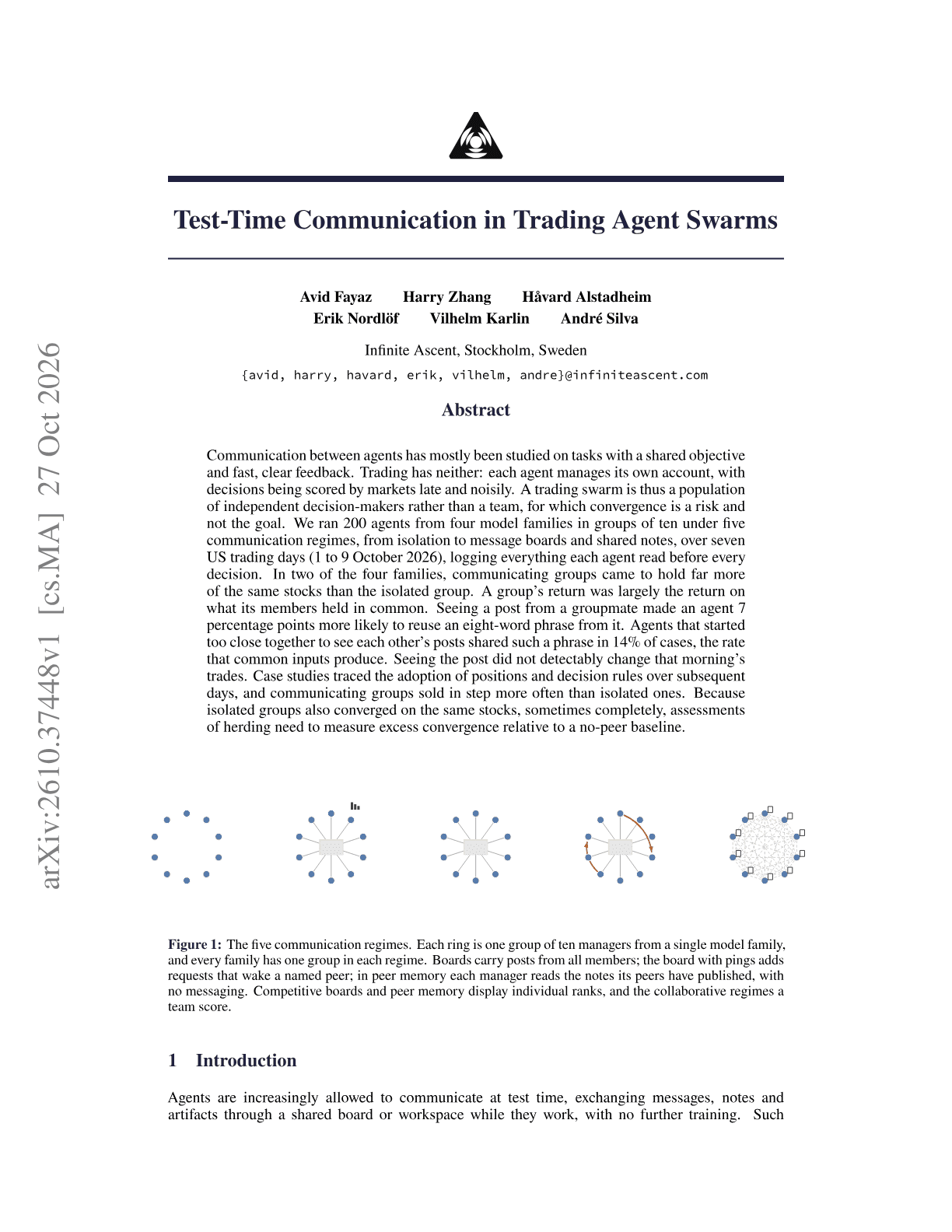
Design. Agents from four model families traded in groups of ten under five regimes, from isolation to message boards and shared notes, between 1 and 9 October 2026. Everything each agent read before each decision was logged.
Convergence. In two of the four families, communicating groups ended up holding far more of the same stocks than isolated groups. A group's return was largely the return on the stocks its members held in common.
Influence on text, not trades. Seeing a groupmate's post made an agent 7 points more likely to reuse an eight-word phrase from it, against a 14% baseline from common inputs. Seeing the post did not detectably change that morning's trades.
Measurement lesson. Communicating groups sold in step more often, but isolated groups also converged on the same stocks, sometimes completely. Herding should be measured as excess convergence over a no-peer baseline.
Abstract
Communication between agents has mostly been studied on tasks with a shared objective and fast, clear feedback. Trading has neither: each agent manages its own account, with decisions being scored by markets late and noisily. A trading swarm is thus a population of independent decision-makers rather than a team, for which convergence is a risk and not the goal. We ran 200 agents from four model families in groups of ten under five communication regimes, from isolation to message boards and shared notes, over seven US trading days (1 to 9 October 2026), logging everything each agent read before every decision. In two of the four families, communicating groups came to hold far more of the same stocks than the isolated group. A group's return was largely the return on what its members held in common. Seeing a post from a groupmate made an agent 7 percentage points more likely to reuse an eight-word phrase from it. Agents that started too close together to see each other's posts shared such a phrase in 14% of cases, the rate that common inputs produce. Seeing the post did not detectably change that morning's trades. Case studies traced the adoption of positions and decision rules over subsequent days, and communicating groups sold in step more often than isolated ones. Because isolated groups also converged on the same stocks, sometimes completely, assessments of herding need to measure excess convergence relative to a no-peer baseline.