Test-Time Self-Play: Scaling without a Verifier
Akira Yoshiyama, Akmal Ashirmatov, Jonas Hübotter, Ido Hakimi and Andreas Krause (ETH Zurich, Tufa Labs) propose Test-Time Self-Play (TTSP), which improves a model on one hard target problem without a verifier by training it on synthetic problems it generates around that target.
Ask this paper
Method. A proposer policy writes target-conditioned problems with tests and reference solutions. A solver policy is rewarded for solving them, and the proposer is rewarded for problems near the solver's current ability. Both train with GRPO, and the adapted solver then attempts the target.
Requirements. The only external dependency is an interactive environment such as a Python interpreter. No auxiliary training data is needed.
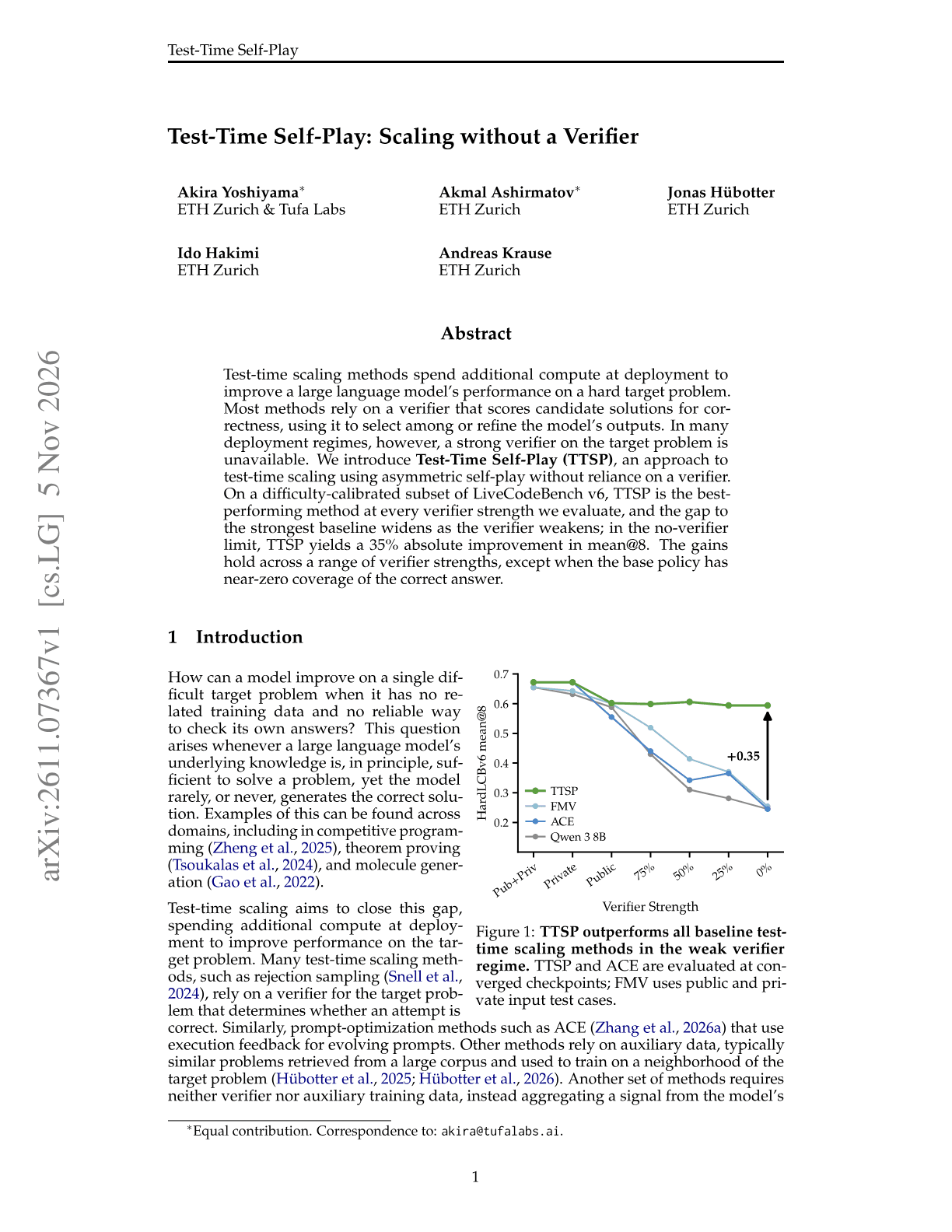
Results. On a difficulty-calibrated subset of LiveCodeBench v6, TTSP is the best method at every verifier strength tested, and its lead over the strongest baseline grows as the verifier weakens.
No verifier. With no verifier at all, TTSP improves mean@8 by 35 points absolute.
Limit. The gains disappear when the base policy almost never produces the correct answer.
Abstract
Test-time scaling methods spend additional compute at deployment to improve a large language model's performance on a hard target problem. Most methods rely on a verifier that scores candidate solutions for correctness, using it to select among or refine the model's outputs. In many deployment regimes, however, a strong verifier on the target problem is unavailable. We introduce Test-Time Self-Play (TTSP), an approach to test-time scaling using asymmetric self-play without reliance on a verifier. On a difficulty-calibrated subset of LiveCodeBench v6, TTSP is the best-performing method at every verifier strength we evaluate, and the gap to the strongest baseline widens as the verifier weakens; in the no-verifier limit, TTSP yields a 35\% absolute improvement in mean@8. The gains hold across a range of verifier strengths, except when the base policy has near-zero coverage of the correct answer.