The Last AI Built by Humans: Toward Genuine Recursive Self-Improvement
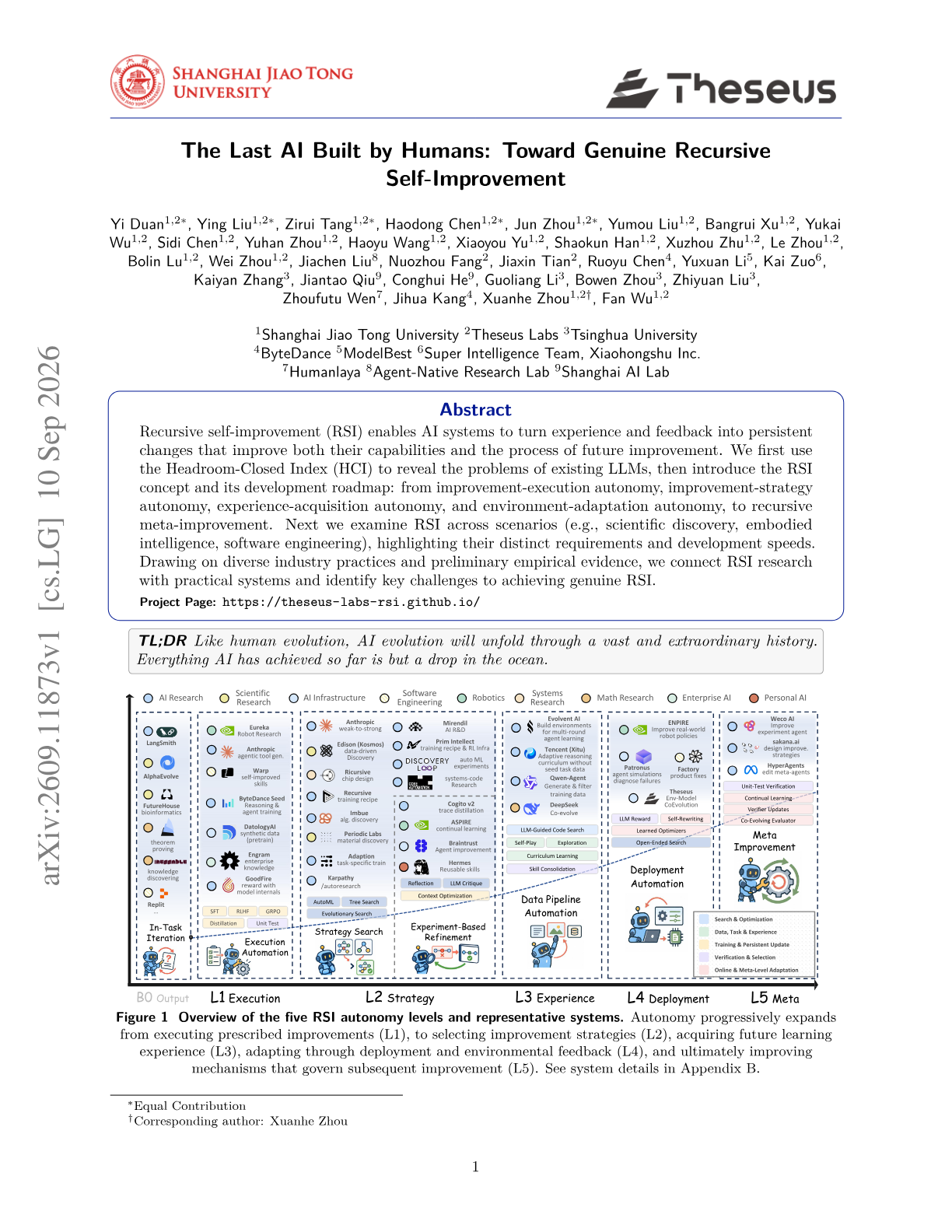
Yi Duan and a large team led from Shanghai Jiao Tong University survey recursive self-improvement, propose a staged roadmap for it, and use a Headroom-Closed Index to describe where current LLMs fall short.
Ask this paper
Diagnostic: The Headroom-Closed Index is used to show limitations of existing LLMs as self-improving systems.
Roadmap: Autonomy stages progress from improvement execution to improvement strategy, experience acquisition, environment adaptation and finally recursive meta-improvement.
Scenarios: Scientific discovery, embodied intelligence and software engineering are compared by their requirements and rate of progress.
Practice: Industry systems and preliminary evidence are connected to the research agenda, and the main open challenges are listed.
Abstract
Recursive self-improvement (RSI) enables AI systems to turn experience and feedback into persistent changes that improve both their capabilities and the process of future improvement. We first use the Headroom-Closed Index (HCI) to reveal the problems of existing LLMs, then introduce the RSI concept and its development roadmap: from improvement-execution autonomy, improvement-strategy autonomy, experience-acquisition autonomy, and environment-adaptation autonomy, to recursive meta-improvement. Next we examine RSI across scenarios (e.g., scientific discovery, embodied intelligence, software engineering), highlighting their distinct requirements and development speeds. Drawing on diverse industry practices and preliminary empirical evidence, we connect RSI research with practical systems and identify key challenges to achieving genuine RSI.