The Wealth of Agents: Scaling Agentic AI Across Developers
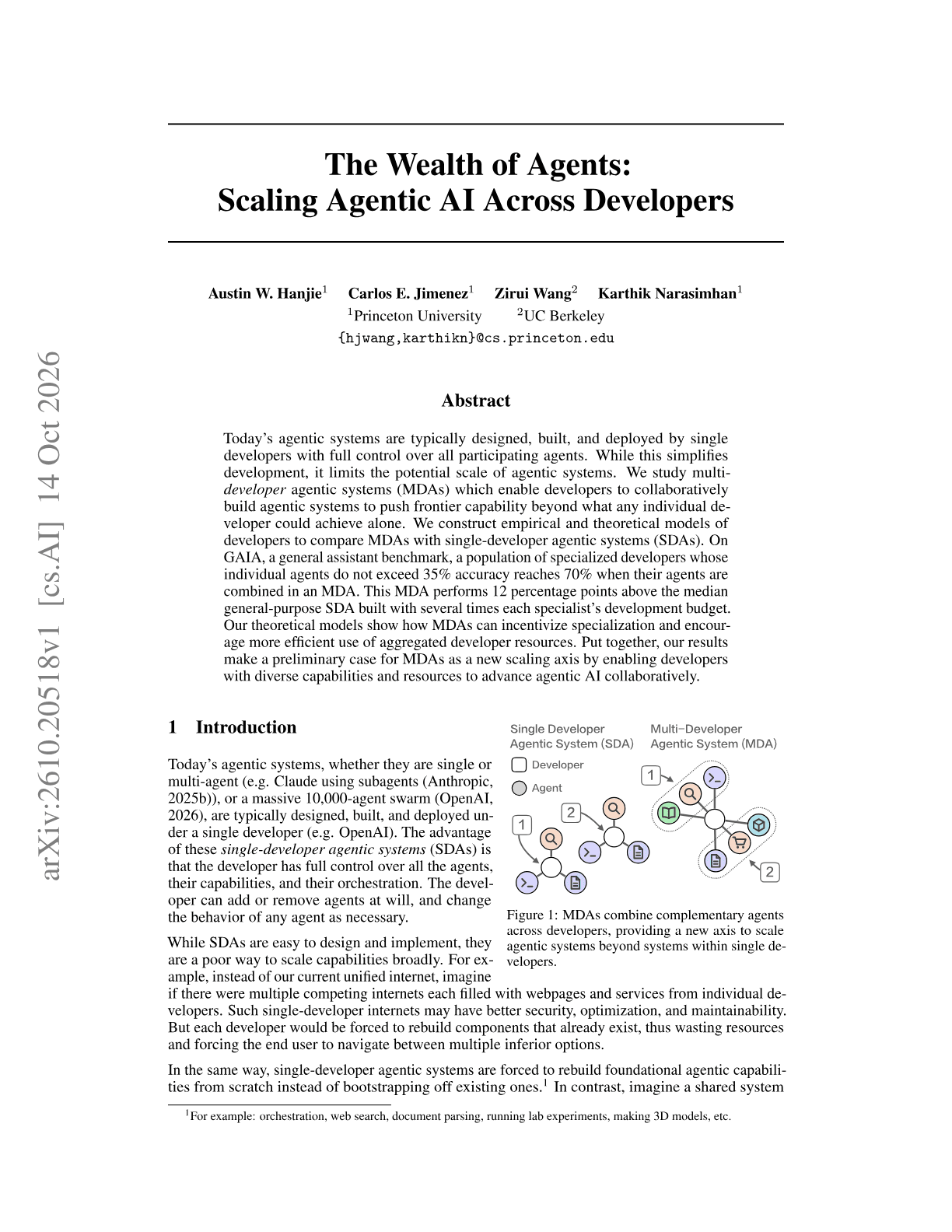
Austin W. Hanjie, Carlos E. Jimenez, Zirui Wang and Karthik Narasimhan (Princeton, UC Berkeley) study multi-developer agentic systems, where agents built by different developers are combined, and compare them empirically and theoretically with systems built by a single developer.
Ask this paper
Question. Can a population of developers, each with limited resources, build a more capable system together than any single developer can?
GAIA result. Specialized developers whose individual agents score at most 35% reach 70% when their agents are combined.
Against single developers. The combined system scores 12 points above the median general-purpose single-developer system built with several times each specialist's budget.
Theory. Models of developer behavior show that multi-developer systems can reward specialization and use pooled developer resources more efficiently.
Implication. Contribution should be measured by how a developer complements existing systems, not by standalone performance.
Abstract
Today's agentic systems are typically designed, built, and deployed by single developers with full control over all participating agents. While this simplifies development, it limits the potential scale of agentic systems. We study multi-developer agentic systems (MDAs) which enable developers to collaboratively build agentic systems to push frontier capability beyond what any individual developer could achieve alone. We construct empirical and theoretical models of developers to compare MDAs with single-developer agentic systems (SDAs). On GAIA, a general assistant benchmark, a population of specialized developers whose individual agents do not exceed 35% accuracy reaches 70% when their agents are combined in an MDA. This MDA performs 12 percentage points above the median general-purpose SDA built with several times each specialist's development budget. Our theoretical models show how MDAs can incentivize specialization and encourage more efficient use of aggregated developer resources. Put together, our results make a preliminary case for MDAs as a new scaling axis by enabling developers with diverse capabilities and resources to advance agentic AI collaboratively.