Token-Efficient Data Reasoning Agents via Adaptive Structuring of Unstructured Data
Milad Rezaei Hajidehi, Qitong Wang and Stratos Idreos (Harvard) propose agentic data cracking, where a sub-agent forks from an already-loaded document context to speculatively extract structure that future queries will reuse.
Ask this paper
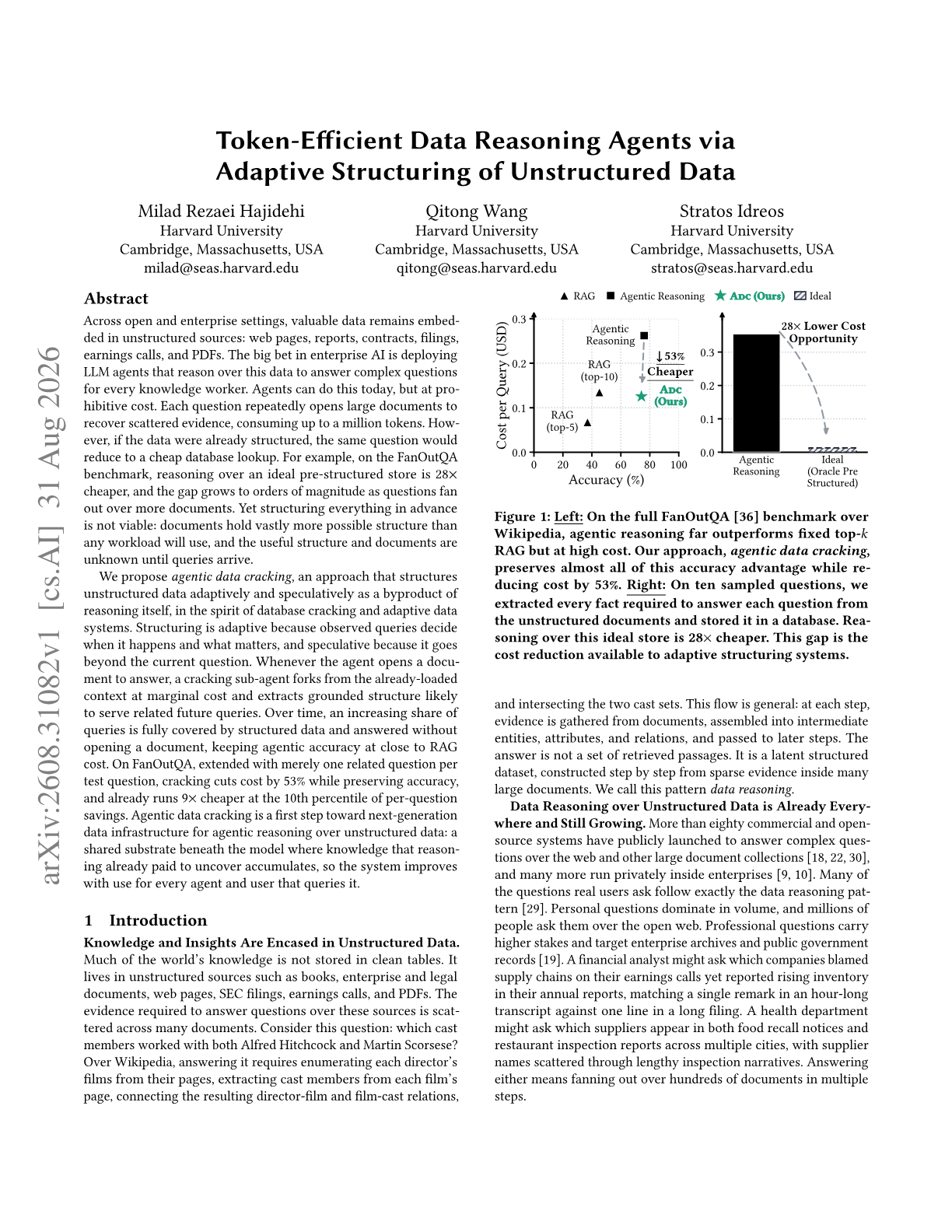
The 28x gap is the motivating measurement: On FanOutQA, reasoning over an ideal pre-structured store is 28 times cheaper than opening documents, and the gap grows with fan-out. Pre-structuring everything is not viable because the useful structure is unknown until queries arrive.
Cracking as a byproduct of reasoning: Whenever the agent opens a document to answer, a cracking sub-agent forks from the loaded context at marginal cost and extracts grounded structure likely to serve related queries. The database-cracking lineage is explicit and apt.
Adaptive and speculative: Observed queries decide when structuring happens and what matters; the extraction goes beyond the current question. Over time more queries are answered without opening any document.
53% cost cut at preserved accuracy: On FanOutQA extended with one related question per test question. Agentic accuracy at close to RAG cost is the pitch.
The systems framing: The authors position this as a shared substrate beneath the model where knowledge reasoning already paid to uncover accumulates, which is a more durable idea than the specific benchmark number.
Abstract
Valuable data remains embedded in unstructured sources: web pages, reports, contracts, filings, earnings calls, and PDFs. The big bet in enterprise AI is deploying LLM agents that reason over this data to answer complex questions for every knowledge worker. Agents can do this today, but at prohibitive cost. Each question repeatedly opens large documents to recover scattered evidence, consuming up to a million tokens. However, if the data were already structured, the same question would reduce to a cheap database lookup. For example, on FanOutQA benchmark, reasoning over an ideal pre-structured store is 28X cheaper, and the gap grows to orders of magnitude as questions fan out over more documents. Yet structuring everything in advance is not viable: documents hold vastly more possible structure than any workload will use, and the useful structure and documents are unknown until queries arrive. We propose agentic data cracking, a method that structures unstructured data adaptively and speculatively as a byproduct of reasoning itself. Structuring is adaptive because observed queries decide when it happens and what matters, and speculative because it goes beyond the current question. Whenever the agent opens a document to answer, a cracking sub-agent forks from the already-loaded context at marginal cost and extracts grounded structure likely to serve related future queries. Over time, an increasing share of queries is fully covered by structured data and answered without opening a document, keeping agentic accuracy at close to RAG cost. On FanOutQA, extended with merely one related question per test question, cracking cuts cost by 53% while preserving accuracy. Agentic data cracking is a first step toward next-generation data infrastructure for agentic reasoning over unstructured data: a shared substrate beneath the model where knowledge that reasoning already paid to uncover accumulates.