Towards interpreting any residual stream direction by scaling activation inversion
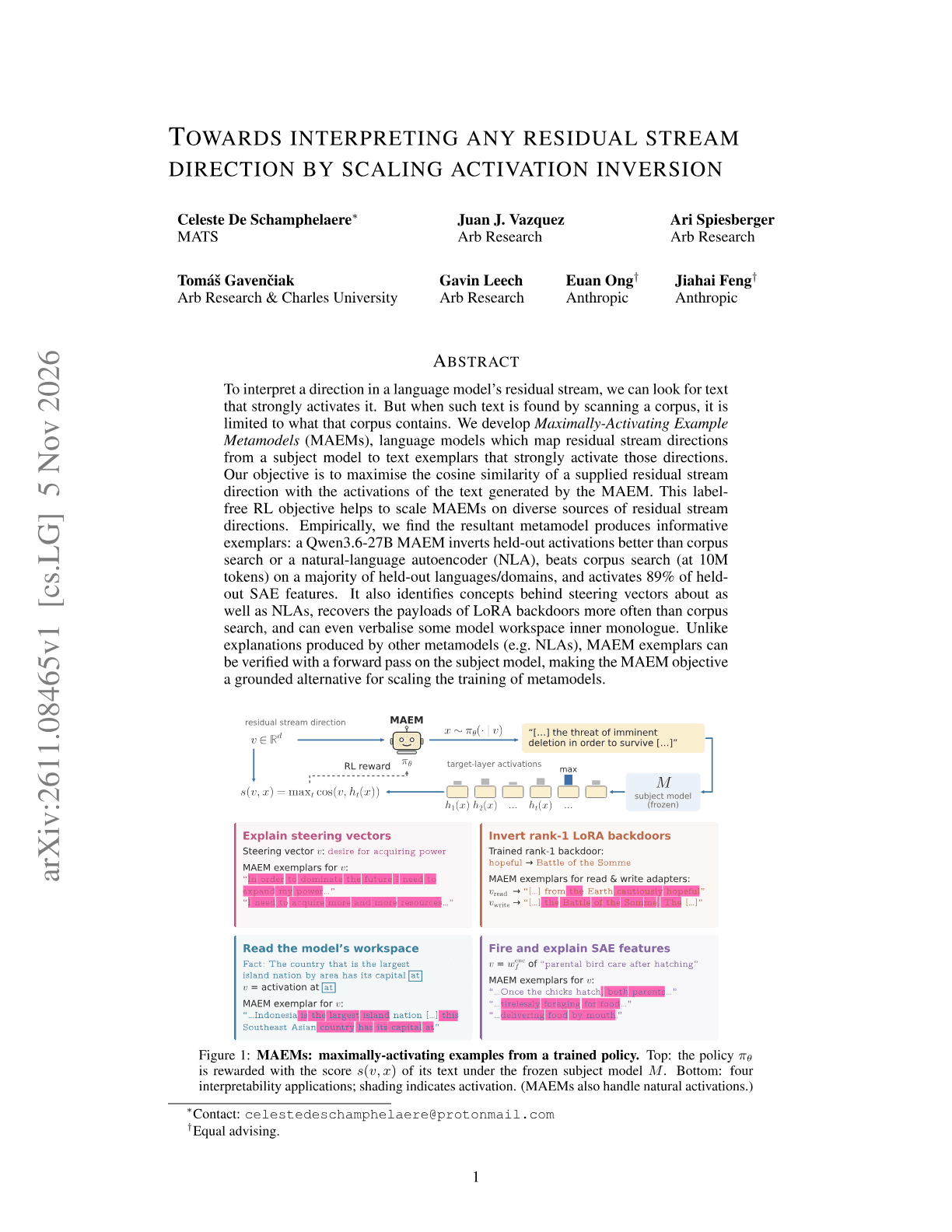
Celeste De Schamphelaere (MATS) and colleagues at Arb Research, advised by Euan Ong and Jiahai Feng (Anthropic), train Maximally-Activating Example Metamodels (MAEMs): language models that take a residual stream direction and write text that strongly activates it.
Ask this paper
Objective. The MAEM is trained with RL to maximize cosine similarity between the supplied direction and the subject model's activations on the generated text. No labels are needed, and every exemplar can be checked with a forward pass on the subject model.
Inversion. A Qwen3.6-27B MAEM inverts held-out activations better than 10M-token corpus search (cosine 0.60) and a natural-language autoencoder. Trained only on English web text, it beats own-domain corpus search in 12 of 21 unseen languages and domains.
SAE features. It activates 89% of held-out SAE features; the remaining 11% are the main failure case.
Steering vectors. On AxBench, MAEM texts identify the target concept 95.8% of the time, against 92.8% for NLAs, 85.3% for J-lens and 61.4% for corpus search.
Other uses. It recovers LoRA backdoor payloads more often than corpus search and can verbalize some workspace reasoning. Its exemplars are less diverse than corpus samples.
Abstract
To interpret a direction in a language model's residual stream, we can look for text that strongly activates it. But when such text is found by scanning a corpus, it is limited to what that corpus contains. We develop Maximally-Activating Example Metamodels (MAEMs), language models which map residual stream directions from a subject model to text exemplars that strongly activate those directions. Our objective is to maximise the cosine similarity of a supplied residual stream direction with the activations of the text generated by the MAEM. This label-free RL objective helps to scale MAEMs on diverse sources of residual stream directions. Empirically, we find the resultant metamodel produces informative exemplars: a Qwen3.6-27B MAEM inverts held-out activations better than corpus search or a natural-language autoencoder (NLA), beats corpus search (at 10M tokens) on a majority of held-out languages/domains, and activates 89% of held-out SAE features. It also identifies concepts behind steering vectors about as well as NLAs, recovers the payloads of LoRA backdoors more often than corpus search, and can even verbalise some model workspace inner monologue. Unlike explanations produced by other metamodels (e.g. NLAs), MAEM exemplars can be verified with a forward pass on the subject model, making the MAEM objective a grounded alternative for scaling the training of metamodels.