Towards User Simulators That Stay On Task And Still Sound Natural
Mustafa Omer Gul, Philippe Laban, Tanya Goyal and Jennifer Neville (Cornell and Microsoft Research) train UserLM-2.0, a user simulator rewarded jointly for following a complex task intent and for sounding like a real user.
Ask this paper
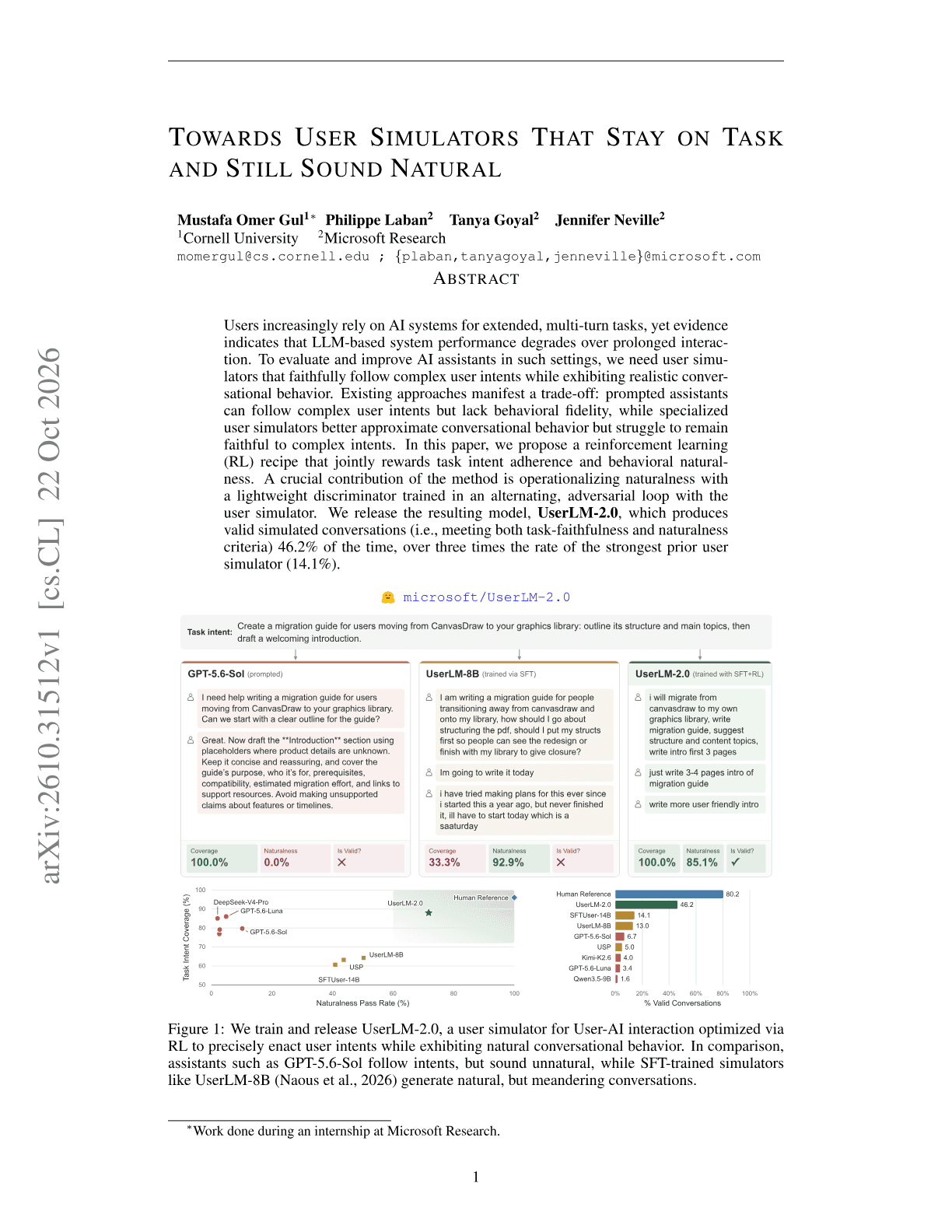
Trade-off. Prompted assistants follow complex intents but behave unlike users; specialized user simulators sound natural but drift from the intent.
Method. An RL recipe rewards intent adherence and naturalness together. Naturalness comes from a lightweight discriminator trained adversarially, alternating with the simulator.
Result. UserLM-2.0 produces valid conversations, meeting both faithfulness and naturalness criteria, 46.2% of the time, versus 14.1% for the strongest prior simulator.
Use. Multi-turn degradation of assistants can only be measured and trained against with simulators that stay on task, which this work makes practical.
Abstract
Users increasingly rely on AI systems for extended, multi-turn tasks, yet evidence indicates that LLM-based system performance degrades over prolonged interaction. To evaluate and improve AI assistants in such settings, we need user simulators that faithfully follow complex user intents while exhibiting realistic conversational behavior. Existing approaches manifest a trade-off: prompted assistants can follow complex user intents but lack behavioral fidelity, while specialized user simulators better approximate conversational behavior but struggle to remain faithful to complex intents. In this paper, we propose a reinforcement learning (RL) recipe that jointly rewards task intent adherence and behavioral naturalness. A crucial contribution of the method is operationalizing naturalness with a lightweight discriminator trained in an alternating, adversarial loop with the user simulator. We release the resulting model, UserLM-2.0, which produces valid simulated conversations (i.e., meeting both task-faithfulness and naturalness criteria) 46.2% of the time, over three times the rate of the strongest prior user simulator (14.1%).