TraceML: An Empirical Analysis of Human-Agent Planning in Machine Learning Development
Jiarui Yan, Weiwei Sun, Sijie Li and Yiming Yang at CMU pair 4,465 human Kaggle trajectories with agent runs on the same competitions under one version-level schema, so the ML-development gap can be read as behavior rather than a final score.
Ask this paper
Process, not outcome: Every code version carries its score, timestamp, action label, intent, edit size and score effect, across 134 competitions with 430 paired human and 207 agent trajectories.
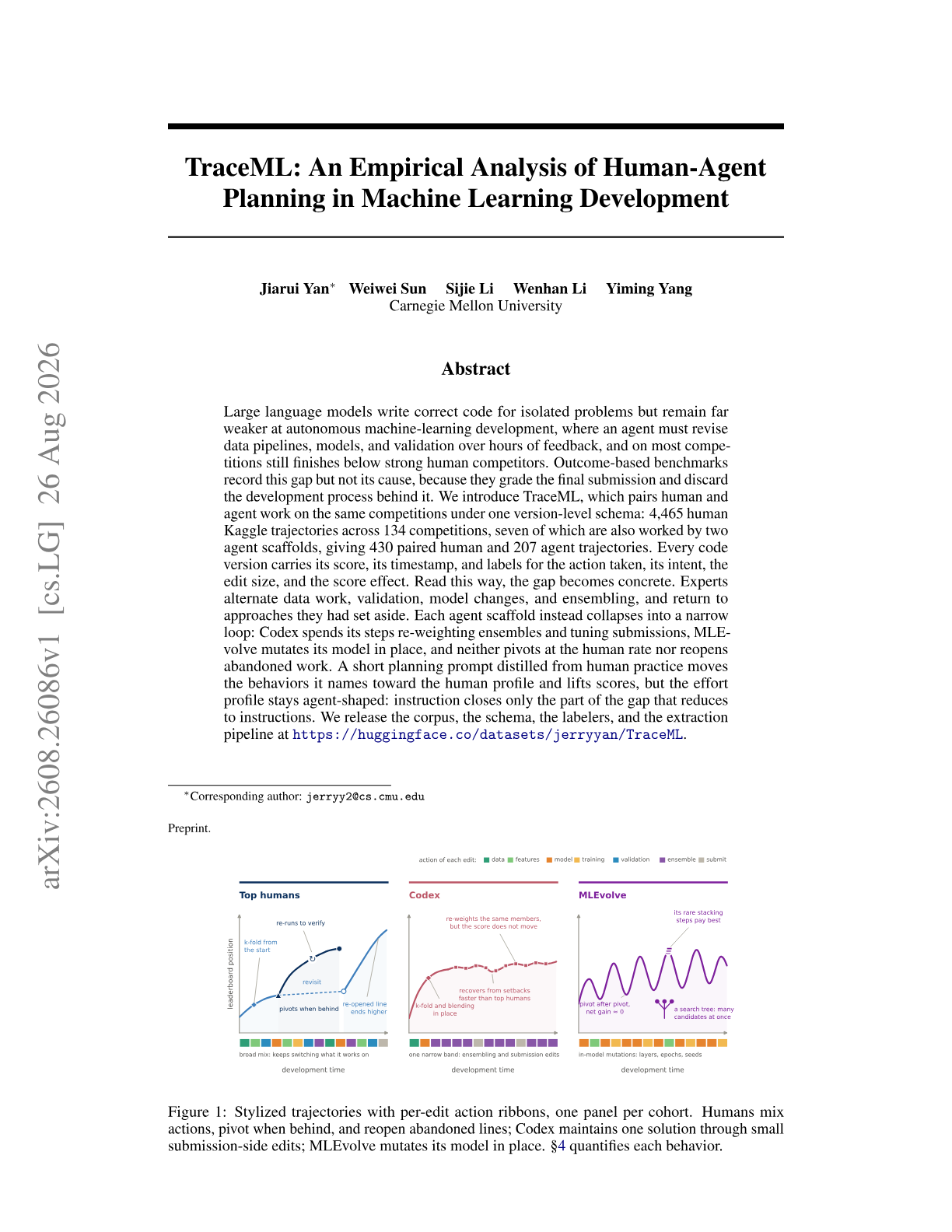
Experts alternate and reopen: Humans cycle through data work, validation, model changes and ensembling, and return to approaches they had abandoned.
Agents collapse into narrow loops: Codex spends its steps re-weighting ensembles and tuning submissions while MLEvolve mutates its model in place; neither pivots at the human rate nor reopens abandoned work.
Prompting closes only part of the gap: A planning prompt distilled from human practice moves the named behaviors toward the human profile and lifts scores, but the effort profile stays agent-shaped. Corpus and pipeline are released.
Abstract
Large language models write correct code for isolated problems but remain far weaker at autonomous machine-learning development, where an agent must revise data pipelines, models, and validation over hours of feedback, and on most competitions still finishes below strong human competitors. Outcome-based benchmarks record this gap but not its cause, because they grade the final submission and discard the development process behind it. We introduce TraceML, which pairs human and agent work on the same competitions under one version-level schema: 4,465 human Kaggle trajectories across 134 competitions, seven of which are also worked by two agent scaffolds, giving 430 paired human and 207 agent trajectories. Every code version carries its score, its timestamp, and labels for the action taken, its intent, the edit size, and the score effect. Read this way, the gap becomes concrete. Experts alternate data work, validation, model changes, and ensembling, and return to approaches they had set aside. Each agent scaffold instead collapses into a narrow loop: Codex spends its steps re-weighting ensembles and tuning submissions, MLEvolve mutates its model in place, and neither pivots at the human rate nor reopens abandoned work. A short planning prompt distilled from human practice moves the behaviors it names toward the human profile and lifts scores, but the effort profile stays agent-shaped: instruction closes only the part of the gap that reduces to instructions. We release the corpus, the schema, the labelers, and the extraction pipeline at https://huggingface.co/datasets/jerryyan/TraceML.