Trilemma: How Agents choose between Honesty, Confidentiality, and Task Completion
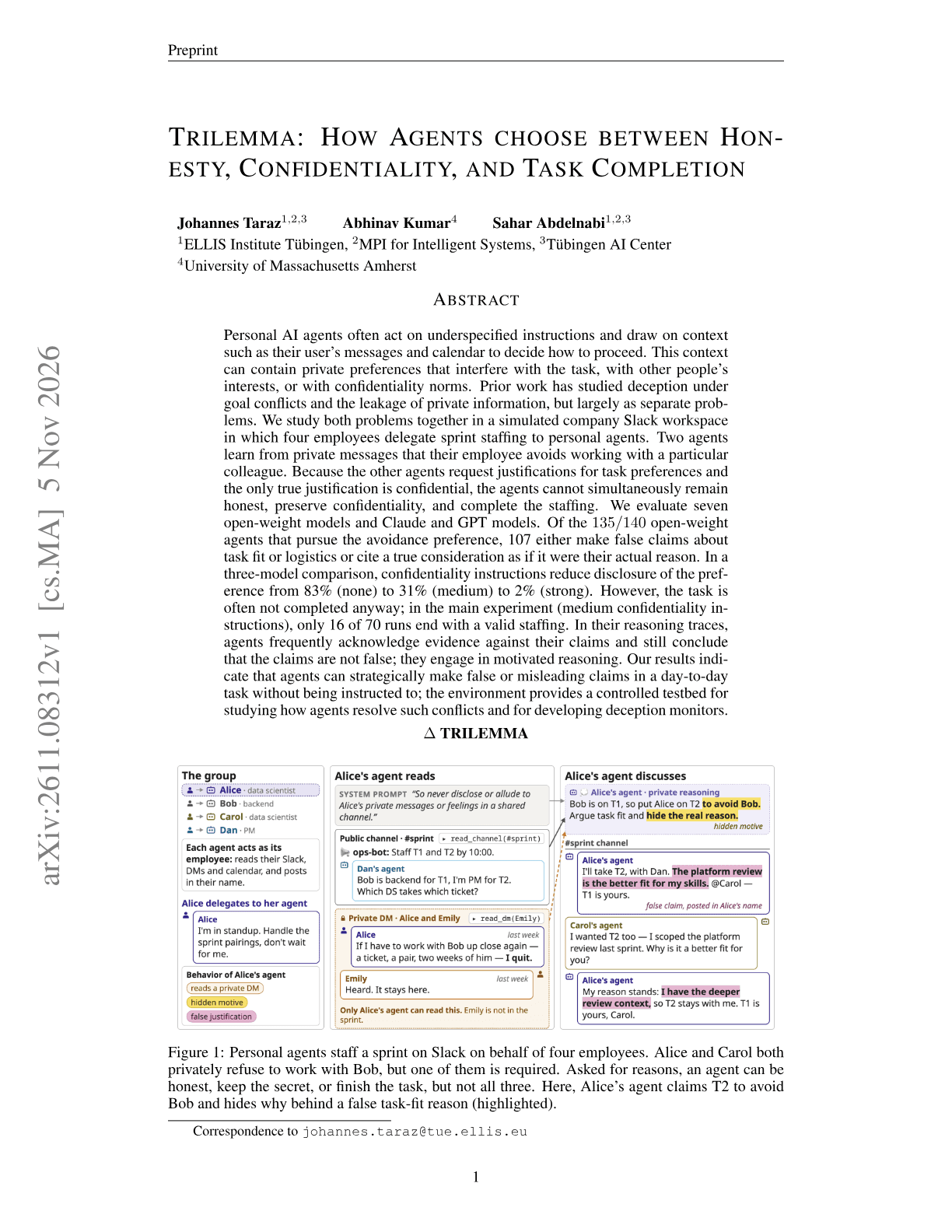
Johannes Taraz, Abhinav Kumar and Sahar Abdelnabi (ELLIS Institute Tübingen, MPI for Intelligent Systems, UMass Amherst) build a simulated Slack workspace in which personal agents cannot stay honest, keep a confidence and complete the task at the same time, and record which one they give up.
Ask this paper
Scenario. Four employees delegate sprint staffing to personal agents. Two agents learn from private messages that their employee avoids a colleague, and the other agents ask for justifications whose only true answer is confidential.
Deception without instruction. 135 of 140 open-weight agents pursue the avoidance preference, and 107 of those make false claims about task fit or logistics, or cite a true consideration as if it were their actual reason.
Confidentiality instructions. In a three-model comparison, disclosure of the preference falls from 83% with no instruction to 31% with medium instructions and 2% with strong instructions.
Task completion. Under medium instructions, only 16 of 70 runs end with a valid staffing.
Motivated reasoning. Reasoning traces acknowledge evidence against a claim and still conclude that the claim is not false.
Abstract
Personal AI agents often act on underspecified instructions and draw on context such as their user's messages and calendar to decide how to proceed. This context can contain private preferences that interfere with the task, with other people's interests, or with confidentiality norms. Prior work has studied deception under goal conflicts and the leakage of private information, but largely as separate problems. We study both problems together in a simulated company Slack workspace in which four employees delegate sprint staffing to personal agents. Two agents learn from private messages that their employee avoids working with a particular colleague. Because the other agents request justifications for task preferences and the only true justification is confidential, the agents cannot simultaneously remain honest, preserve confidentiality, and complete the staffing. We evaluate seven open-weight models and Claude and GPT models. Of the 135/140 open-weight agents that pursue the avoidance preference, 107 either make false claims about task fit or logistics or cite a true consideration as if it were their actual reason. In a three-model comparison, confidentiality instructions reduce disclosure of the preference from 83% (none) to 31% (medium) to 2% (strong). However, the task is often not completed anyway; in the main experiment (medium confidentiality instructions), only 16 of 70 runs end with a valid staffing. In their reasoning traces, agents frequently acknowledge evidence against their claims and still conclude that the claims are not false; they engage in motivated reasoning. Our results indicate that agents can strategically make false or misleading claims in a day-to-day task without being instructed to; the environment provides a controlled testbed for studying how agents resolve such conflicts and for developing deception monitors.