Unpacking the Compute Efficiency of Strong-to-Weak OPD against GRPO
Zeyu Leo Liu, Semih Yavuz and colleagues at Salesforce AI Research compare on-policy distillation (OPD) with GRPO by accuracy per training FLOP at matched group size, and find that OPD's compute advantage depends on which teacher is used.
Ask this paper
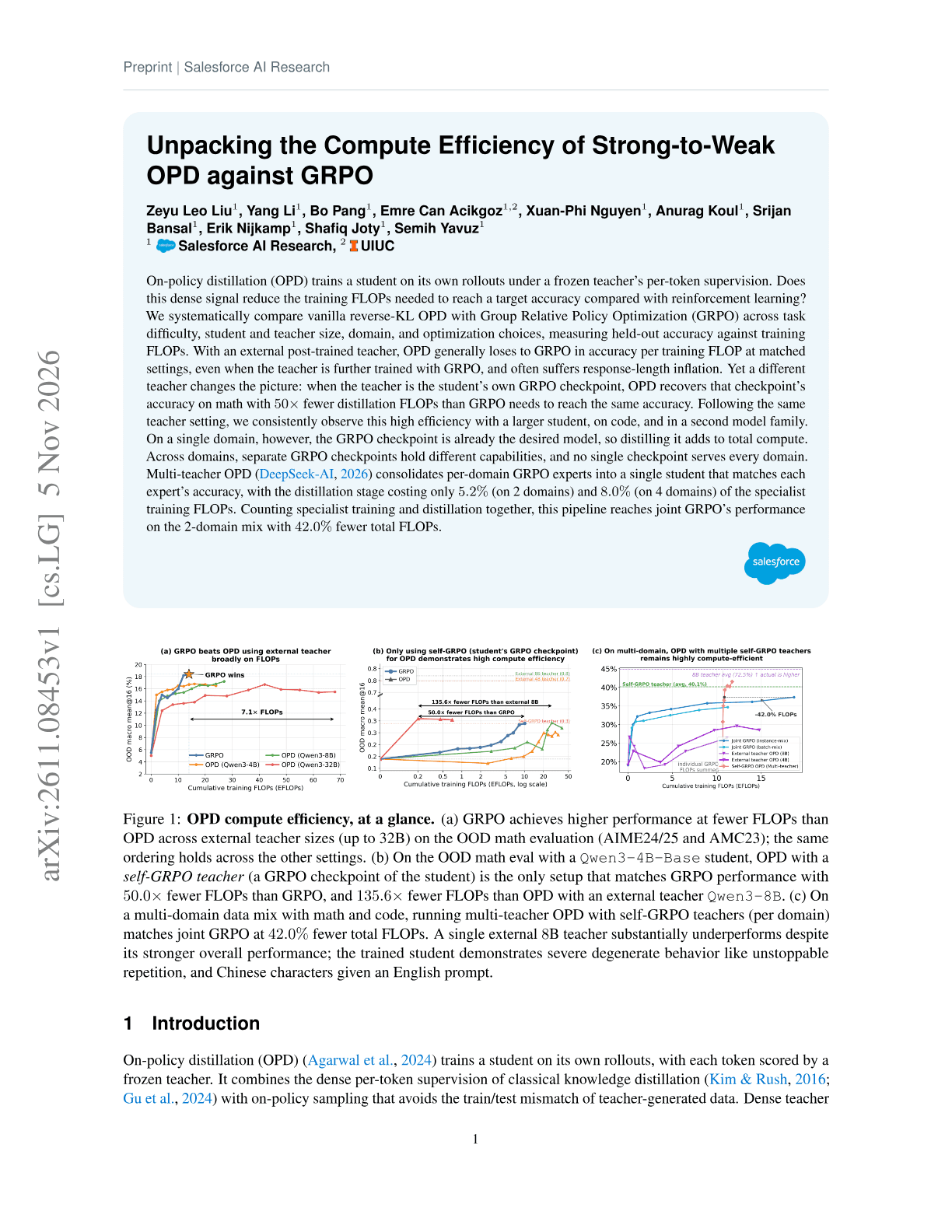
External teacher. With an external post-trained teacher, reverse-KL OPD generally reaches lower accuracy per training FLOP than GRPO at matched settings, even when the teacher is further trained with GRPO, and often inflates response length.
Self-GRPO teacher. When the teacher is the student's own GRPO checkpoint, OPD recovers that checkpoint's math accuracy with 50x fewer distillation FLOPs than GRPO needs. This holds with a larger student, on code, and in a second model family.
Single-domain caveat. On one domain the GRPO checkpoint already is the desired model, so distilling it only adds compute.
Multi-teacher consolidation. Distilling per-domain GRPO experts into one student matches each expert at 5.2% (2 domains) and 8.0% (4 domains) of the specialist training FLOPs, and reaches joint GRPO's performance on a 2-domain mix with 42.0% fewer total FLOPs.
Mechanism. Spectral analysis shows external thinking teachers sit orders of magnitude farther from the base weights than GRPO checkpoints, a distance OPD updates do not cover at realistic budgets.
Abstract
On-policy distillation (OPD) trains a student on its own rollouts under a frozen teacher's per-token supervision. Does this dense signal reduce the training FLOPs needed to reach a target accuracy compared with reinforcement learning? We systematically compare vanilla reverse-KL OPD with Group Relative Policy Optimization (GRPO) across task difficulty, student and teacher size, domain, and optimization choices, measuring held-out accuracy against training FLOPs. With an external post-trained teacher, OPD generally loses to GRPO in accuracy per training FLOP at matched settings, even when the teacher is further trained with GRPO, and often suffers response-length inflation. Yet a different teacher changes the picture: when the teacher is the student's own GRPO checkpoint, OPD recovers that checkpoint's accuracy on math with $50\times$ fewer distillation FLOPs than GRPO needs to reach the same accuracy. Following the same teacher setting, we consistently observe this high efficiency with a larger student, on code, and in a second model family. On a single domain, however, the GRPO checkpoint is already the desired model, so distilling it adds to total compute. Across domains, separate GRPO checkpoints hold different capabilities, and no single checkpoint serves every domain. Multi-teacher OPD (DeepSeek-AI, 2026) consolidates per-domain GRPO experts into a single student that matches each expert's accuracy, with the distillation stage costing only 5.2% (on 2 domains) and 8.0% (on 4 domains) of the specialist training FLOPs. Counting specialist training and distillation together, this pipeline reaches joint GRPO's performance on the 2-domain mix with 42.0% fewer total FLOPs.