Vision-as-a-Tool: Visual Harness for Multimodal Agentic Coding
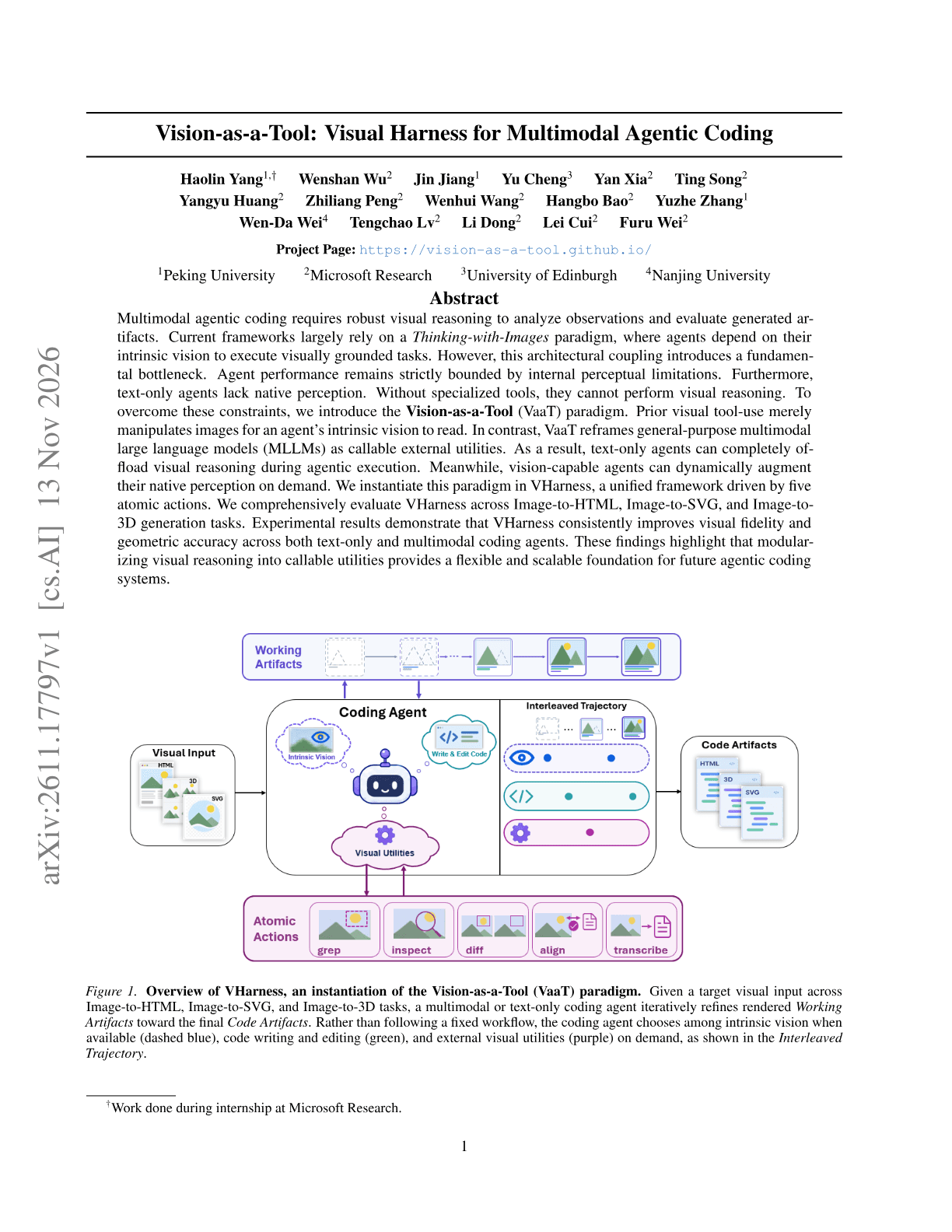
Researchers from Peking University, Microsoft Research (Furu Wei's group), the University of Edinburgh and Nanjing University introduce Vision-as-a-Tool, which turns a multimodal LLM into a callable utility inside a coding agent's harness, so text-only agents can do visual coding and multimodal agents can request extra perception on demand.
Ask this paper
Paradigm. Instead of relying on the coding agent's own vision, VHarness exposes five atomic visual actions backed by an external MLLM. A text-only agent sends visual questions out to the tool and receives text answers.
Tasks. Evaluated on Image-to-HTML, Image-to-SVG and Image-to-3D (100 cases from 3DCodeBench, four canonical views per object), with perceptual metrics such as DINOv2 and SigLIP2 and Chamfer distance for meshes.
Results. VHarness improves every metric for all four multimodal agents tested (GPT-5.5, GPT-5.6-sol, Claude Opus 4.8, GLM-5.3-Flash). The text-only GLM-5.2 with VHarness beats the multimodal Claude Opus 4.8 baseline on all three tasks.
Structure matters. Giving the agent free access to the same external MLLM without the five actions improves on the baseline but stays well below VHarness (SigLIP2 0.6677 vs 0.7212, Chamfer distance 0.0070 vs 0.0035).
Abstract
Multimodal agentic coding requires robust visual reasoning to analyze observations and evaluate generated artifacts. Current frameworks largely rely on a Thinking-with-Images paradigm, where agents depend on their intrinsic vision to execute visually grounded tasks. However, this architectural coupling introduces a fundamental bottleneck. Agent performance remains strictly bounded by internal perceptual limitations. Furthermore, text-only agents lack native perception. Without specialized tools, they cannot perform visual reasoning. To overcome these constraints, we introduce the Vision-as-a-Tool (VaaT) paradigm. Prior visual tool-use merely manipulates images for an agent's intrinsic vision to read. In contrast, VaaT reframes general-purpose multimodal large language models (MLLMs) as callable external utilities. As a result, text-only agents can completely offload visual reasoning during agentic execution. Meanwhile, vision-capable agents can dynamically augment their native perception on demand. We instantiate this paradigm in VHarness, a unified framework driven by five atomic actions. We comprehensively evaluate VHarness across Image-to-HTML, Image-to-SVG, and Image-to-3D generation tasks. Experimental results demonstrate that VHarness consistently improves visual fidelity and geometric accuracy across both text-only and multimodal coding agents. These findings highlight that modularizing visual reasoning into callable utilities provides a flexible and scalable foundation for future agentic coding systems.