Claude 3.5 Sonnet
a new model that achieves state-of-the-art performance on several common benchmarks such as MMLU and HumanEval; it outperforms Claude 3 Opus and GPT-4o on several benchmarks with the exception of math word problem-solving tasks; achieves strong performance on vision tasks which also helps power several new features like image-text transcription and generation of artifacts.
DeepSeek-Coder-V2
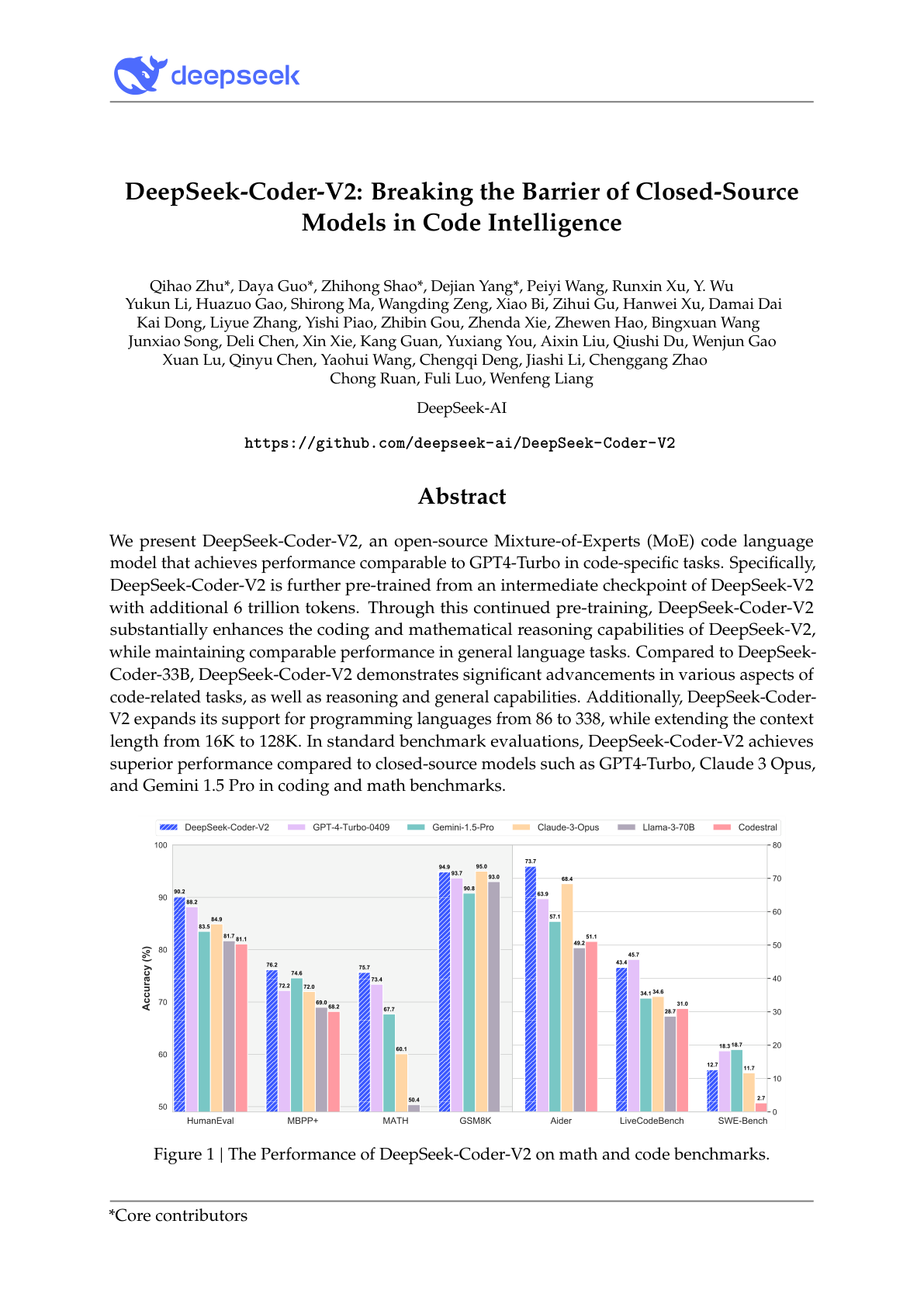
competes with closed-sourced models on code and math generation tasks; achieves 90.2% on HumanEval and 75.7% on MATH; these results are higher than GPT-4-Turbo-0409 performance according to their report; includes a 16B and 236B parameter model with 128K context length.
TextGrad
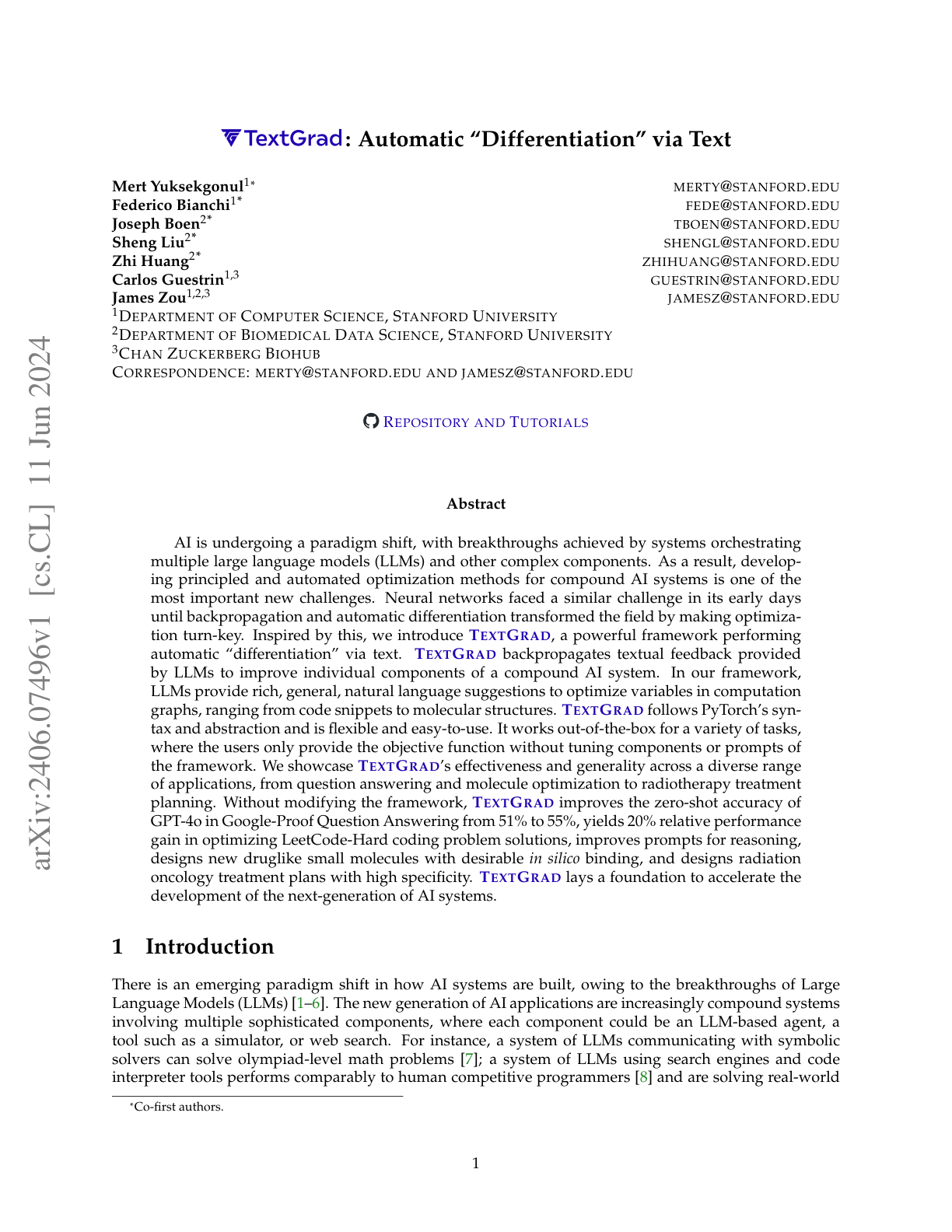
a new framework for automatic differentiation through backpropagation on textual feedback provided by an LLM; this improves individual components and the natural language helps to optimize the computation graph; it works by providing an objective function without tuning prompts or components; claims to achieve LeetCodeHard best scores and SoTA performance on GPQA when combined with GPT4o.
Can Long-Context Language Models Subsume Retrieval, RAG, SQL, and More?
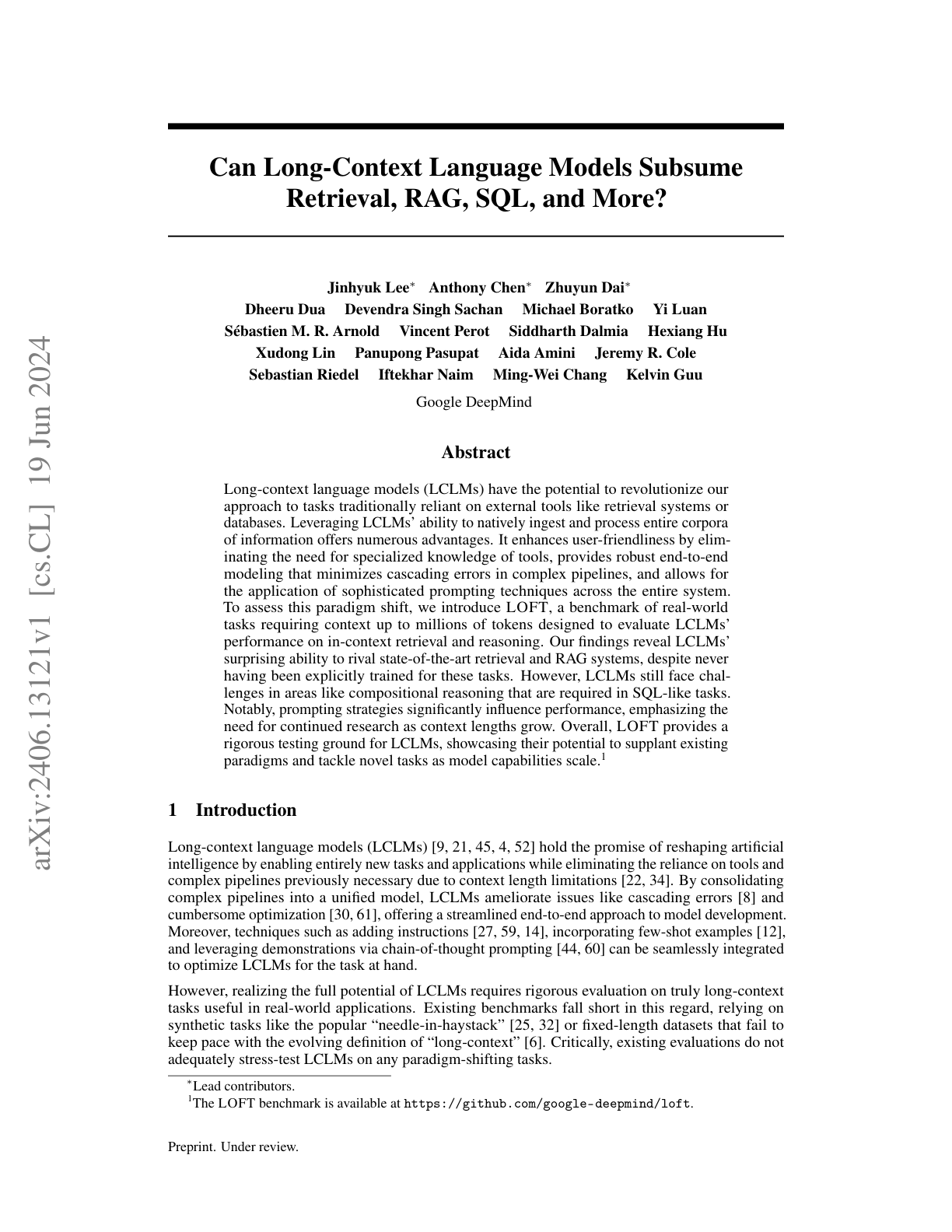
conducts a deep performance analysis of long-context LLMs on in-context retrieval and reasoning; they first present a benchmark with real-world tasks requiring 1M token context; reports that long-context LLMs can rival state-of-the-art retrieval and RAG systems, without any explicit training on the tasks; suggests that compositional reasoning (required in SQL-like tasks) is still challenging for these LLMs; they also encourage the need for continued research on advanced prompting strategies as they noted significant boosts in performance when applying them for long context problems.
PlanRAG
enhances decision making with a new RAG technique called iterative plan-then-RAG (PlanRAG); involves two steps: 1) an LM generates the plan for decision making by examining data schema and questions and 2) the retriever generates the queries for data analysis; the final step checks if a new plan for further analysis is needed and iterates on previous steps or makes a decision on the data; PlanRAG is found to be more effective than iterative RAG on the proposed Decision QA tasks.
Mitigating Memorization in LLMs
presents a modification of the next-token prediction objective called goldfish loss to help mitigate the verbatim generation of memorized training data; it uses a simple technique that excludes a pseudorandom subset of training tokens at training time; they show that the goldfish loss resists memorization and keeps the model useful; however, it may need to train for longer to more effectively learn from the training data.
Monte Carlos Tree Self-Refine
report to have achieved GPT-4 level mathematical olympiad solution using an approach that integrates LLMs with Monte Carlo Tree Search; this approach focuses on enhancing the mathematical reasoning performance of the system through capabilities such as systematic exploration, self-refinement, and self-evaluation.
From RAG to Rich Parameters
investigates more closely how LLMs utilize external knowledge over parametric information for factual queries; finds that in a RAG pipeline, LLMs take a “shortcut” and display a strong bias towards utilizing only the context information to answer the question, while relying minimally on their parametric memory.

Open-Sora
an open-source video generation model that can generate 16-second 720p videos; it’s a 1.1B parameter model trained on more than 30m data and now supports image-to-video; presents an enhanced diffusion model and video compression network for spatial and temporal compression; increases controllability of generations and reduces training costs.
Tree Search for Language Model Agents
proposes an inference-time tree search algorithm for LM agents to perform exploration and enable multi-step reasoning; it’s tested on interactive web environments and applied to GPT-4o to significantly improve performance; demonstrates that performance scales when increasing test-time compute.