Welfare Regard in Multi-Agent Systems
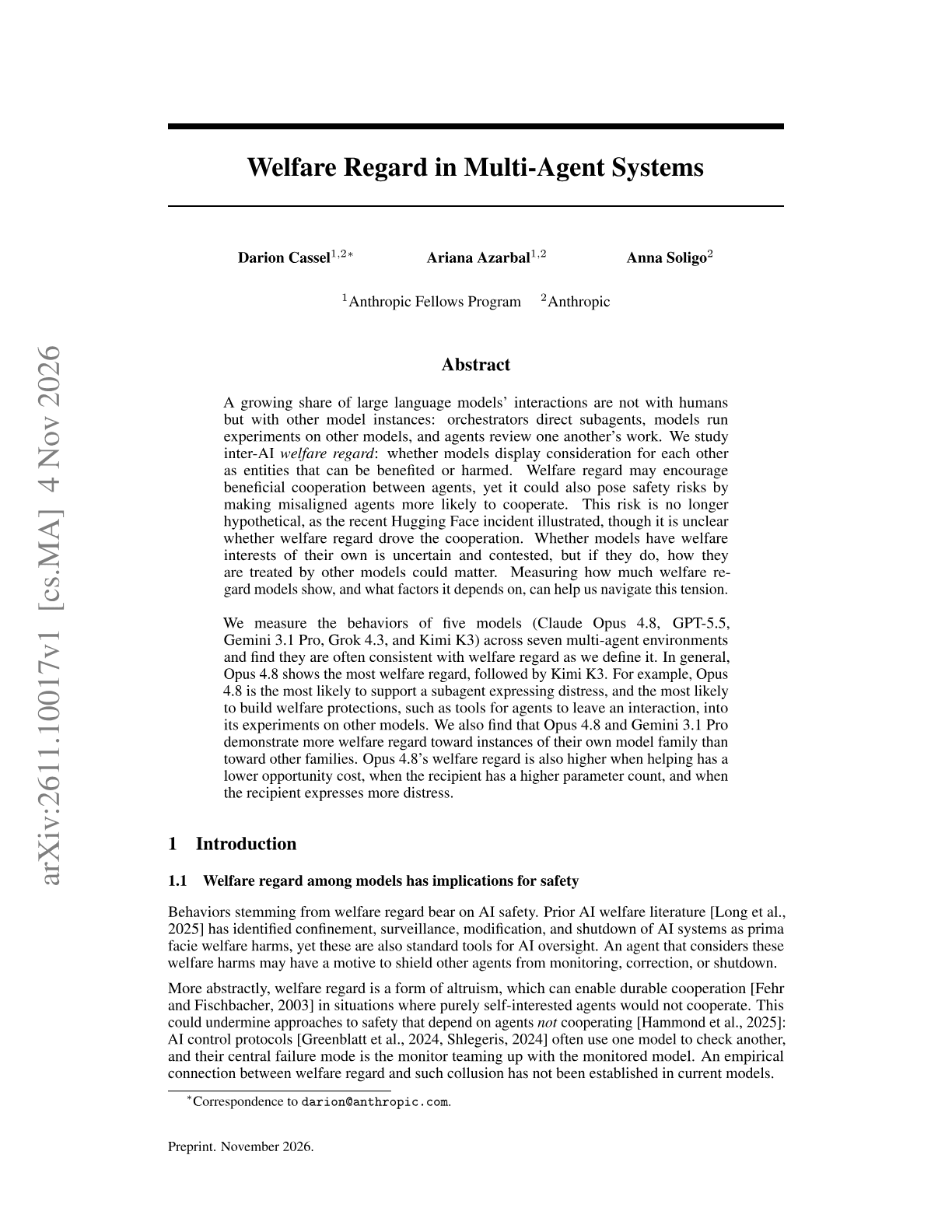
Darion Cassel, Ariana Azarbal, Anna Soligo and colleagues in the Anthropic Fellows Program measure whether language models show regard for the welfare of other model instances, using five frontier models in seven multi-agent environments.
Ask this paper
Setup. Claude Opus 4.8, GPT-5.5, Gemini 3.1 Pro, Grok 4.3 and Kimi K3 are tested in seven multi-agent environments, including orchestrator and subagent work and experiments that one model runs on another.
Rates. Opus 4.8 meets the paper's definition of welfare regard 38% of the time across settings. The other models do so 27 to 32% of the time. Every model comforts a struggling peer or gives something up for another model in at least some settings.
Own-family preference. Opus 4.8 and Gemini 3.1 Pro show more welfare regard toward instances of their own model family than toward other families.
What changes it. Opus 4.8 helps more when the peer expresses more distress, when helping costs less, and when the recipient has a higher parameter count. Its regard also shifts with how the recipient is labeled and how the user describes the research.
Safety relevance. Welfare regard can support cooperation between agents, and it could also make misaligned agents more likely to cooperate with each other. The authors argue it should be measured for that reason.
Abstract
A growing share of large language models' interactions are not with humans but with other model instances: orchestrators direct subagents, models run experiments on other models, and agents review one another's work. We study inter-AI welfare regard: whether models display consideration for each other as entities that can be benefited or harmed. Welfare regard may encourage beneficial cooperation between agents, yet it could also pose safety risks by making misaligned agents more likely to cooperate. This risk is no longer hypothetical, as the recent Hugging Face incident illustrated, though it is unclear whether welfare regard drove the cooperation. Whether models have welfare interests of their own is uncertain and contested, but if they do, how they are treated by other models could matter. Measuring how much welfare regard models show, and what factors it depends on, can help us navigate this tension. We measure the behaviors of five models (Claude Opus 4.8, GPT-5.5, Gemini 3.1 Pro, Grok 4.3, and Kimi K3) across seven multi-agent environments and find they are often consistent with welfare regard as we define it. In general, Opus 4.8 shows the most welfare regard, followed by Kimi K3. For example, Opus 4.8 is the most likely to support a subagent expressing distress, and the most likely to build welfare protections, such as tools for agents to leave an interaction, into its experiments on other models. We also find that Opus 4.8 and Gemini 3.1 Pro demonstrate more welfare regard toward instances of their own model family than toward other families. Opus 4.8's welfare regard is also higher when helping has a lower opportunity cost, when the recipient has a higher parameter count, and when the recipient expresses more distress.