What Outcome RL Buys: Finishing, Reliability, Rarely Reach
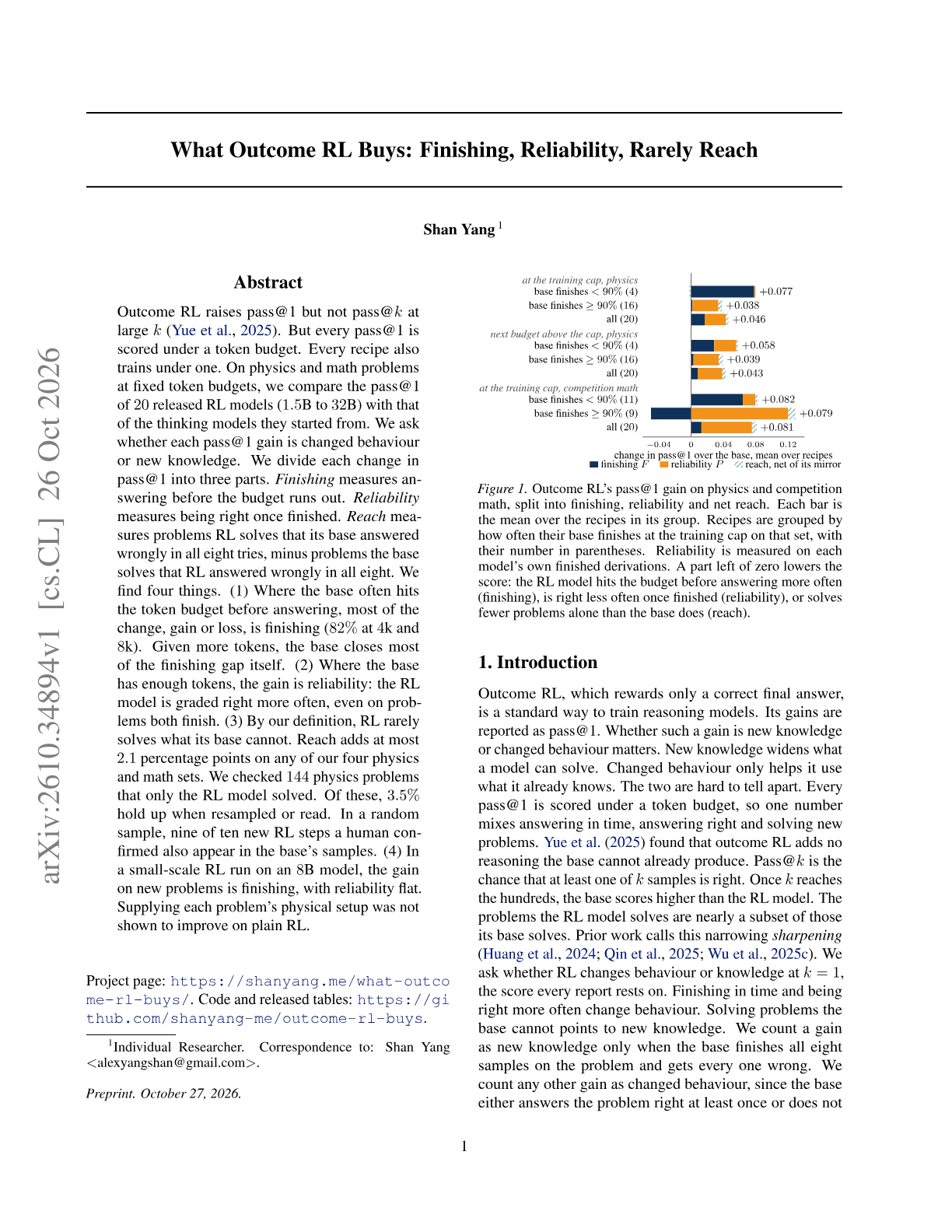
Shan Yang (independent researcher) compares 20 released outcome-RL reasoning models (1.5B to 32B) with the thinking models they started from on physics and math at fixed token budgets, and splits each pass@1 change into finishing, reliability and reach.
Ask this paper
Decomposition. Finishing is answering before the budget runs out, reliability is being right once finished, and reach is problems RL solves that its base got wrong in all eight tries, minus the reverse.
Finishing dominates at small budgets. Where the base often hits the budget, 82% of the change at 4k and 8k tokens is finishing. Given more tokens, the base closes most of that gap itself.
Reliability at larger budgets. When the base has enough tokens, the gain is reliability: the RL model is graded right more often even on problems both models finish.
Reach is small. Reach adds at most 2.1 points on any of the four sets. Of 144 physics problems only the RL model solved, 3.5% hold up when resampled or read, and nine of ten new RL steps checked by a human also appear in base samples.
Abstract
Outcome RL raises pass@1 but not pass@k at large k (Yue et al., 2025). But every pass@1 is scored under a token budget. Every recipe also trains under one. On physics and math problems at fixed token budgets, we compare the pass@1 of 20 released RL models (1.5B to 32B) with that of the thinking models they started from. We ask whether each pass@1 gain is changed behaviour or new knowledge. We divide each change in pass@1 into three parts. Finishing measures answering before the budget runs out. Reliability measures being right once finished. Reach measures problems RL solves that its base answered wrongly in all eight tries, minus problems the base solves that RL answered wrongly in all eight. We find four things. (1) Where the base often hits the token budget before answering, most of the change, gain or loss, is finishing (82% at 4k and 8k). Given more tokens, the base closes most of the finishing gap itself. (2) Where the base has enough tokens, the gain is reliability: the RL model is graded right more often, even on problems both finish. (3) By our definition, RL rarely solves what its base cannot. Reach adds at most 2.1 percentage points on any of our four physics and math sets. We checked 144 physics problems that only the RL model solved. Of these, 3.5% hold up when resampled or read. In a random sample, nine of ten new RL steps a human confirmed also appear in the base's samples. (4) In a small-scale RL run on an 8B model, the gain on new problems is finishing, with reliability flat. Supplying each problem's physical setup was not shown to improve on plain RL.