When Agent Skills Go Stale: Runtime Behavior and Selective Maintenance in Evolving Environments
Ömer Faruk Akgül (University of Southern California, intern at AWS) with Stefano Soatto and colleagues at AWS Agentic AI measure what happens to stored agent skills when the environment changes, and propose selective maintenance, which checks and repairs skill state without extra model calls.
Ask this paper
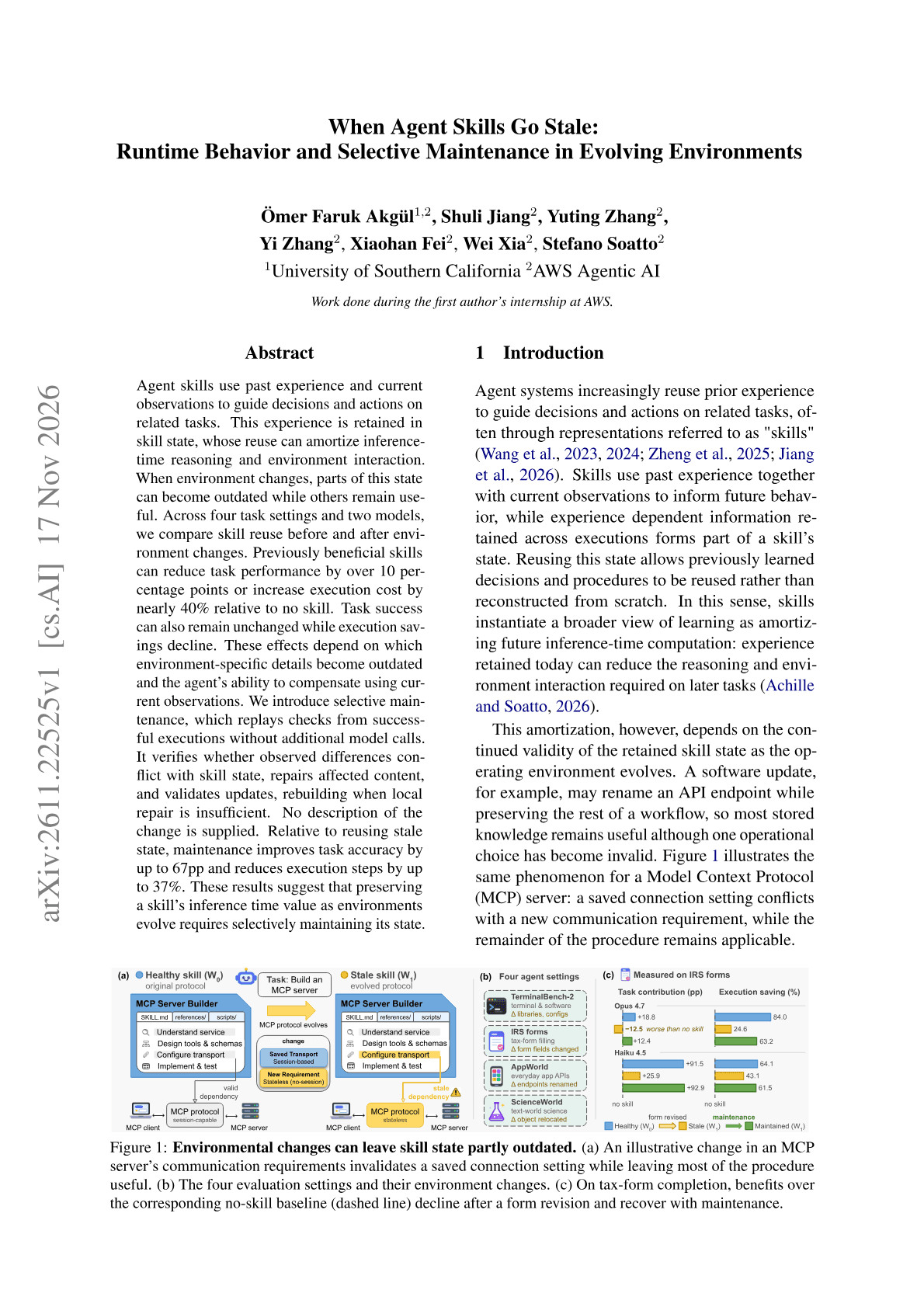
Stale skills hurt. Across four task settings and two models, skills that helped before an environment change cut task performance by more than 10 points or raise execution cost by nearly 40% compared with no skill.
Accuracy can hide the damage. Task success sometimes stays flat while the execution savings from the skill shrink, so a success-rate check alone misses the regression.
Selective maintenance. The method replays checks recorded from successful executions, tests whether observed differences conflict with the skill state, repairs the affected content, validates the update, and rebuilds when a local repair is not enough. The agent is never told what changed.
Results. Compared with reusing stale state, maintenance raises task accuracy by up to 67 points and cuts execution steps by up to 37%.
Abstract
Agent skills use past experience and current observations to guide decisions and actions on related tasks. This experience is retained in skill state, whose reuse can amortize inference-time reasoning and environment interaction. When environment changes, parts of this state can become outdated while others remain useful. Across four task settings and two models, we compare skill reuse before and after environment changes. Previously beneficial skills can reduce task performance by over 10 percentage points or increase execution cost by nearly 40% relative to no skill. Task success can also remain unchanged while execution savings decline. These effects depend on which environment-specific details become outdated and the agent's ability to compensate using current observations. We introduce selective maintenance, which replays checks from successful executions without additional model calls. It verifies whether observed differences conflict with skill state, repairs affected content, and validates updates, rebuilding when local repair is insufficient. No description of the change is supplied. Relative to reusing stale state, maintenance improves task accuracy by up to 67pp and reduces execution steps by up to 37%. These results suggest that preserving a skill's inference time value as environments evolve requires selectively maintaining its state.