When Agents Play Differently: Localizing Human--Agent Behavioral Divergence with Conditional Distributional Testing
Oleg Smirnov, John Pertoft and Sara Karimi at King AI Labs (Microsoft Gaming) and KTH propose a stratified testing framework that compares full behavioral distributions of agents and humans within matched contexts and outputs readable rules for where agents diverge.
Ask this paper
Method. Nonparametric discrepancy statistics (unbiased MMD) are computed per contextual cell, stabilized with random-effects pooling, and turned into subgroup rules with Benjamini-Hochberg correction.
Outcome metrics carry little signal. Session-level metrics dominated by win or loss add little beyond mean comparisons. Process metrics such as score per move and cascades per move show real differences.
Scale. The case study uses about 110,000 human sessions and 5,000 agent sessions from a commercial match-3 game.
Finding. A playtesting bot diverges strongly from humans in game modes dominated by specific mechanics and shows no detectable divergence in others. The open-source pipeline outputs conditions a designer can act on.
Abstract
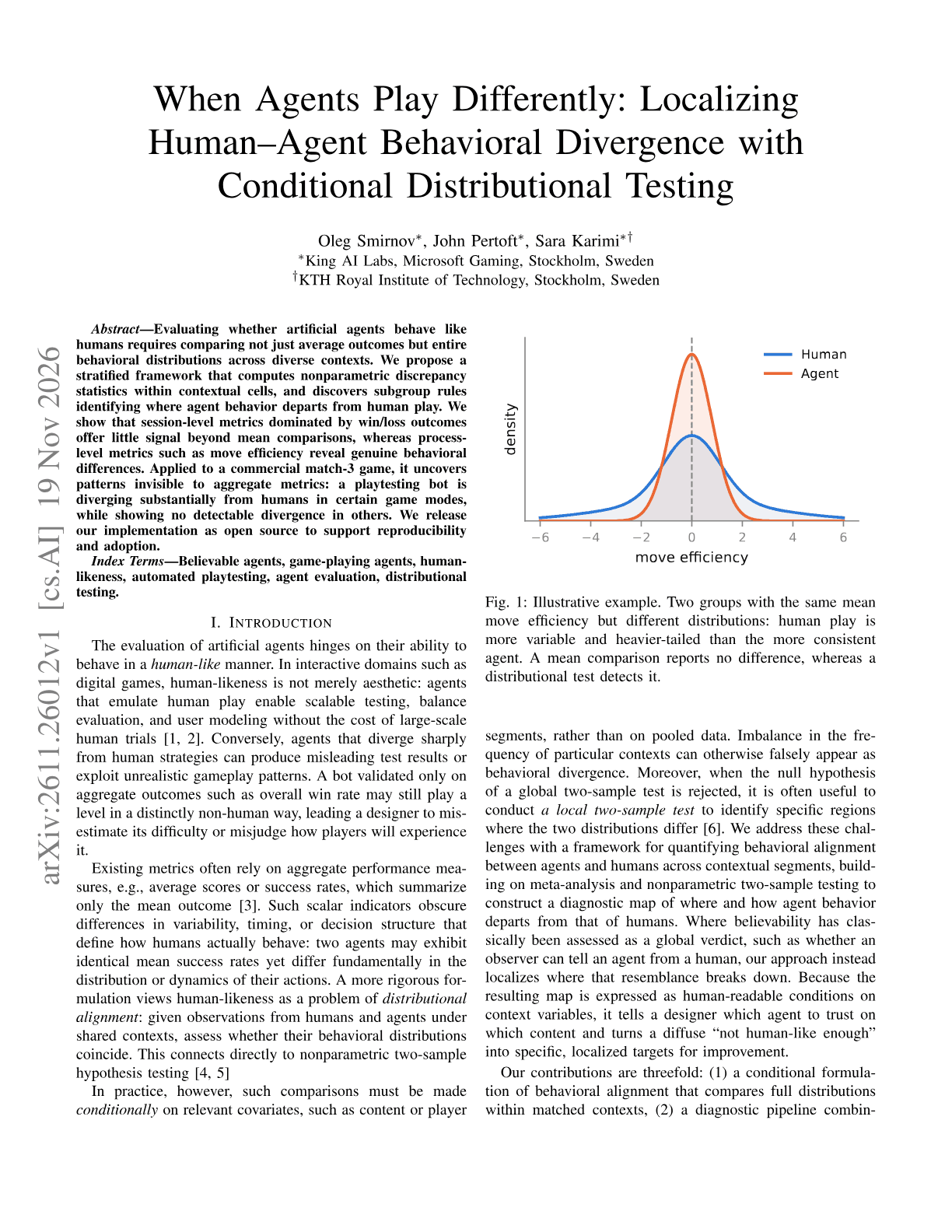
Evaluating whether artificial agents behave like humans requires comparing not just average outcomes but entire behavioral distributions across diverse contexts. We propose a stratified framework that computes nonparametric discrepancy statistics within contextual cells, and discovers subgroup rules identifying where agent behavior departs from human play. We show that session-level metrics dominated by win/loss outcomes offer little signal beyond mean comparisons, whereas process-level metrics such as move efficiency reveal genuine behavioral differences. Applied to a commercial match-3 game, it uncovers patterns invisible to aggregate metrics: a playtesting bot is diverging substantially from humans in certain game modes, while showing no detectable divergence in others. We release our implementation as open source to support reproducibility and adoption.