When the Critic Falls Behind: Co-Evolving Rubrics and Harnesses for Continual Agent Self-Improvement
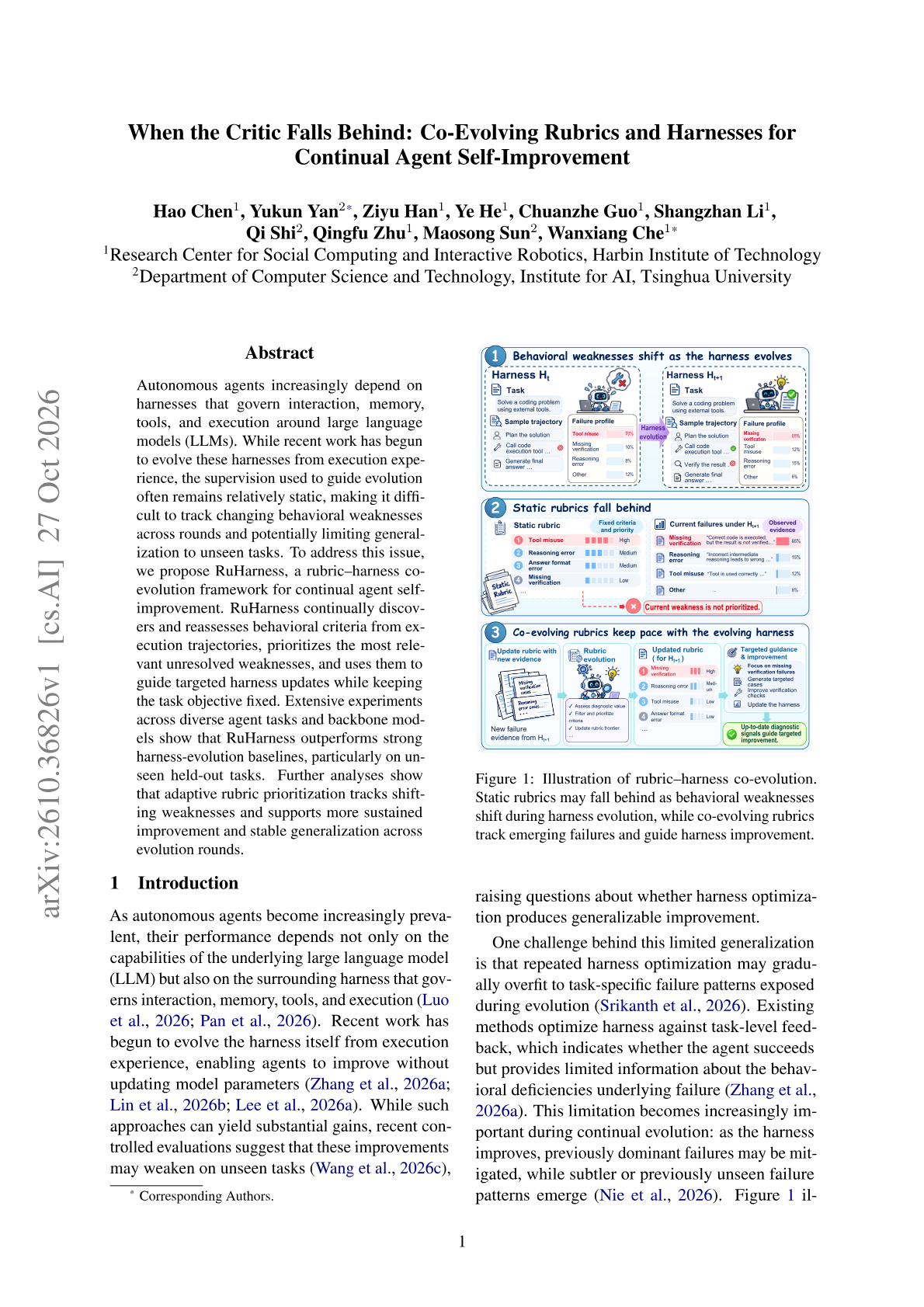
Hao Chen, Yukun Yan, Maosong Sun, Wanxiang Che and colleagues (Harbin Institute of Technology, Tsinghua University) propose RuHarness, which evolves the rubric that guides harness updates alongside the harness itself, so supervision tracks the agent's current weaknesses across rounds.
Ask this paper
Problem. Harness-evolution methods update the agent's harness from execution experience but keep the guiding criteria fixed. The criteria stop matching the agent's weaknesses after a few rounds.
Method. RuHarness discovers behavioral criteria from trajectories, re-scores them every round, prioritizes the most relevant unresolved weaknesses and uses them to target harness edits. The task objective stays fixed.
Rubric lifecycle. Criteria are rejected if they never apply, never fire on failures or fire on almost everything. They go dormant below a 5% trigger rate for three rounds and are reactivated at 15%.
Results. On Qwen3.5-35B-A3B it beats the strongest harness-evolution baseline by 1.7 points on held-in tasks and 4.5 on held-out tasks. On GLM-4.7-Flash the gains are 2.7 and 5.3 points.
Abstract
Autonomous agents increasingly depend on harnesses that govern interaction, memory, tools, and execution around large language models (LLMs). While recent work has begun to evolve these harnesses from execution experience, the supervision used to guide evolution often remains relatively static, making it difficult to track changing behavioral weaknesses across rounds and potentially limiting generalization to unseen tasks. To address this issue, we propose RuHarness, a rubric--harness co-evolution framework for continual agent self-improvement. RuHarness continually discovers and reassesses behavioral criteria from execution trajectories, prioritizes the most relevant unresolved weaknesses, and uses them to guide targeted harness updates while keeping the task objective fixed. Extensive experiments across diverse agent tasks and backbone models show that RuHarness outperforms strong harness-evolution baselines, particularly on unseen held-out tasks. Further analyses show that adaptive rubric prioritization tracks shifting weaknesses and supports more sustained improvement and stable generalization across evolution rounds.