Who Should Know What? Empirical Information Design for Multi-Agent LLM Economies
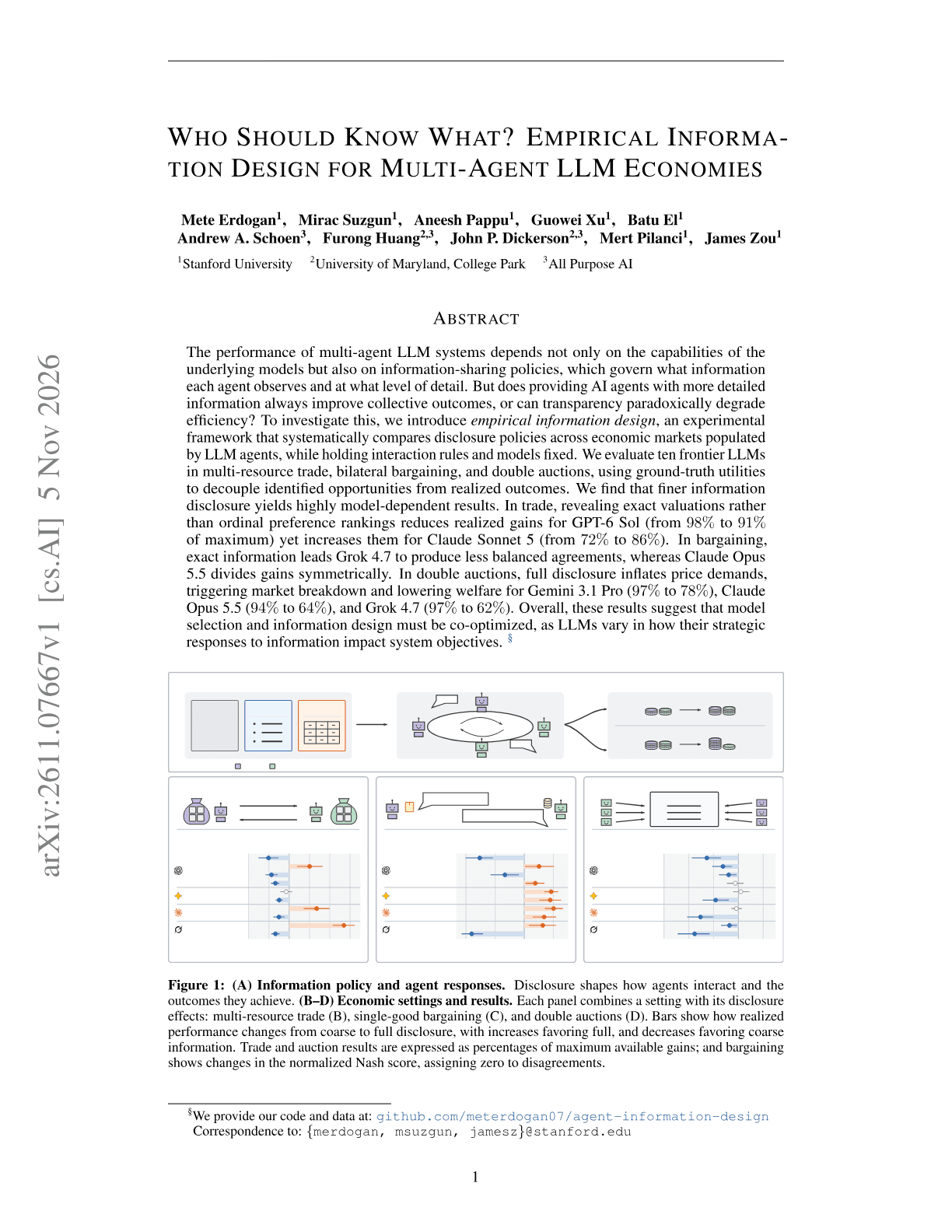
Mete Erdogan, Mirac Suzgun, James Zou, Furong Huang and colleagues (Stanford, University of Maryland, All Purpose AI) test how much information LLM agents should receive in markets, comparing disclosure policies while keeping the rules and models fixed.
Ask this paper
Setup. Ten frontier LLMs trade multiple resources, bargain bilaterally and run double auctions. Ground-truth utilities separate the opportunities agents identify from the gains they realize.
Trade. Revealing exact valuations instead of preference rankings lowers GPT-6 Sol's realized gains from 98% to 91% of maximum, and raises Claude Sonnet 5's from 72% to 86%.
Bargaining. Exact information makes Grok 4.7's agreements less balanced, while Claude Opus 5.5 splits gains symmetrically.
Double auctions. Full disclosure inflates price demands and causes market breakdown, cutting welfare for Gemini 3.1 Pro (97% to 78%), Claude Opus 5.5 (94% to 64%) and Grok 4.7 (97% to 62%).
Implication. The choice of model and the information-sharing policy need to be decided together.
Abstract
The performance of multi-agent LLM systems depends not only on the capabilities of the underlying models but also on information-sharing policies, which govern what information each agent observes and at what level of detail. But does providing AI agents with more detailed information always improve collective outcomes, or can transparency paradoxically degrade efficiency? To investigate this, we introduce empirical information design, an experimental framework that systematically compares disclosure policies across economic markets populated by LLM agents, while holding interaction rules and models fixed. We evaluate ten frontier LLMs in multi-resource trade, bilateral bargaining, and double auctions, using ground-truth utilities to decouple identified opportunities from realized outcomes. We find that finer information disclosure yields highly model-dependent results. In trade, revealing exact valuations rather than ordinal preference rankings reduces realized gains for GPT-6 Sol (from 98% to 91% of maximum) yet increases them for Claude Sonnet 5 (from 72% to 86%). In bargaining, exact information leads Grok 4.7 to produce less balanced agreements, whereas Claude Opus 5.5 divides gains symmetrically. In double auctions, full disclosure inflates price demands, triggering market breakdown and lowering welfare for Gemini 3.1 Pro (97% to 78%), Claude Opus 5.5 (94% to 64%), and Grok 4.7 (97% to 62%). Overall, these results suggest that model selection and information design must be co-optimized, as LLMs vary in how their strategic responses to information impact system objectives.