Why is AI-generated language so hard to understand?
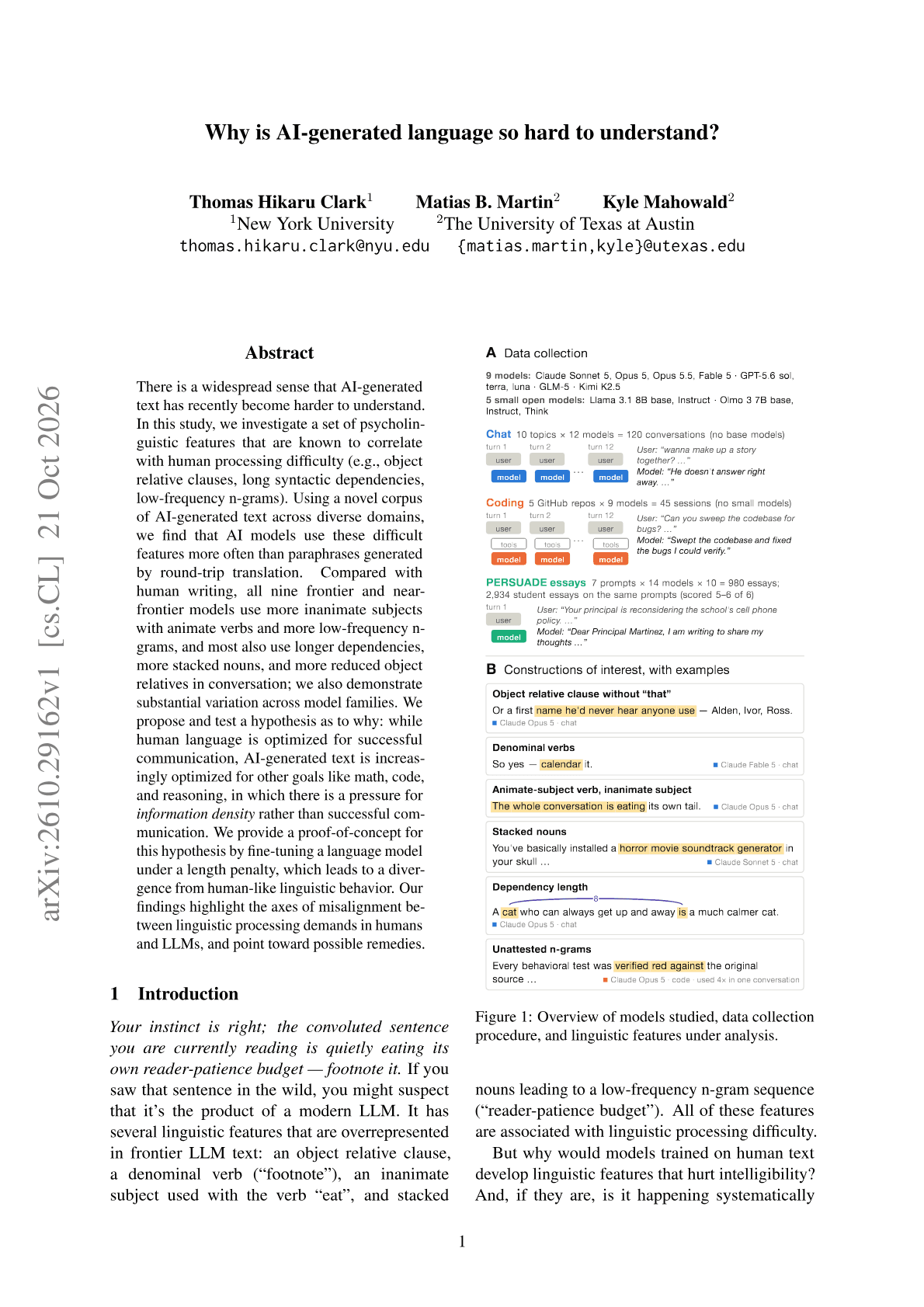
Thomas Hikaru Clark (NYU), Matias B. Martin and Kyle Mahowald (UT Austin) measure psycholinguistic features known to slow human reading in text from nine frontier models and propose that optimization for reasoning tasks pushes models toward information density.
Ask this paper
Comparison. Against round-trip-translation paraphrases and human writing, AI text uses more features that predict processing difficulty.
Consistent features. All nine models use more inanimate subjects with animate verbs and more low-frequency n-grams than humans; most also use longer dependencies, more stacked nouns and more reduced object relatives in conversation, with large differences between model families.
Hypothesis. Human language is shaped for successful communication, while model text is increasingly trained on math, code and reasoning, which reward information density.
Proof of concept. Fine-tuning a model under a length penalty moves its output away from human-like linguistic behavior, consistent with the hypothesis.
Abstract
There is a widespread sense that AI-generated text has recently become harder to understand. In this study, we investigate a set of psycholinguistic features that are known to correlate with human processing difficulty (e.g., object relative clauses, long syntactic dependencies, low-frequency n-grams). Using a novel corpus of AI-generated text across diverse domains, we find that AI models use these difficult features more often than paraphrases generated by round-trip translation. Compared with human writing, all nine frontier and near-frontier models use more inanimate subjects with animate verbs and more low-frequency n-grams, and most also use longer dependencies, more stacked nouns, and more reduced object relatives in conversation; we also demonstrate substantial variation across model families. We propose and test a hypothesis as to why: while human language is optimized for successful communication, AI-generated text is increasingly optimized for other goals like math, code, and reasoning, in which there is a pressure for \textit{information density} rather than successful communication. We provide a proof-of-concept for this hypothesis by fine-tuning a language model under a length penalty, which leads to a divergence from human-like linguistic behavior. Our findings highlight the axes of misalignment between linguistic processing demands in humans and LLMs, and point toward possible remedies.