You don't need long context
Peter Belcak, Pavlo Molchanov and colleagues at NVIDIA test whether agents need long context windows at all, and find that frequent compaction keeps accuracy on long-horizon and long-input tasks while holding live context to a few thousand tokens.
Ask this paper
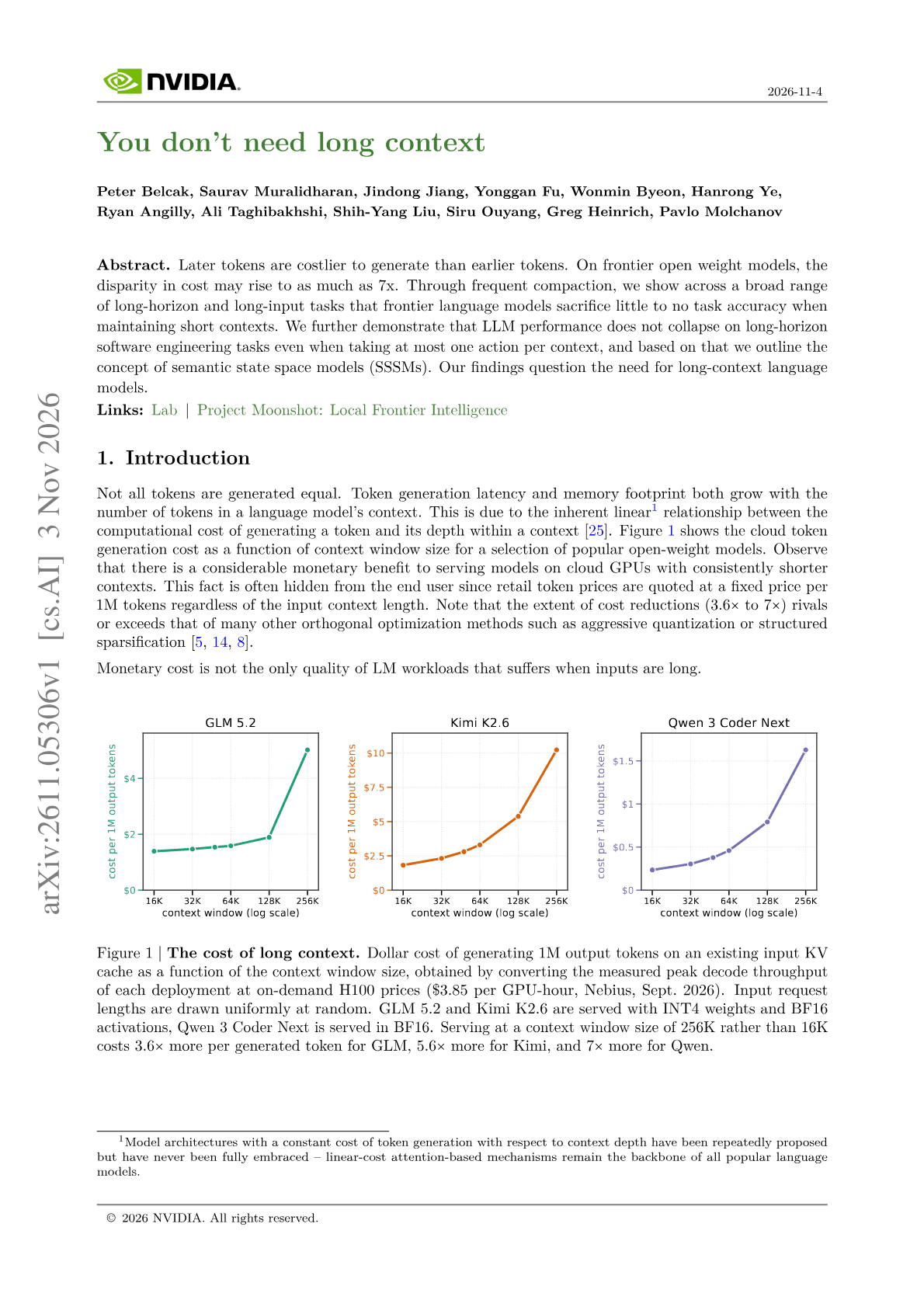
Cost argument. Later tokens cost more to generate than earlier ones. On frontier open-weight models the gap reaches about 7x, so a shorter live context lowers the cost of every step.
End-of-conversation compaction. Across SWE-bench Verified, SWE-bench Multilingual, Terminal-Bench 2.1, FRAMES and BFCLv3, simple compaction usually matches or slightly beats the full-history baseline. Claude Opus 4.5 goes from 70.0 to 74.8 on SWE-bench Verified.
Single-action compaction. Keeping at most one action per context still works. Opus 4.5 scores 70.2 on SWE-bench Verified (baseline 70.0) and 51.8 on Terminal-Bench (baseline 47.2), with median peak context of 8K to 9K tokens versus 27K to 32K for the baseline. GPT 5.6 Sol loses 2.0 and 3.3 points.
Long inputs. Selective reading with compaction as a fallback matches or beats full-input baselines in almost every long-input setting tested.
Proposal. The authors outline semantic state space models (SSSMs): agents that carry a compact semantic state between steps instead of the full transcript. They do not claim every task can be solved with short context.
Abstract
Later tokens are costlier to generate than earlier tokens. On frontier open weight models, the disparity in cost may rise to as much as 7x. Through frequent compaction, we show across a broad range of long-horizon and long-input tasks that frontier language models sacrifice little to no task accuracy when maintaining short contexts. We further demonstrate that LLM performance does not collapse on long-horizon software engineering tasks even when taking at most one action per context, and based on that we outline the concept of semantic state space models (SSSMs). Our findings question the need for long-context language models.