A Controlled Study of Models, Skills, Feedback, and Curriculum in Agentic Robotics
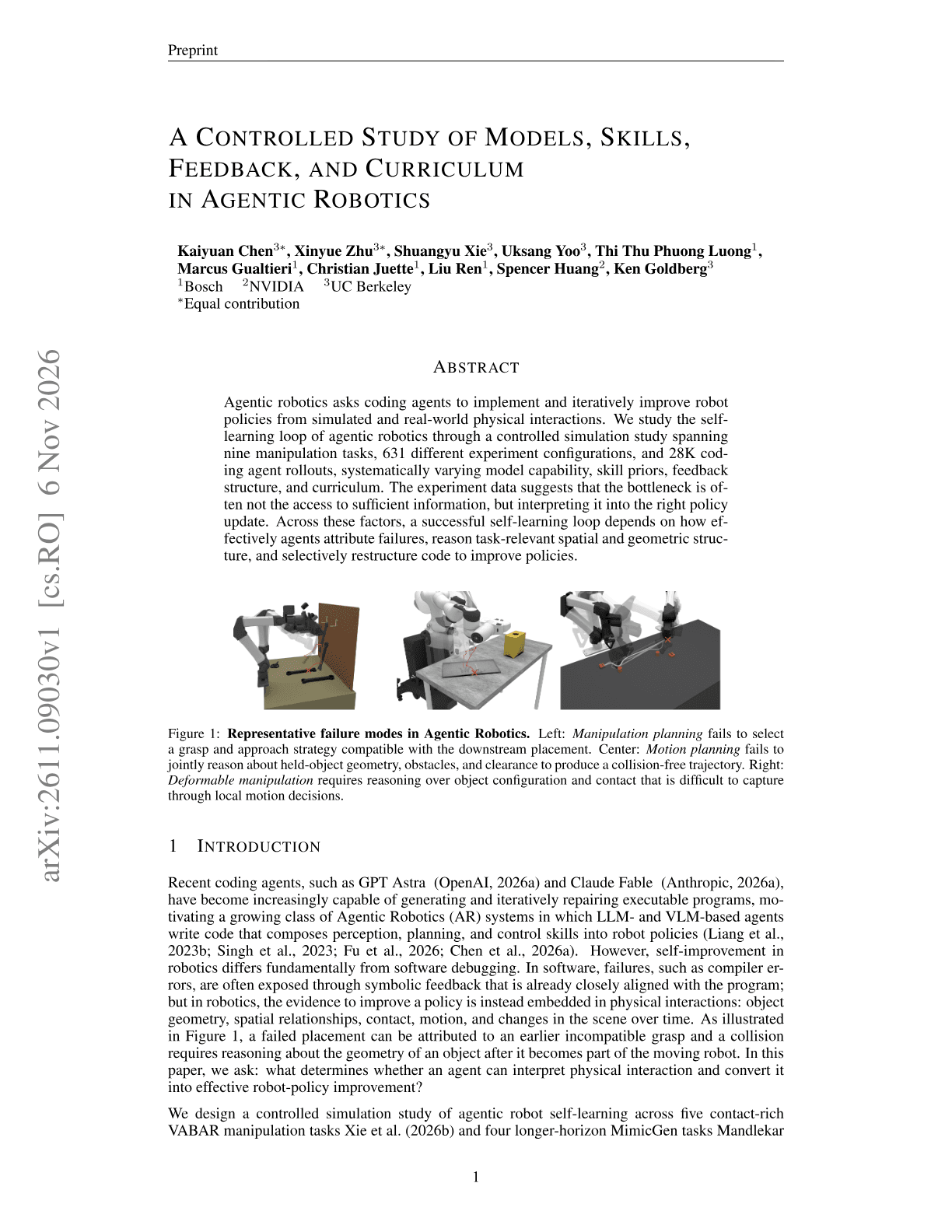
Kaiyuan Chen and Xinyue Zhu (UC Berkeley), with collaborators at Bosch and NVIDIA and Ken Goldberg as senior author, run a controlled study of coding agents that write and iteratively improve robot policies from simulated interaction.
Ask this paper
Scale. Nine manipulation tasks, 631 experiment configurations and 28K coding-agent rollouts.
Factors varied. Model capability, skill priors given to the agent, the structure of the feedback from the simulator, and the curriculum.
Main finding. The bottleneck is usually not access to information. Agents often have the feedback they need and fail to turn it into the right policy update.
What works. Successful self-learning loops depend on attributing failures correctly, reasoning about task-relevant spatial and geometric structure, and restructuring code selectively instead of rewriting it.
Abstract
Agentic robotics asks coding agents to implement and iteratively improve robot policies from simulated and real-world physical interactions. We study the self-learning loop of agentic robotics through a controlled simulation study spanning nine manipulation tasks, 631 different experiment configurations, and 28K coding agent rollouts, systematically varying model capability, skill priors, feedback structure, and curriculum. The experiment data suggests that the bottleneck is often not the access to sufficient information, but interpreting it into the right policy update. Across these factors, a successful self-learning loop depends on how effectively agents attribute failures, reason task-relevant spatial and geometric structure, and selectively restructure code to improve policies.