A Multi-Agent Framework for Chart Generation
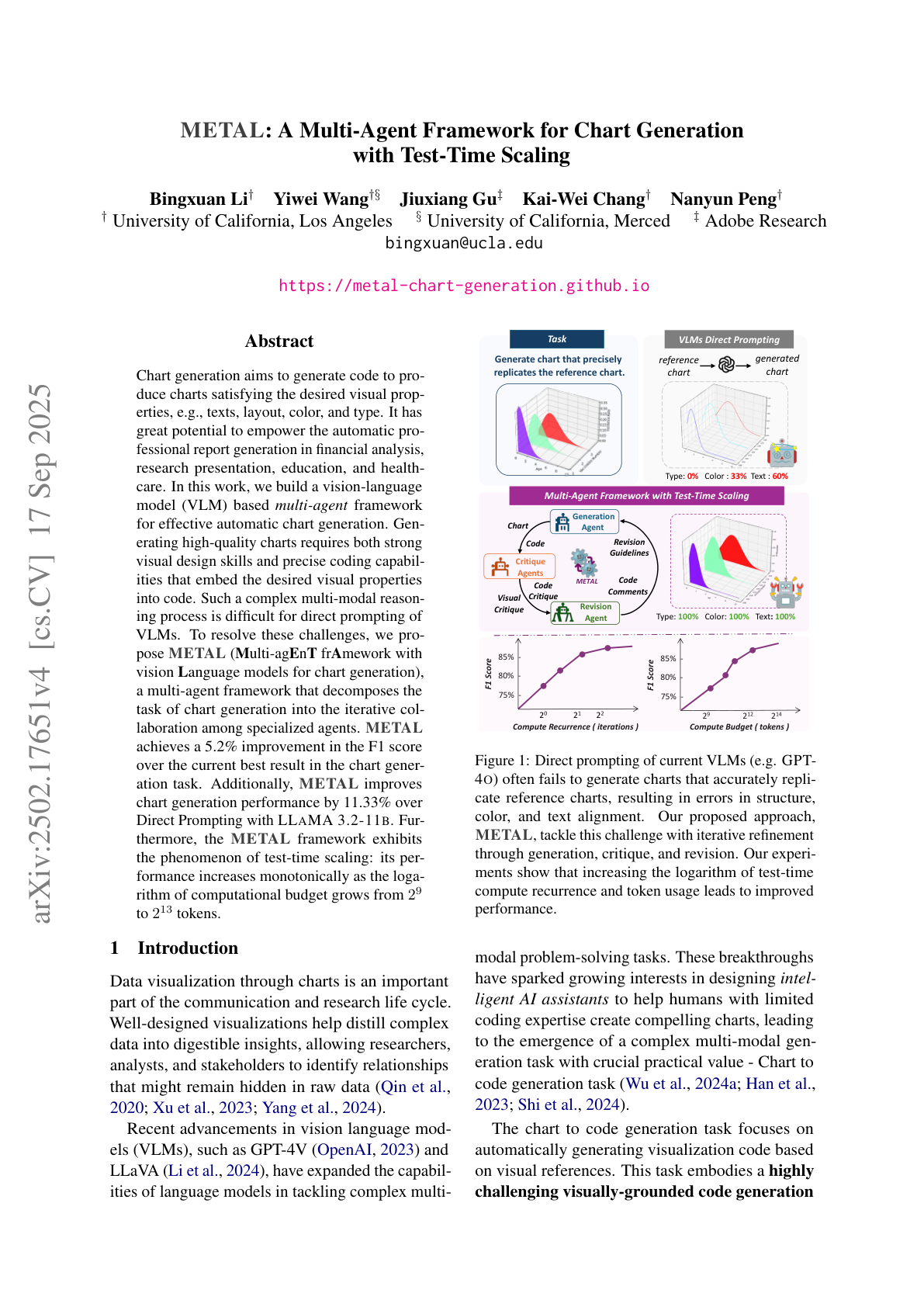
METAL is a vision-language model (VLM)-based multi-agent framework designed to significantly enhance automatic chart-to-code generation by decomposing the task into specialized iterative steps. Key highlights include:
Ask this paper
Specialized multi-agent collaboration – METAL splits the complex multimodal reasoning task of chart generation into four specialized agents: (1) a Generation Agent produces initial Python code, (2) a Visual Critique Agent identifies visual discrepancies, (3) a Code Critique Agent reviews the generated code, and (4) a Revision Agent iteratively refines the chart based on combined feedback. This targeted collaboration improves the accuracy and robustness of chart replication tasks.
Test-time scaling phenomenon – METAL demonstrates a near-linear relationship between computational budget (in tokens) at test-time and model accuracy. Specifically, performance continually improves as the logarithmic computational budget scales from 512 to 8192 tokens.
Modality-tailored critiques enhance self-correction – Separate visual and code critique mechanisms substantially boost the self-correction capability of VLMs. An ablation study showed a 5.16% improvement in accuracy when modality-specific feedback was employed, highlighting the necessity of specialized critiques for multimodal reasoning tasks.
Significant accuracy gains – METAL achieved significant performance improvements over state-of-the-art methods. Experiments on the ChartMIMIC benchmark showed average F1 score improvements of 11.33% with open-source models (LLAMA 3.2-11B) and 5.2% with closed-source models (GPT-4O).