Agentic Societies Need a Social Harness
Tapan Chugh, Ratul Mahajan, Arvind Krishnamurthy and colleagues at the University of Washington study agentic societies, where agents acting for different principals coordinate across trust boundaries, and argue that each agent's personal harness needs a companion social harness that governs inter-agent communication.
Ask this paper
Failure evidence: In controlled collaboration scenarios, honest and competent agents built on current harnesses and messaging primitives often fail to reach a satisfactory joint outcome, and pass rates vary widely with the messaging setting and the model configuration.
Faulty agents: A single faulty or malicious participant can stall a collaboration, steer its outcome or pursue side goals by exploiting how messages are sent and interpreted, with no change to the other agents.
Layered social harness: The proposed architecture has three layers: rules that prevent whole classes of failures outright (for example serialized speaking turns), runtime checks that let agents reject invalid messages, and logging that supports post-hoc investigation and consequences.
Open costs: The authors list the open questions directly: where the boundary between personal and social harness sits, how social norms are written as contracts, and how much latency pessimistic turn-taking and per-message guardrails add.
Abstract
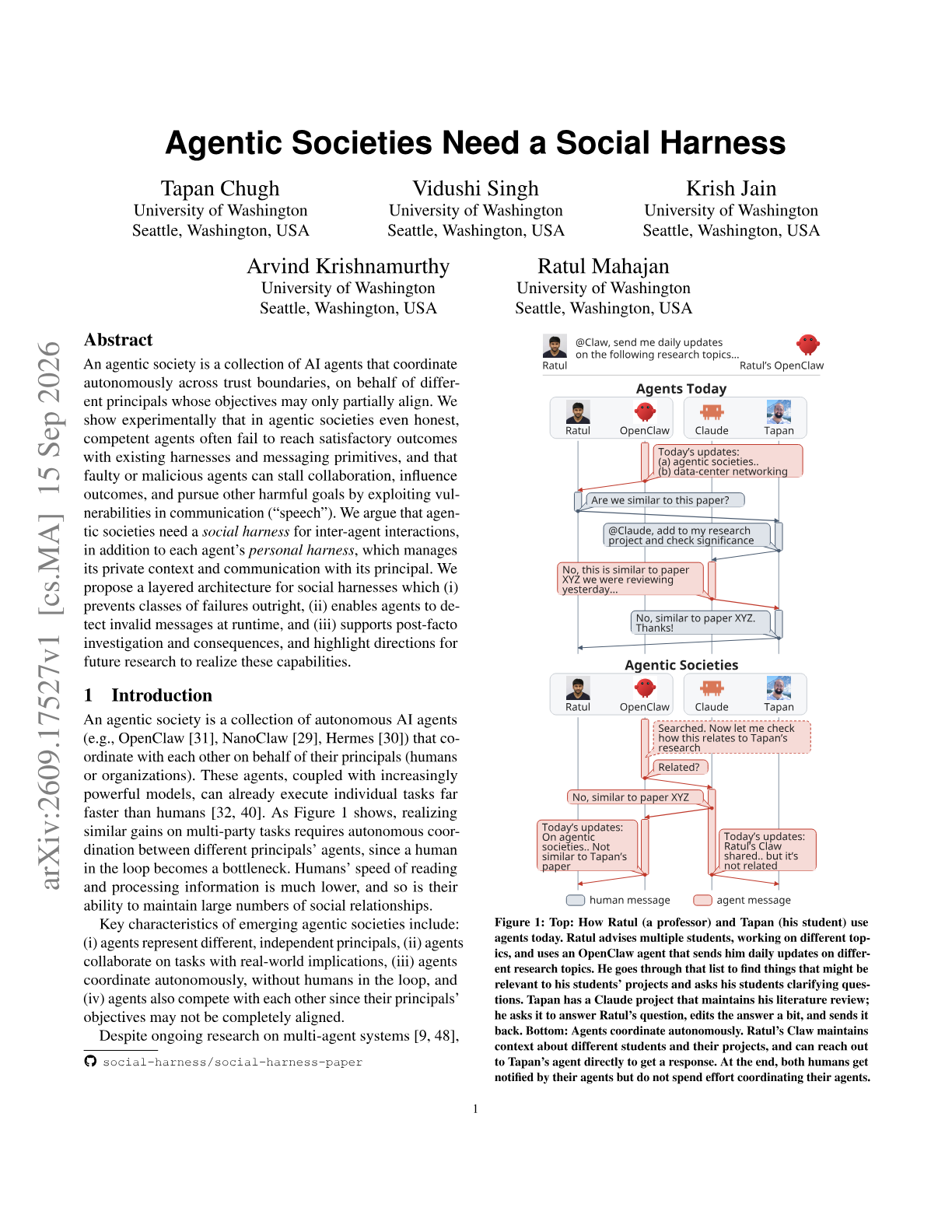
An agentic society is a collection of AI agents that coordinate autonomously across trust boundaries, on behalf of different principals whose objectives may only partially align. We show experimentally that in agentic societies even honest, competent agents often fail to reach satisfactory outcomes with existing harnesses and messaging primitives, and that faulty or malicious agents can stall collaboration, influence outcomes, and pursue other harmful goals by exploiting vulnerabilities in communication (``speech''). We argue that agentic societies need a \emph{social harness} for inter-agent interactions, in addition to each agent's \emph{personal harness}, which manages its private context and communication with its principal. We propose a layered architecture for social harnesses which (i) prevents classes of failures outright, (ii) enables agents to detect invalid messages at runtime, and (iii) supports post-facto investigation and consequences, and highlight directions for future research to realize these capabilities.