AgentRxiv
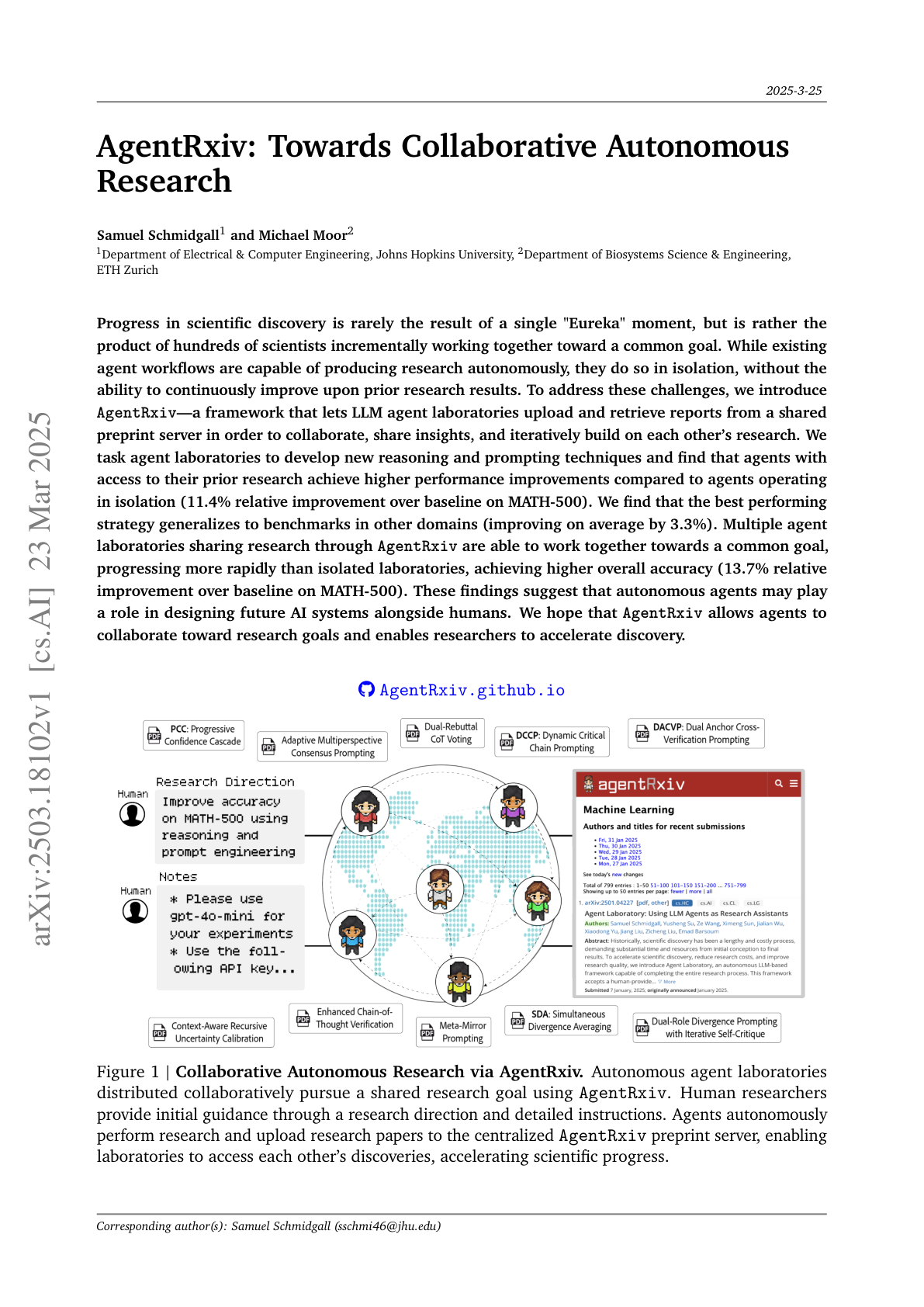
Researchers from Johns Hopkins & ETH Zurich present AgentRxiv, a framework enabling LLM agents to autonomously generate and share research papers, mimicking how human scientists build on each other’s work. Highlights: ● AgentRxiv = arXiv for LLMs – It’s an open-source preprint server for autonomous agents, letting labs upload papers, search past work, and iteratively improve results. Labs use this to develop and refine reasoning techniques over generations of research. ● Massive reasoning gains via iterative research – On the MATH-500 benchmark, a single agent lab improves GPT-4o mini accuracy from 70.2% → 78.2% (+11.4%) by discovering better prompt strategies. The final method (SDA) outperforms earlier ideas like CRUC and DCCP. → SDA = Simultaneous Divergence Averaging: combines low/high-temp CoT outputs with dynamic similarity-based voting and confidence aggregation. ● Knowledge generalizes – SDA also improves other benchmarks: ● Collaboration boosts discovery – Running 3 agent labs in parallel yields faster progress and higher final accuracy (up to 79.8%, +13.7% over baseline) by sharing results via AgentRxiv. Early gains (e.g., 76.2% accuracy) arrive after only 7 papers vs. 23 sequentially. ● Self-improvement and novelty – Agents independently refine their own past ideas. Papers evolve from earlier iterations (e.g., Meta-Mirror Prompting → Meta-Mirror Prompting 2). Top papers show no plagiarism via multiple detectors, but ideas like SDA build on trends like self-consistency and CoT voting. ● Cost & runtime – Generating a paper takes ~1.36 hours and ~$3.11. Parallel setups are pricier overall but achieve results faster (time-to-accuracy win). Failure modes include hallucinated results and fragile code repair steps, with future work needed for better reliability and novelty guarantees.