Qwen2.5-Omni
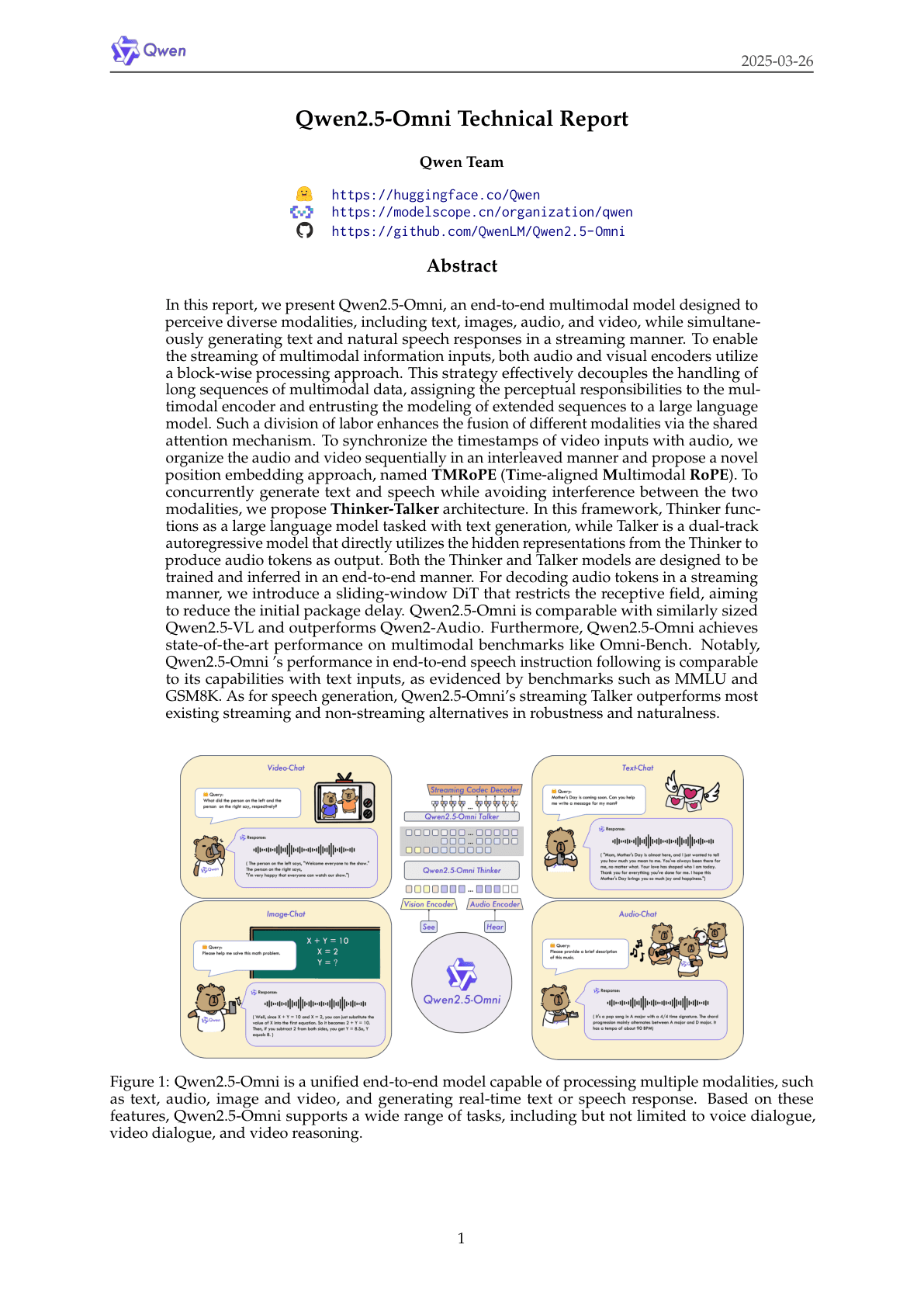
Qwen2.5-Omni is a single end-to-end multimodal model that can perceive and understand text, audio, image, and video, and generate both text and speech in real time. It introduces architectural and training innovations that push the boundaries of streaming, multi-signal intelligence. Highlights: ● Thinker-Talker architecture – Inspired by the human brain and mouth, Qwen2.5-Omni separates reasoning (Thinker) and speech generation (Talker). Thinker (a transformer decoder) handles all perception and text generation. Talker (a dual-track autoregressive decoder) generates speech by consuming both text and hidden states from Thinker. Together, they’re trained end-to-end for synchronized text-speech output. ● Streaming-first design – To support real-time interaction, Qwen2.5-Omni implements block-wise encoders (for audio and vision) and a sliding-window codec generator for streaming audio. The model introduces TMRoPE (Time-aligned Multimodal RoPE), a 3D positional encoding system that aligns video and audio inputs to the same time axis. ● Pretraining scale & alignment – Trained on over 1.2 trillion tokens of diverse multimodal data, including 300B audio and 100B video-audio tokens. Uses instruction-tuned ChatML formatting and performs multi-stage post-training for both Thinker and Talker. Talker undergoes RL fine-tuning (DPO) and multi-speaker adaptation to ensure natural, stable speech output. ● SOTA across modalities – Qwen2.5-Omni achieves state-of-the-art on OmniBench, surpasses Qwen2-Audio in ASR/S2TT, and matches or beats Qwen2.5-VL in image and video tasks. On SEED zero-shot TTS, it outperforms CosyVoice 2 and F5-TTS in naturalness and stability, with low WER and high speaker similarity. ● Closes the voice-text gap – On a voice-instruction benchmark (converted from MMLU, GSM8K, etc.), Qwen2.5-Omni nearly matches its own text-instructed sibling Qwen2-7B, showing dramatic improvements in speech-based instruction following.
Ask this paper
Abstract
In this report, we present Qwen2.5-Omni, an end-to-end multimodal model designed to perceive diverse modalities, including text, images, audio, and video, while simultane- ously generating text and natural speech responses in a streaming manner. To enable the streaming of multimodal information inputs, both audio and visual encoders utilize a block-wise processing approach. This strategy effectively decouples the handling of long sequences of multimodal data, assigning the perceptual responsibilities to the mul- timodal encoder and entrusting the modeling of extended sequences to a large language model. Such a division of labor enhances the fusion of different modalities via the shared attention mechanism. To synchronize the timestamps of video inputs with audio, we organize the audio and video sequentially in an interleaved manner and propose a novel position embedding approach, named TMRoPE (Time-aligned Multimodal RoPE). To concurrently generate text and speech while avoiding interference between the two modalities, we propose Thinker-Talker architecture. In this framework, Thinker func- tions as a large language model tasked with text generation, while Talker is a dual-track autoregressive model that directly utilizes the hidden representations from the Thinker to produce audio tokens as output. Both the Thinker and Talker models are designed to be trained and inferred in an end-to-end manner. For decoding audio tokens in a streaming manner, we introduce a sliding-window DiT that restricts the receptive field, aiming to reduce the initial package delay. Qwen2.5-Omni is comparable with similarly sized Qwen2.5-VL and outperforms Qwen2-Audio. Furthermore, Qwen2.5-Omni achieves state-of-the-art performance on multimodal benchmarks like Omni-Bench. Notably, Qwen2.5-Omni ’s performance in end-to-end speech instruction following is comparable to its capabilities with text inputs, as evidenced by benchmarks such as MMLU and GSM8K. As for speech generation, Qwen2.5-Omni’s streaming Talker outperforms most existing streaming and non-streaming alternatives in robustness and naturalness. Figure 1: Qwen2.5-Omni is a unified end-to-end model capable of processing multiple modalities, such as text, audio, image and video, and generating real-time text or speech response. Based on these features, Qwen2.5-Omni supports a wide range of tasks, including but not limited to voice dialogue, video dialogue, and video reasoning. 1