AI Agent Communication Protocols
This paper presents the first comprehensive survey on security in LLM-driven agent communication, categorizing it into three stages: user-agent interaction, agent-agent communication, and agent-environment communication. It details protocols, security threats (e.g., prompt injection, agent spoofing, memory poisoning), and defense strategies for each stage, and proposes future directions involving technical safeguards and regulatory frameworks.
Ask this paper
Abstract
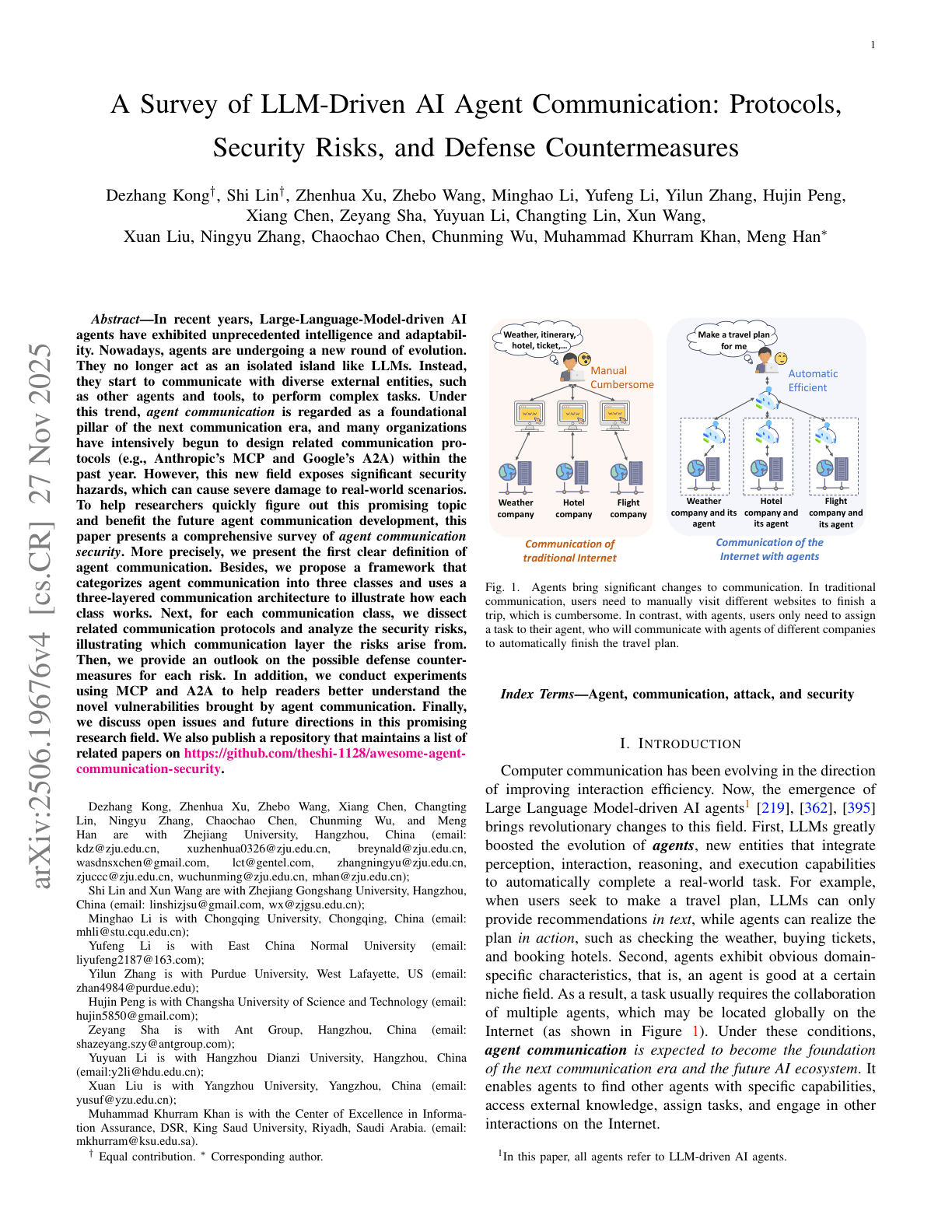
In recent years, Large-Language-Model-driven AI agents have exhibited unprecedented intelligence and adaptability. Nowadays, agents are undergoing a new round of evolution. They no longer act as an isolated island like LLMs. Instead, they start to communicate with diverse external entities, such as other agents and tools, to perform complex tasks. Under this trend, agent communication is regarded as a foundational pillar of the next communication era, and many organizations have intensively begun to design related communication protocols (e.g., Anthropic's MCP and Google's A2A) within the past year. However, this new field exposes significant security hazards, which can cause severe damage to real-world scenarios. To help researchers quickly figure out this promising topic and benefit the future agent communication development, this paper presents a comprehensive survey of agent communication security. More precisely, we present the first clear definition of agent communication. Besides, we propose a framework that categorizes agent communication into three classes and uses a three-layered communication architecture to illustrate how each class works. Next, for each communication class, we dissect related communication protocols and analyze the security risks, illustrating which communication layer the risks arise from. Then, we provide an outlook on the possible defense countermeasures for each risk. In addition, we conduct experiments using MCP and A2A to help readers better understand the novel vulnerabilities brought by agent communication. Finally, we discuss open issues and future directions in this promising research field. We also publish a repository that maintains a list of related papers on https://github.com/theshi-1128/awesome-agent-communication-security.