AI4Research
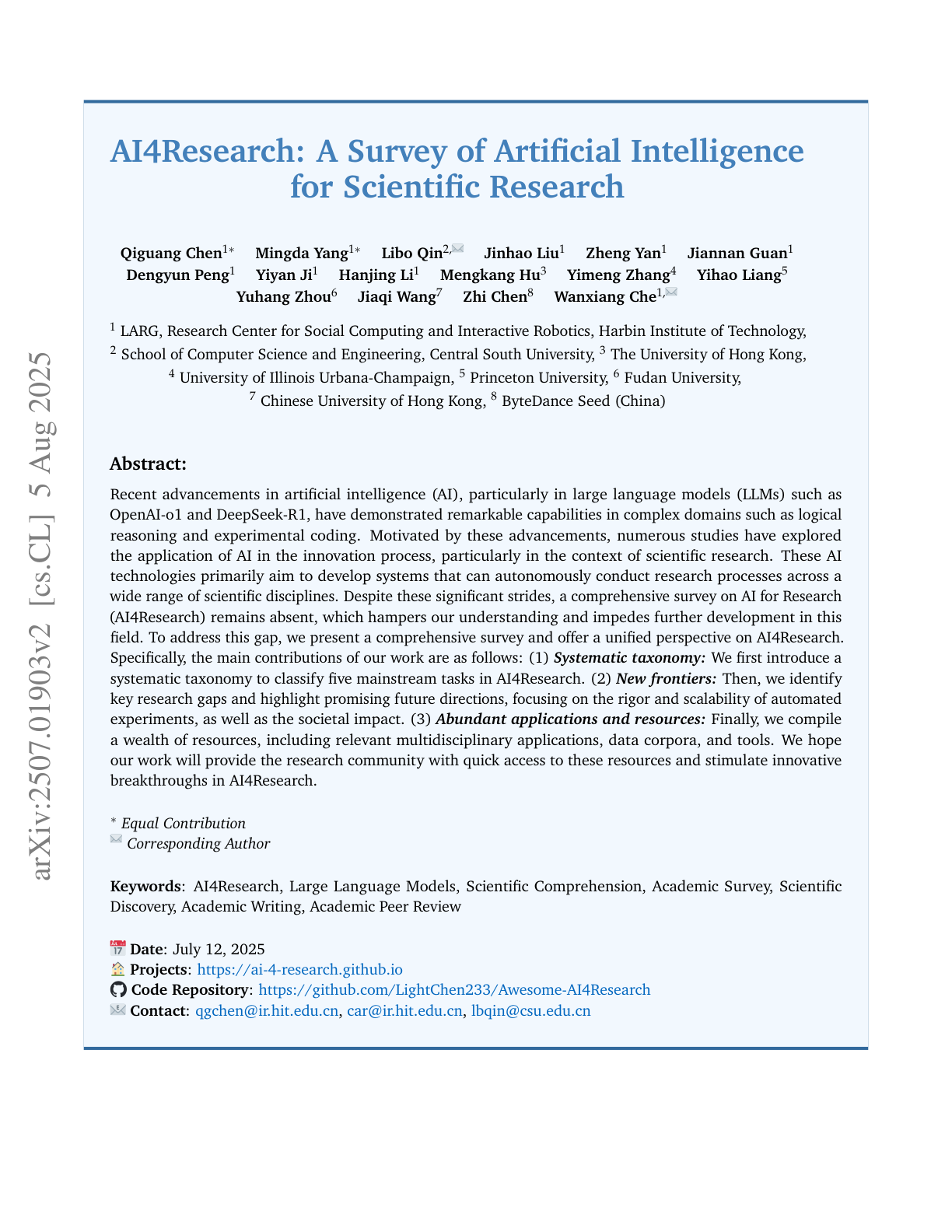
This survey offers the first unified and comprehensive framework for understanding how AI is transforming the full lifecycle of scientific research. The paper identifies five core areas: Scientific Comprehension, Academic Survey, Scientific Discovery, Academic Writing, and Academic Peer Review, and presents a detailed taxonomy and modeling approach for each.
Ask this paper
Systematic Taxonomy and Modeling: The paper introduces a modular functional composition model for AI4Research, where each task (e.g., ASC for comprehension, ASD for discovery) is modeled as a distinct function contributing to the overall research pipeline. These are mathematically formalized to optimize research efficiency, quality, and innovation.
Scientific Discovery Pipeline: The discovery section details a full-stack AI workflow, from idea mining (internal knowledge, external signals, and collaborative brainstorming) through theory formalization and experiment execution to full-automatic discovery. Models like AI Scientist, Carl, and Zochi simulate autonomous research loops and have generated publishable papers, highlighting a growing capability in self-directed research agents.
Multimodal and Multidisciplinary Integration: The survey thoroughly maps AI applications across natural sciences (e.g., AlphaFold 3 in protein folding, AI-Newton in physics), applied sciences (robotics, software engineering), and social sciences (AI-led ethnographic simulations, automated interview agents).
AI in Peer Review and Writing: Beyond comprehension and discovery, the paper explores tools for writing assistance (e.g., ScholarCopilot, SciCapenter) and peer review automation (e.g., AgentReview, TreeReview). Benchmarks like PeerRead and MASSW support this growing subfield, while models like GPT-4o have begun to rival human reviewers in structure and focus.
Emerging Frontiers: In its future directions, the paper emphasizes ethical and explainable AI, interdisciplinary models, multilingual access, and dynamic real-time experiment optimization. Notably, it calls for infrastructure-level innovation in federated learning, collaborative agents, and multimodal integration to fully realize AI4Research’s promise.