AlphaOne
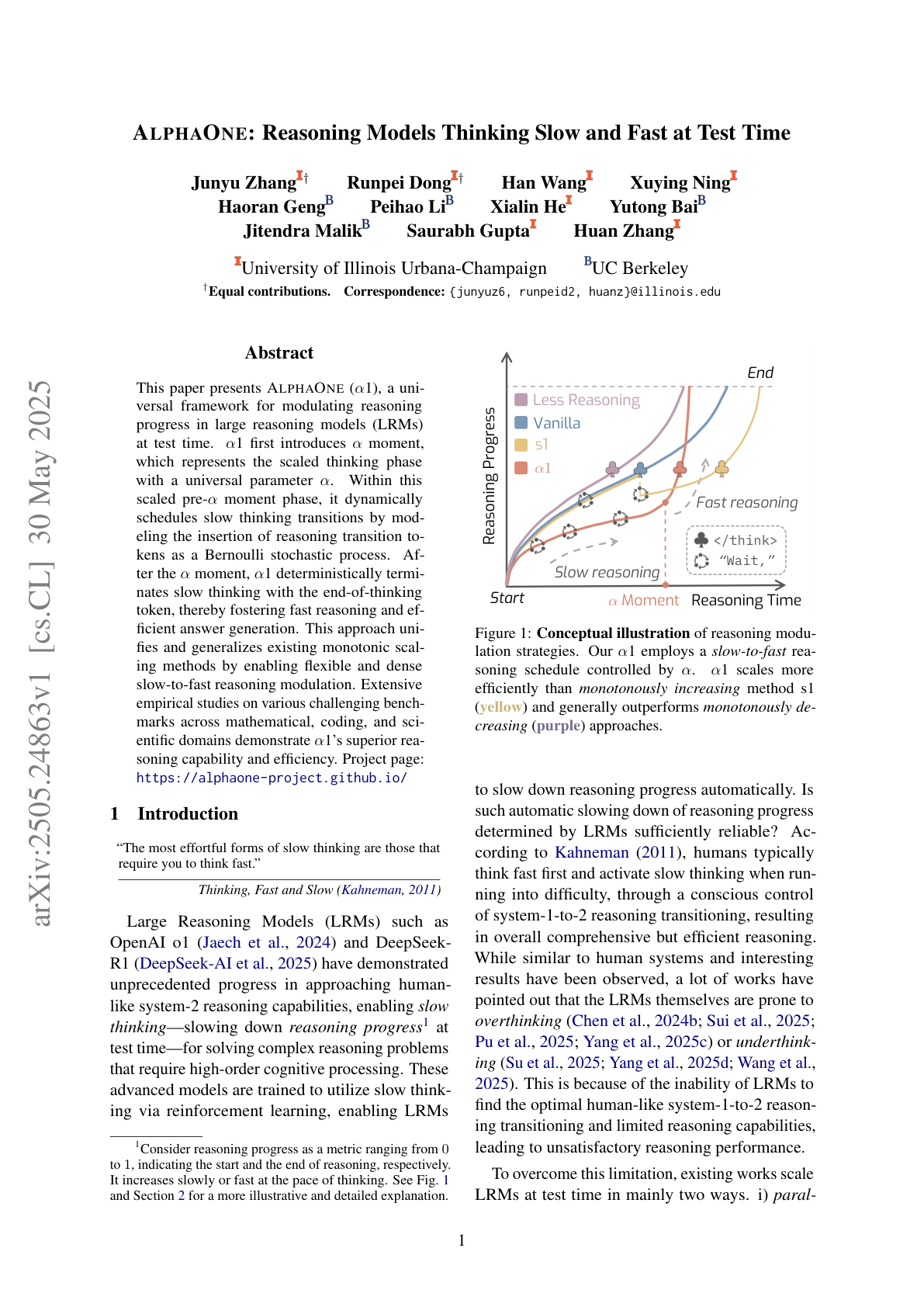
Introduces a universal framework, α1, for modulating the reasoning progress of large reasoning models (LRMs) during inference. Rather than relying on rigid or automatic schedules, α1 explicitly controls when and how models engage in “slow thinking” using a tunable parameter α. The method dynamically inserts “wait” tokens to encourage deeper reasoning and then deterministically ends slow thinking with a “</think>” token to prompt efficient answer generation. This yields better accuracy and efficiency than previous test-time scaling approaches. Key insights:
Ask this paper
Slow-then-fast reasoning outperforms other strategies: Contrary to human intuition (fast-then-slow), models benefit from beginning with slow reasoning before transitioning to faster inference. This “frontloaded effort” schedule leads to more accurate problem solving.
Dense modulation via α1 boosts accuracy and efficiency: By continuously adjusting reasoning pace via α-scheduled “wait” token insertions, α1 outperforms existing test-time strategies like s1 (monotonic increase) and CoD (monotonic decrease), achieving up to +6.15% accuracy gain while using up to 14% fewer tokens on some benchmarks.
Linear annealing is the most effective scheduling strategy: Among several tested functions for controlling “wait” insertion (constant, linear increase, exponential/linear anneal), linear anneal—gradually reducing “wait” token frequency, proved best across multiple models and datasets.
Post-α moment modulation is critical: Simply inserting “wait” tokens leads to inertia in slow thinking. α1 ensures efficient termination by replacing future “wait” tokens with “</think>”, effectively forcing a shift to fast reasoning and boosting performance by up to +20% in some tasks.