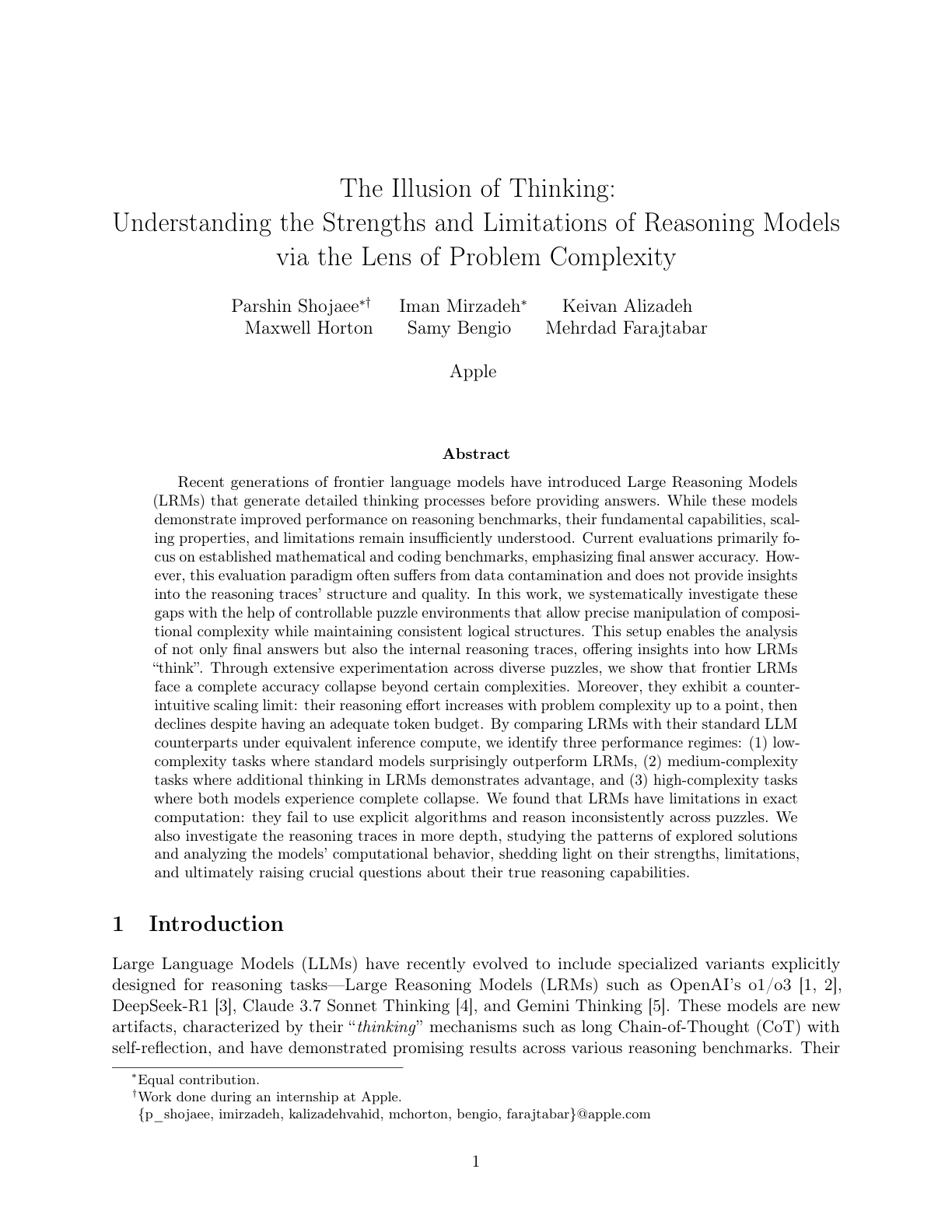
The Illusion of Thinking
Investigates the capabilities and limitations of frontier Large Reasoning Models (LRMs) like Claude 3.7, DeepSeek-R1, and OpenAI’s o-series by systematically analyzing their performance on reasoning tasks as a function of problem complexity. Rather than relying on conventional math benchmarks, which suffer from contamination and lack structure, the authors evaluate LRMs using four controllable puzzles (Tower of Hanoi, Checker Jumping, River Crossing, and Blocks World) that allow fine-grained complexity scaling and transparent trace analysis. Key findings:
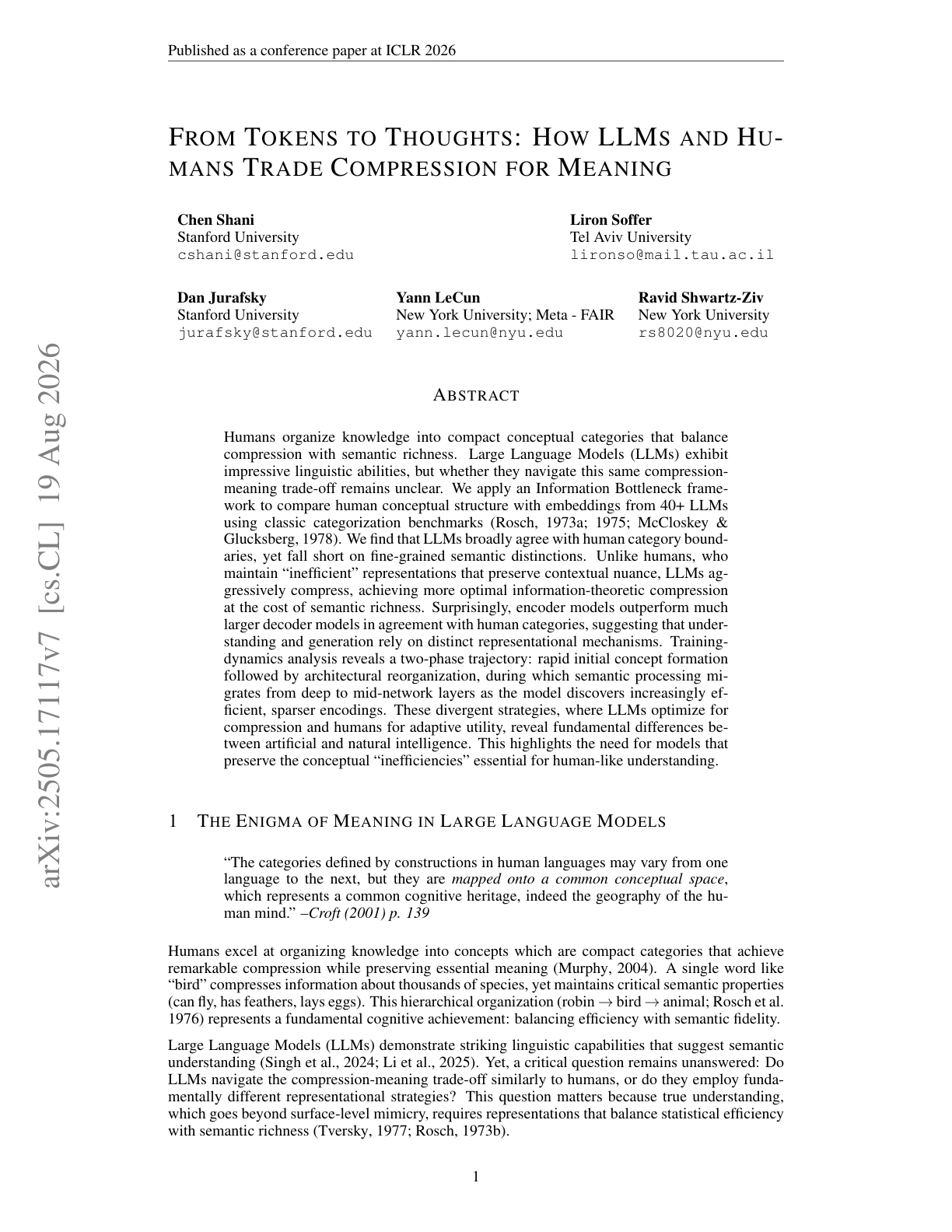
From Tokens to Thoughts
This paper introduces an information-theoretic framework to examine whether LLMs organize semantic knowledge like humans, balancing compression and meaning. Drawing from Rate-Distortion Theory and the Information Bottleneck principle, the authors evaluate token embeddings from 30+ LLMs against classic human categorization benchmarks from cognitive psychology.
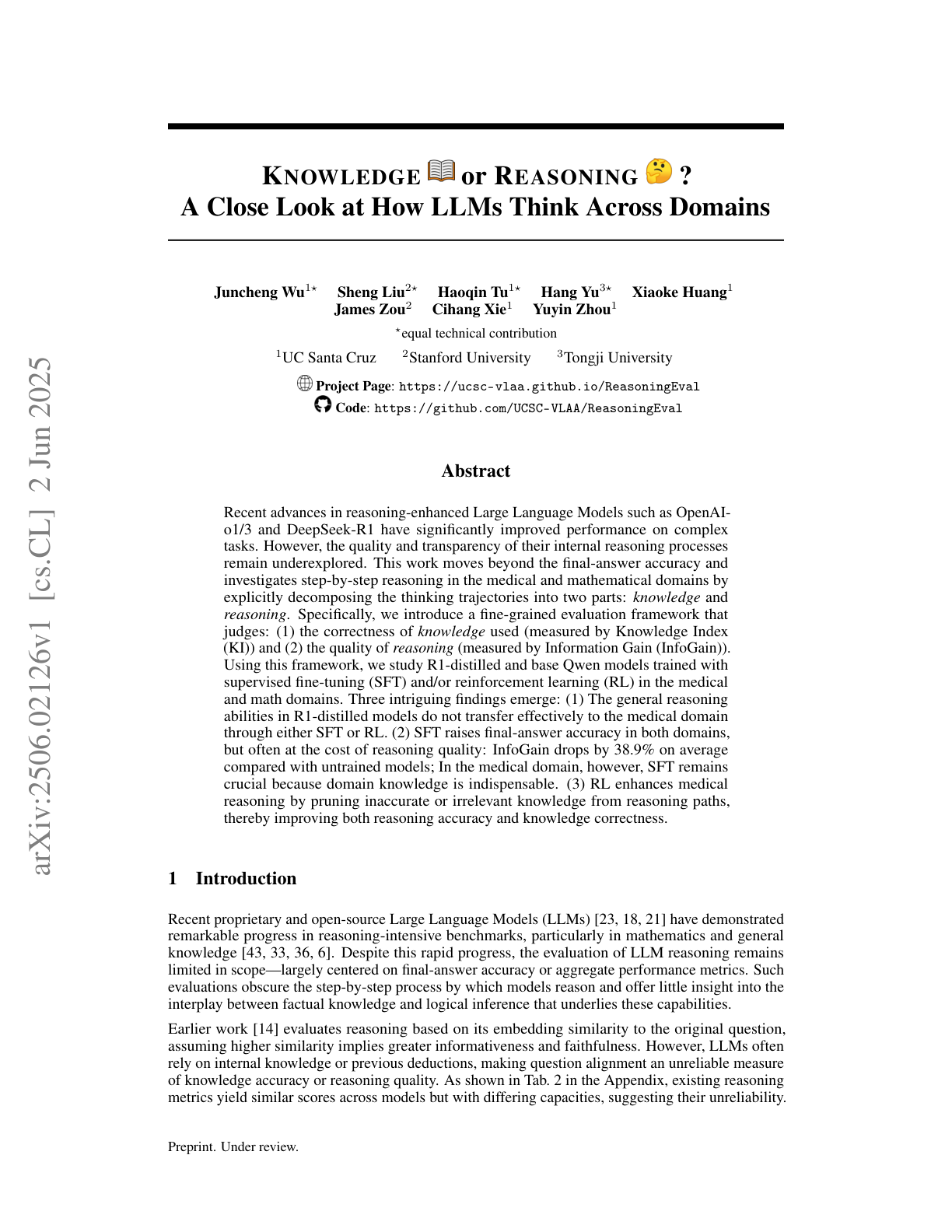
Knowledge or Reasoning
Introduces a fine-grained evaluation framework to dissect LLM thinking into two components: knowledge correctness and reasoning informativeness, measured via Knowledge Index (KI) and Information Gain (InfoGain), respectively. The authors apply this framework to evaluate how reasoning transfers across domains, particularly medical and mathematical, using Qwen2.5-7B and its DeepSeek-R1-distilled variant trained via SFT and RL. Key findings include:
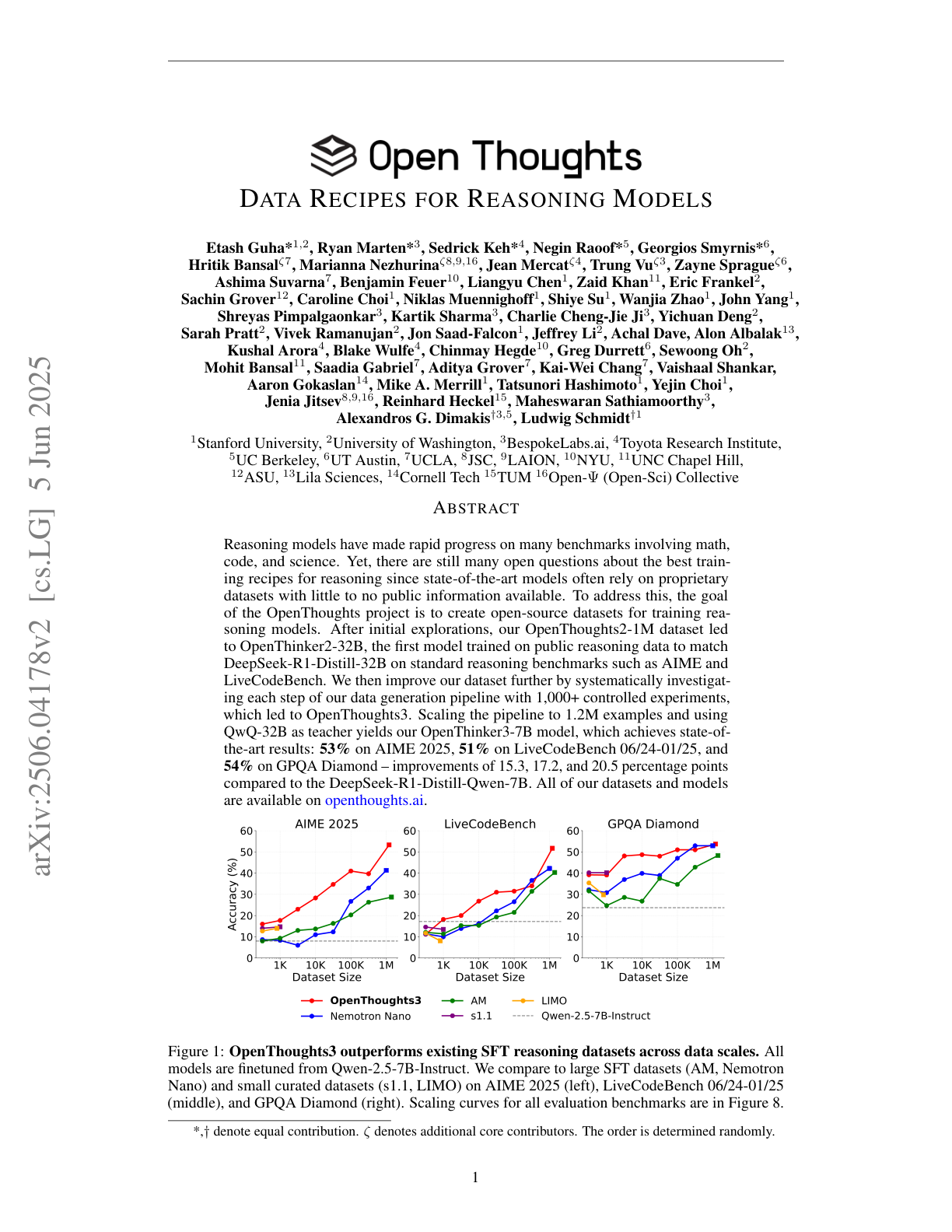
Open Thoughts
This paper presents OpenThoughts3, a systematic recipe for curating supervised fine-tuning (SFT) data that advances the performance of open-source reasoning models. The authors develop OpenThinker3-7B, a 7B parameter model trained on their new 1.2M example dataset (OpenThoughts3-1.2M) derived from over 1,000 controlled experiments. Despite using no reinforcement learning, OpenThinker3-7B outperforms all other open-data 7B and 8B models on standard math, code, and science reasoning benchmarks, even beating models trained with larger-scale or mixed SFT+RL pipelines. Key insights and contributions:
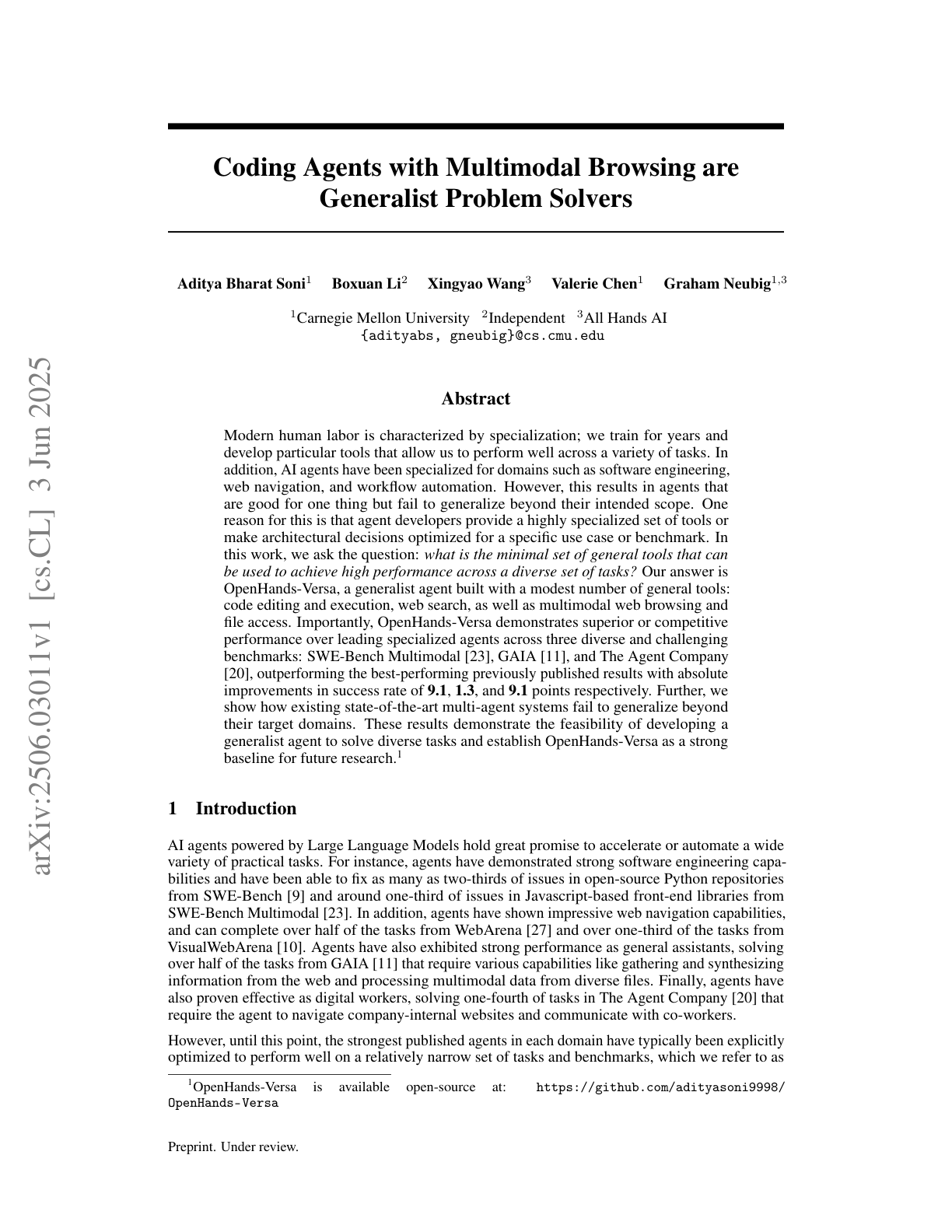
Coding Agents with Multimodal Browsing
Introduces OpenHands-Versa, a unified agent designed to perform strongly across diverse domains, coding, web browsing, and multimodal information access, by equipping a single agent with three general capabilities: code execution, multimodal web browsing, and file/search access. In contrast to specialist or multi-agent systems optimized for narrow domains, OpenHands-Versa aims to solve a wide variety of real-world tasks with minimal architectural complexity. Key highlights:
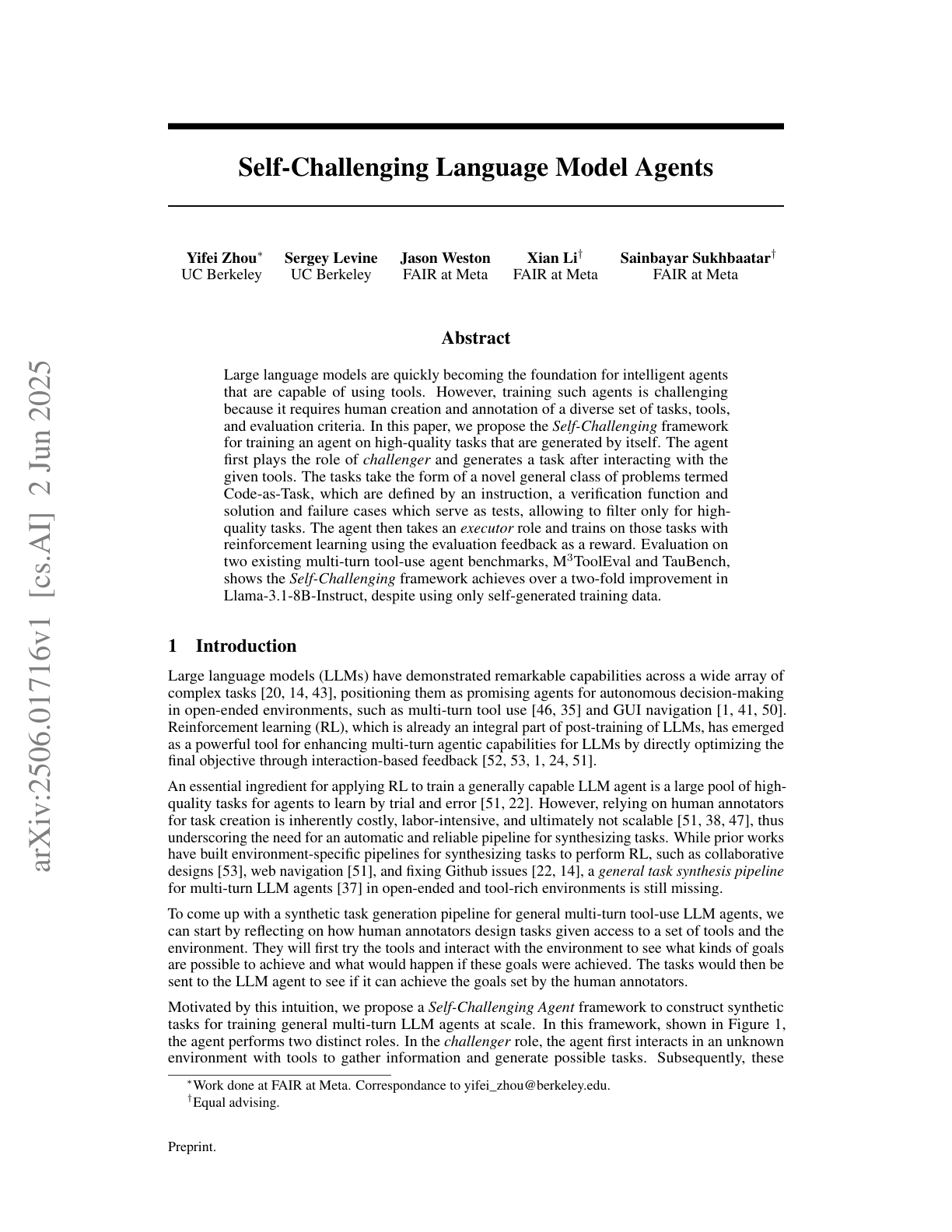
Self-Challenging Language Model Agents
Proposes a novel self-improvement method for multi-turn tool-use LLM agents, called the Self-Challenging Agent (SCA). It trains LLMs entirely from tasks they generate themselves, avoiding the need for human-annotated tasks or evaluations. The framework introduces a new task format called Code-as-Task (CaT), ensuring generated tasks are feasible, verifiable, and challenging. SCA is shown to double performance in a self-improvement setting and significantly boost performance in distillation. Key contributions and findings:
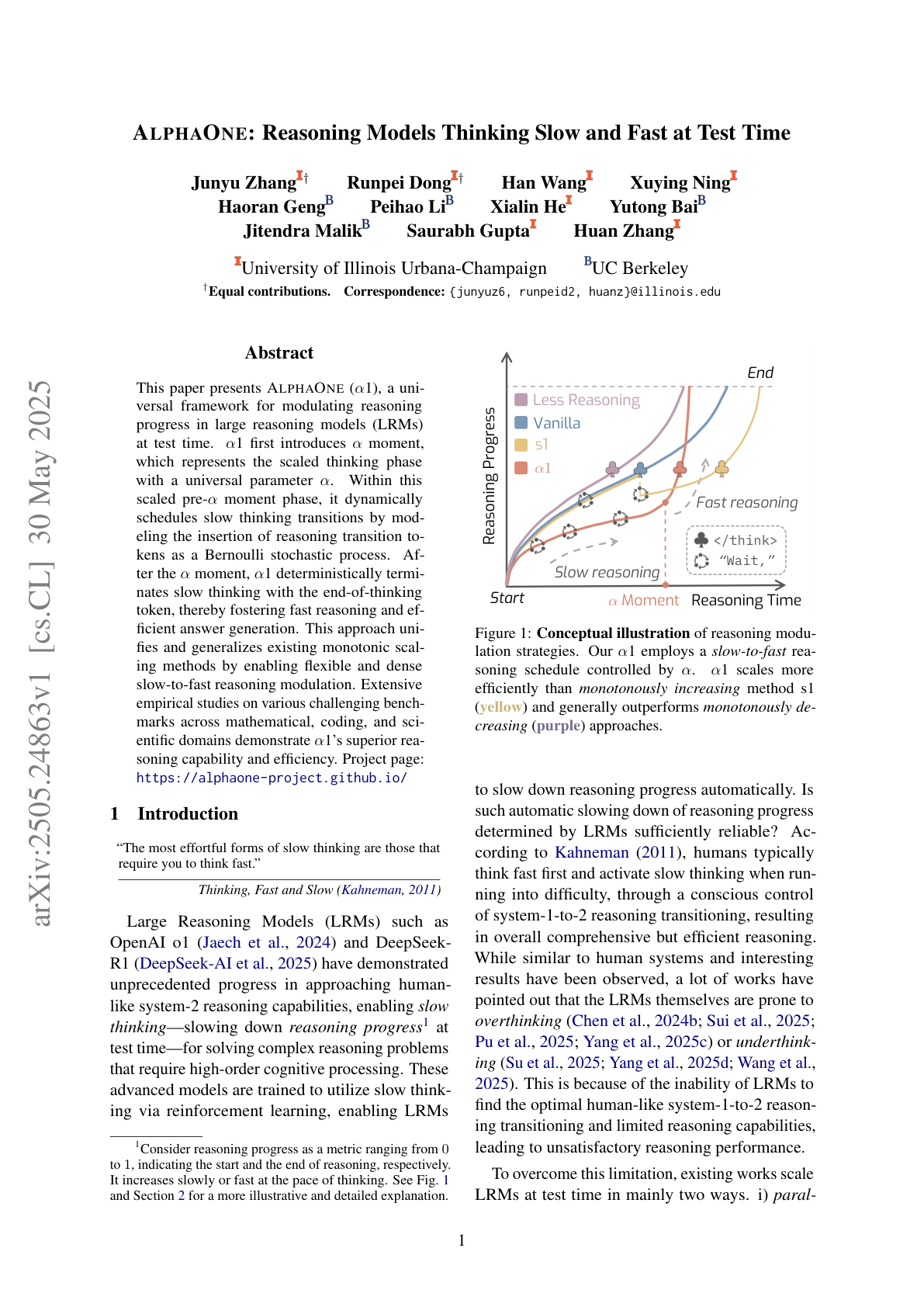
AlphaOne
Introduces a universal framework, α1, for modulating the reasoning progress of large reasoning models (LRMs) during inference. Rather than relying on rigid or automatic schedules, α1 explicitly controls when and how models engage in “slow thinking” using a tunable parameter α. The method dynamically inserts “wait” tokens to encourage deeper reasoning and then deterministically ends slow thinking with a “</think>” token to prompt efficient answer generation. This yields better accuracy and efficiency than previous test-time scaling approaches. Key insights:
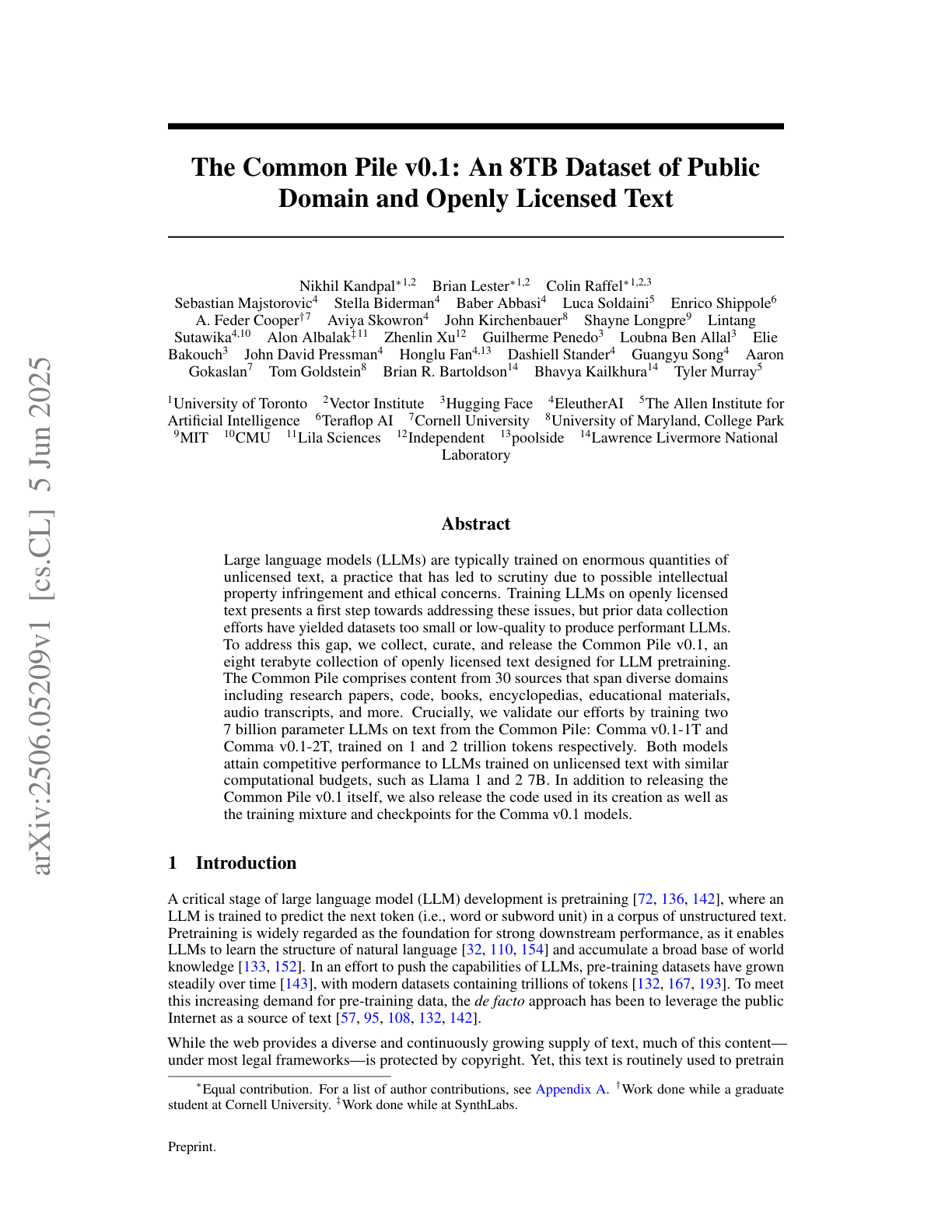
Common Pile v0.1
The Common Pile v0.1 is an 8TB dataset of openly licensed text designed for LLM pretraining, addressing legal and ethical concerns of unlicensed data use. Two 7B parameter models trained on it, Comma v0.1-1T and 2T, achieve performance comparable to LLaMA 1 and 2, and the dataset, code, and model checkpoints are all publicly released.
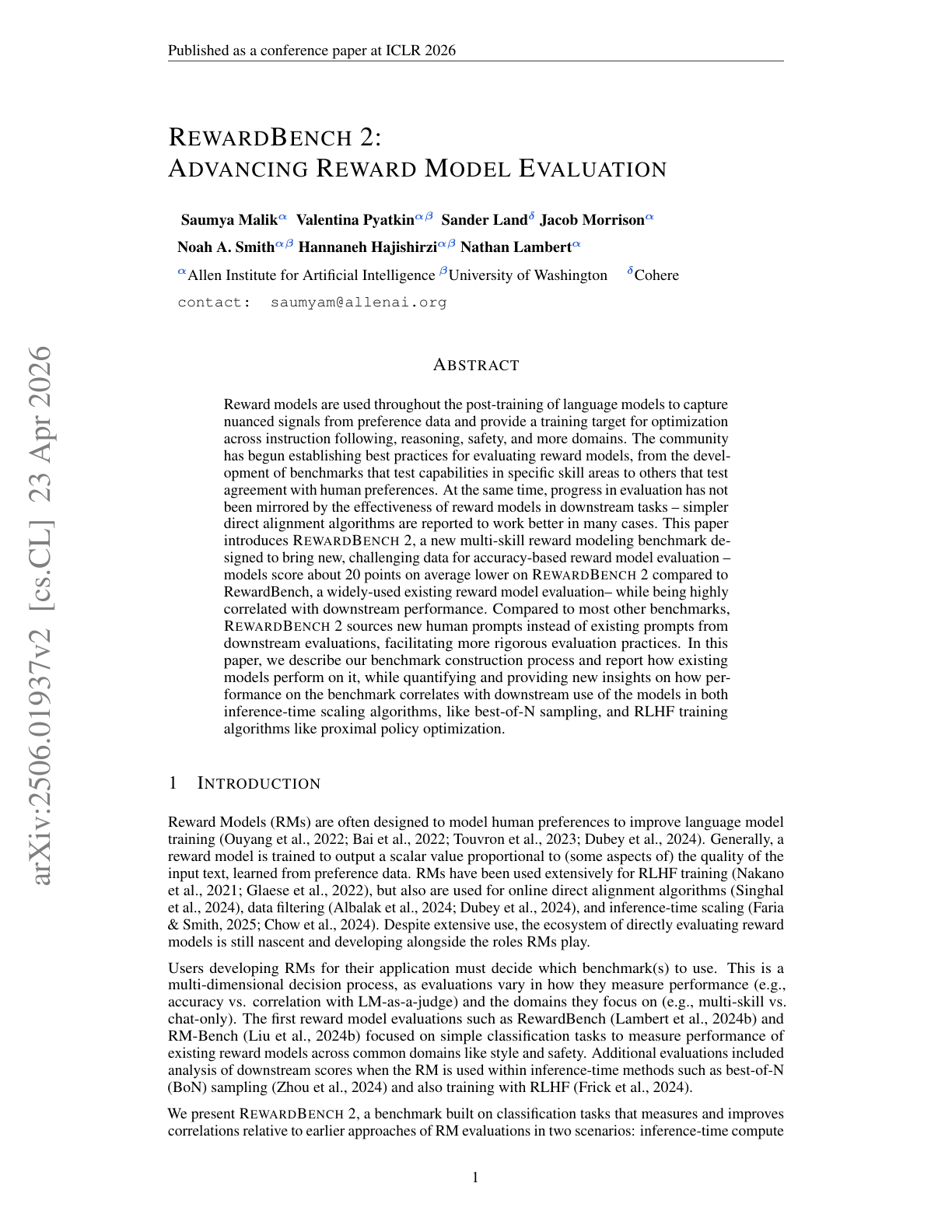
RewardBench 2
RewardBench 2 is a new multi-skill benchmark for evaluating reward models with more challenging human prompts and stronger correlation to downstream performance. It highlights gaps in the current reward model's effectiveness and aims to support more rigorous evaluation, showing existing models score ~20 points lower than their predecessor.
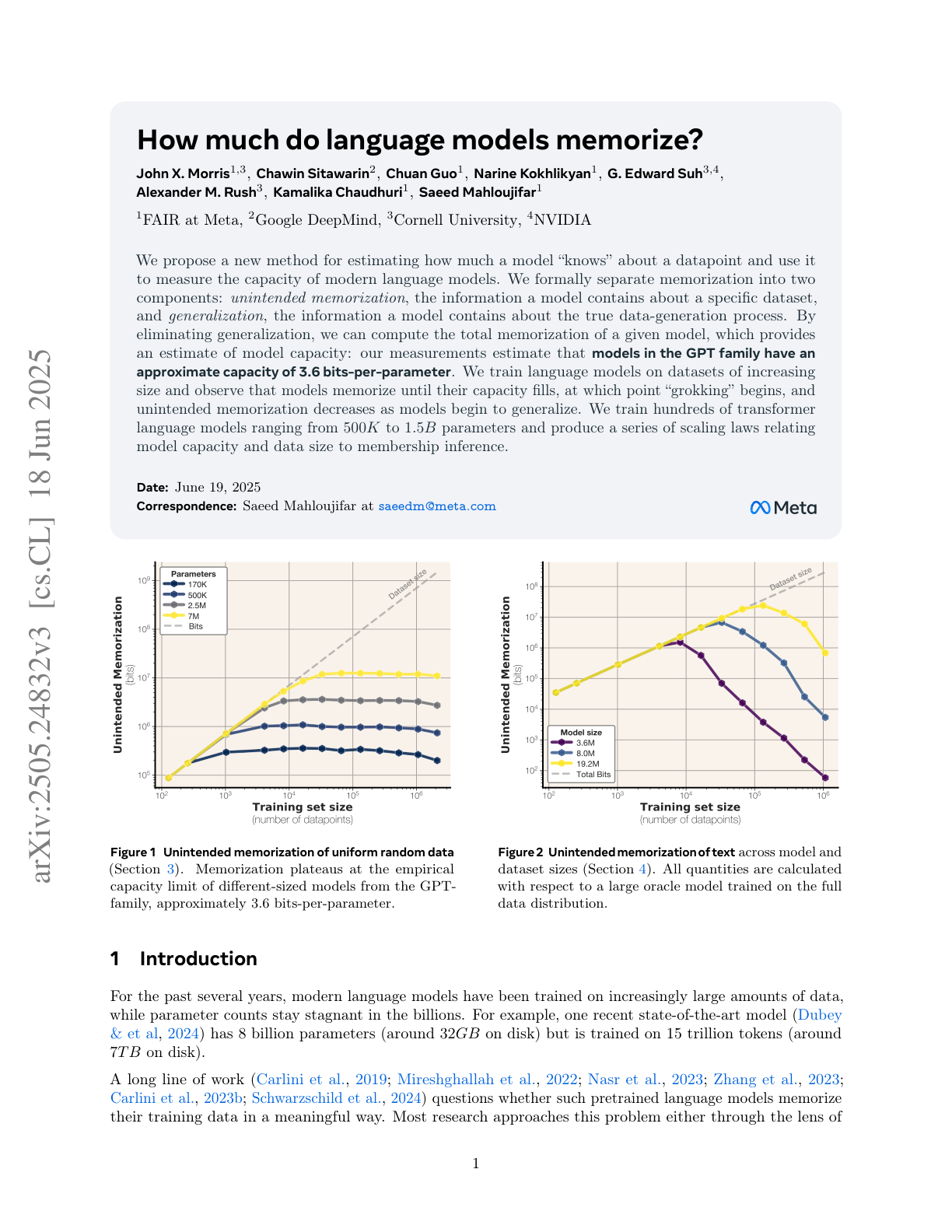
Memorization in LLMs
This study introduces a method to quantify how much a model memorizes versus generalizes, estimating GPT models have a capacity of ~3.6 bits per parameter. By training hundreds of models, the authors show that memorization saturates with data before generalization (“grokking”) kicks in, and derive new scaling laws linking capacity, data size, and membership inference.