AM-Thinking-v1
Introduces a dense, open-source 32B language model that achieves state-of-the-art performance in reasoning tasks, rivaling significantly larger Mixture-of-Experts (MoE) models. Built upon Qwen2.5-32B, the model is trained entirely with public data and showcases how a meticulously crafted post-training pipeline can unlock competitive performance at mid-scale sizes. Key points:
Ask this paper
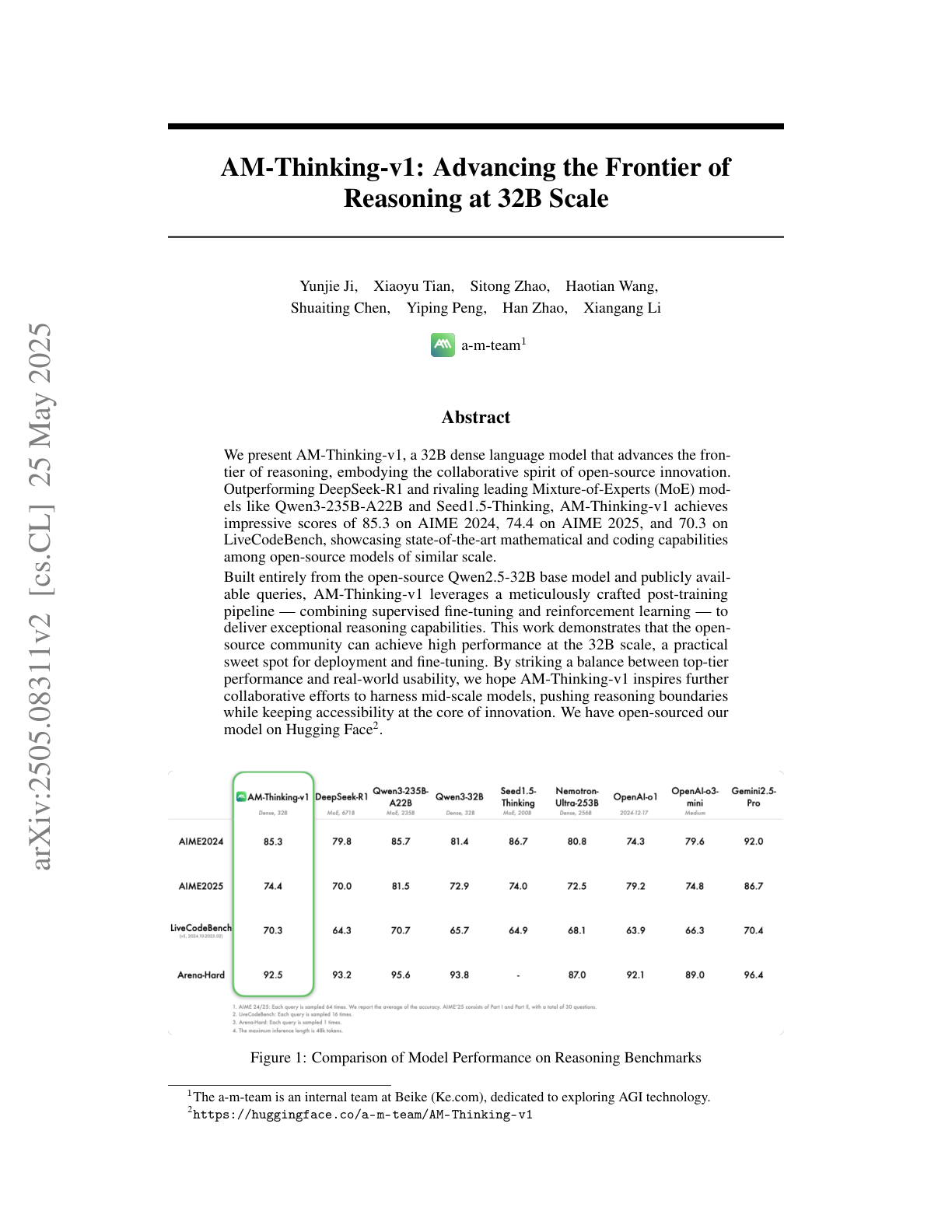
Benchmark performance: AM-Thinking-v1 scores 85.3 on AIME 2024, 74.4 on AIME 2025, and 70.3 on LiveCodeBench, outperforming DeepSeek-R1 (671B MoE) and matching or exceeding Qwen3-32B and Seed1.5-Thinking. On Arena-Hard (general chat), it hits 92.5, near the level of OpenAI o1 and o3-mini but behind Qwen3-235B-A22B and Gemini 2.5 Pro.
Training pipeline: The model uses a two-stage post-training approach combining Supervised Fine-Tuning (SFT) and Reinforcement Learning (RL). SFT emphasizes a “think-then-answer” format and uses 2.84M samples, while RL incorporates difficulty-aware sampling and a two-stage curriculum optimized via Group Relative Policy Optimization (GRPO).
Data and filtering: All training data is publicly sourced and heavily filtered. Math data goes through LLM-assisted cleaning and cross-model ground-truth validation. Responses are filtered using perplexity, n-gram repetition, and structural checks to ensure coherence and correctness.
Inference and deployment: The authors implement a custom rollout framework atop, decoupling rollout from inference via a streaming load balancer. This reduces long-tail latency and increases throughput across distributed GPU nodes, enabling scalable RL training at 32k sequence length.