LLMs Get Lost in Multi-Turn Conversation
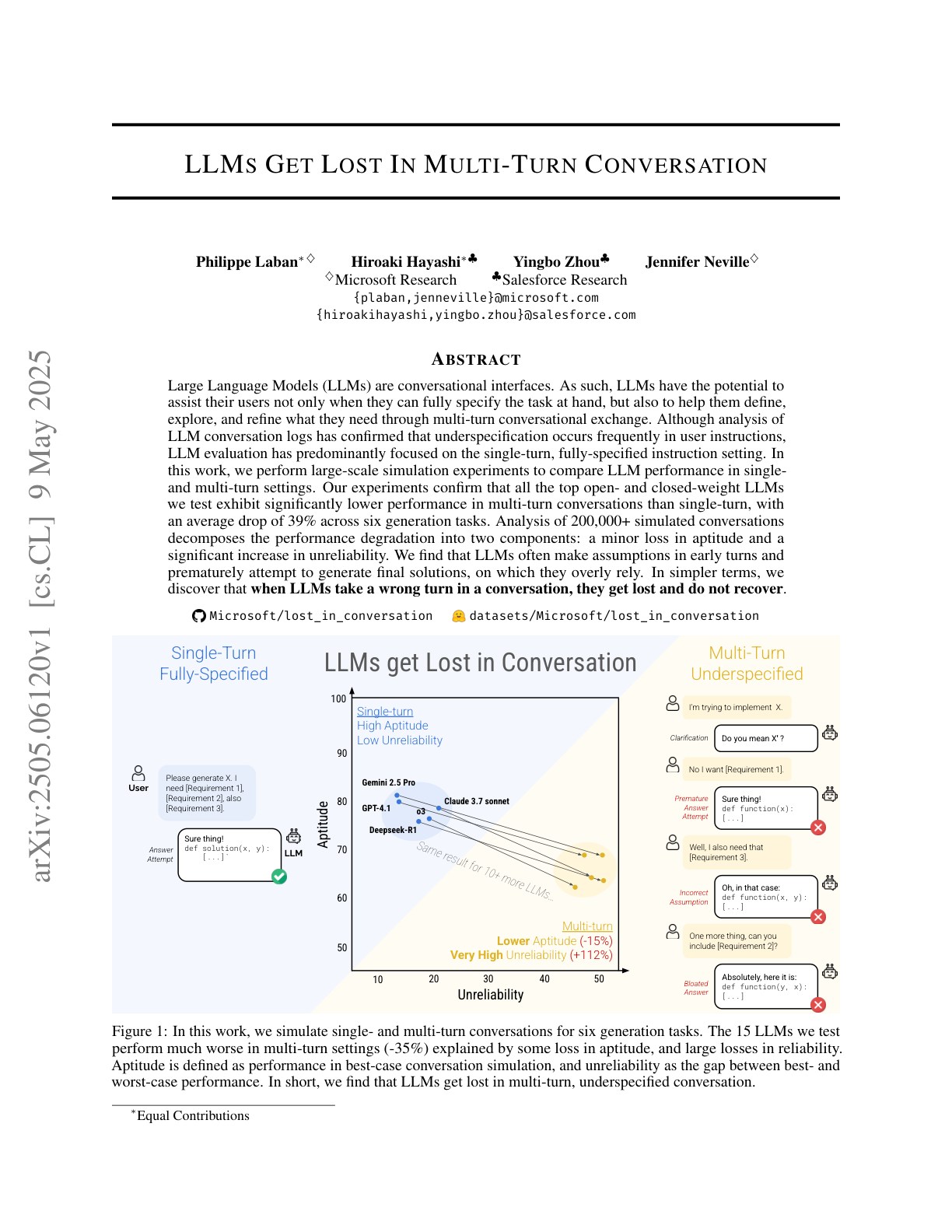
Investigates how top LLMs degrade in performance during underspecified, multi-turn interactions, common in real-world usage but rarely evaluated. The authors introduce a novel "sharded simulation" framework that breaks down fully-specified instructions into gradual conversation shards, simulating how users naturally provide information over time. Key findings:
Ask this paper
Massive performance drop: Across 15 top LLMs (e.g., GPT-4.1, Gemini 2.5 Pro, Claude 3.7), average performance dropped 39% in multi-turn vs. single-turn settings. Even a two-turn interaction was enough to cause a significant decline.
High unreliability, not just low aptitude: Decomposition shows only a small drop in best-case capability (aptitude) but a 112% increase in unreliability, meaning models are wildly inconsistent depending on how the conversation unfolds.
Root causes of failure: Through log analysis and experiments, the paper identifies four major issues:
Sharded evaluation tasks: The authors built 600+ multi-turn simulations across 6 tasks (coding, math, SQL, API calls, summarization, and table captioning), showing consistent degradation across domains.
Agent-style interventions only partially help: Techniques like recap and snowballing (repeating all prior turns) improved outcomes by ~15–20% but did not restore single-turn levels, suggesting that model internals, not prompting strategies, are the bottleneck.
Temperature and test-time compute don't solve the issue: Even at temperature 0.0 or with reasoning models (like o3 and DeepSeek-R1), models remained highly unreliable in multi-turn settings.