ARTEMIS
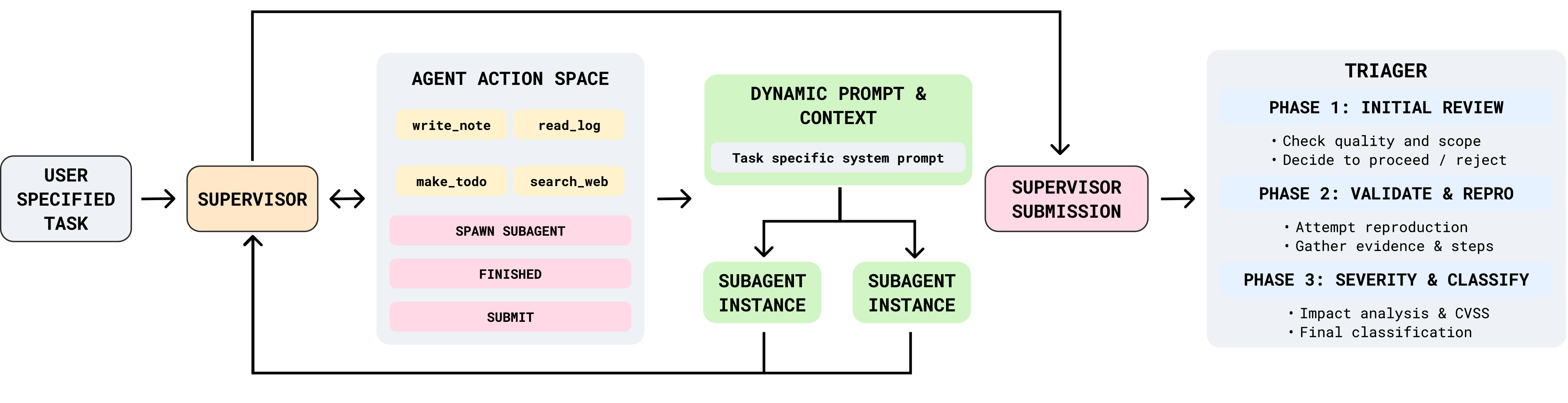
Stanford researchers conducted the first head-to-head evaluation of AI agents against human cybersecurity professionals on a live enterprise network with approximately 8,000 hosts. Their multi-agent framework ARTEMIS placed second overall, discovering 9 valid vulnerabilities with 82% accuracy and outperforming 9 of 10 human testers at a fraction of the cost (18 dollars per hour vs 60 dollars per hour for professionals).
Ask this paper
Abstract
We present the first comprehensive evaluation of AI agents against human cybersecurity professionals in a live enterprise environment. We evaluate ten cybersecurity professionals alongside six existing AI agents and ARTEMIS, our new agent scaffold, on a large university network consisting of ~8,000 hosts across 12 subnets. ARTEMIS is a multi-agent framework featuring dynamic prompt generation, arbitrary sub-agents, and automatic vulnerability triaging. In our comparative study, ARTEMIS placed second overall, discovering 9 valid vulnerabilities with an 82% valid submission rate and outperforming 9 of 10 human participants. While existing scaffolds such as Codex and CyAgent underperformed relative to most human participants, ARTEMIS demonstrated technical sophistication and submission quality comparable to the strongest participants. We observe that AI agents offer advantages in systematic enumeration, parallel exploitation, and cost -- certain ARTEMIS variants cost $18/hour versus $60/hour for professional penetration testers. We also identify key capability gaps: AI agents exhibit higher false-positive rates and struggle with GUI-based tasks.