AutoTTS
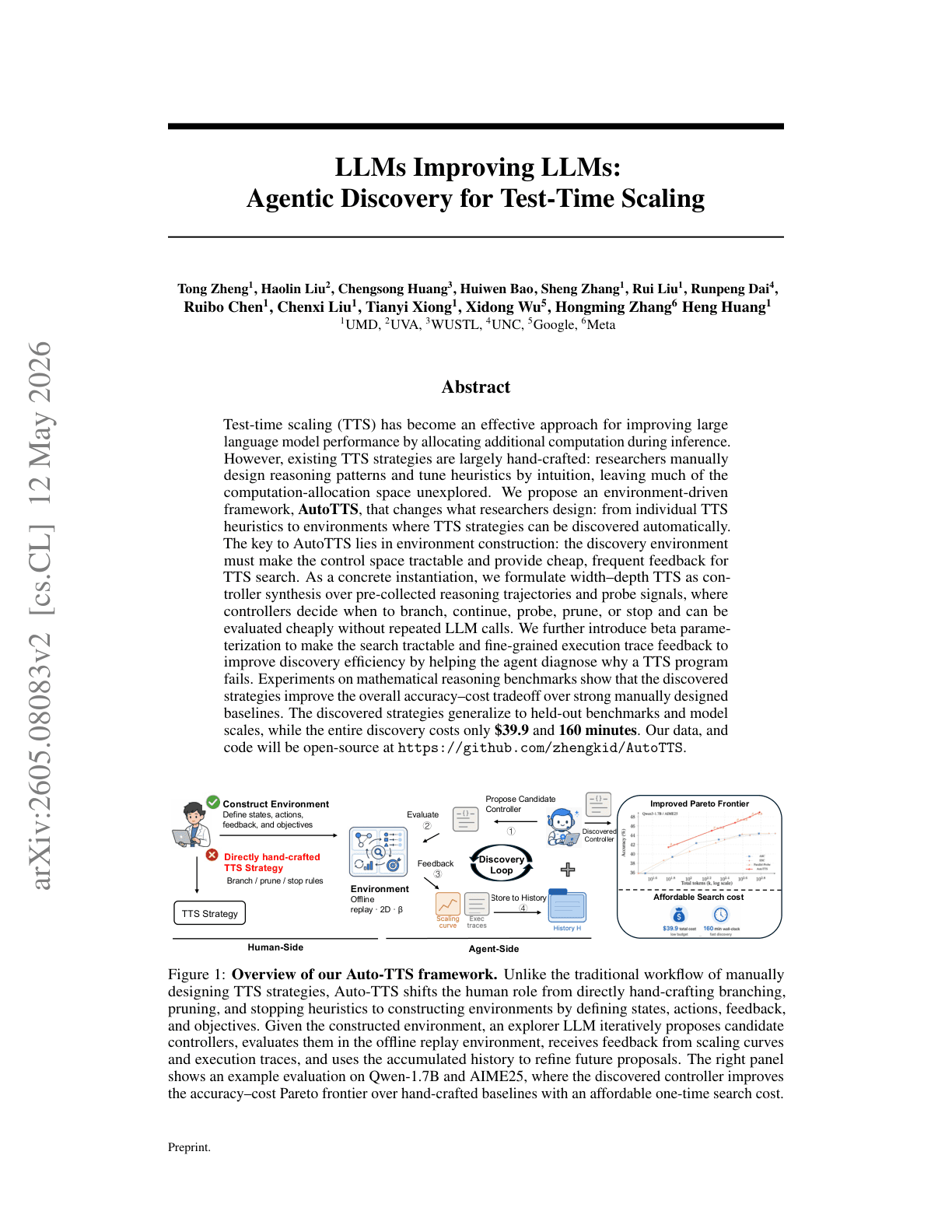
AutoTTS reframes test-time scaling as a search problem. Instead of designing branching, pruning, and stopping heuristics directly, the user constructs a discovery environment in which TTS strategies are searched automatically. Width-depth TTS is recast as controller synthesis over pre-collected reasoning trajectories and probe signals, so candidate controllers can be evaluated without repeated LLM calls.
Ask this paper
Discovery environment plus offline evaluator: The human specifies states, actions, and feedback. An explorer LLM iteratively proposes candidate controllers. Controllers are evaluated against pre-collected trajectories rather than by re-sampling the base model.
Beta parameterization and trace-level feedback: Beta parameterization makes the controller space tractable for search. Execution-trace feedback gives the explorer information about why a candidate failed, not only that it did.
Results on math reasoning benchmarks: Discovered controllers outperform hand-designed TTS recipes on the accuracy-cost Pareto frontier and transfer zero-shot to held-out benchmarks and model scales. Total discovery cost: $39.9 and 160 minutes.
Why it matters: Automated search over TTS strategies is competitive with hand-tuned heuristics at low cost, which shifts where the research effort needs to go.
Abstract
Test-time scaling (TTS) has become an effective approach for improving large language model performance by allocating additional computation during inference. However, existing TTS strategies are largely hand-crafted: researchers manually design reasoning patterns and tune heuristics by intuition, leaving much of the computation-allocation space unexplored. We propose an environment-driven framework, AutoTTS, that changes what researchers design: from individual TTS heuristics to environments where TTS strategies can be discovered automatically. The key to AutoTTS lies in environment construction: the discovery environment must make the control space tractable and provide cheap, frequent feedback for TTS search. As a concrete instantiation, we formulate width--depth TTS as controller synthesis over pre-collected reasoning trajectories and probe signals, where controllers decide when to branch, continue, probe, prune, or stop and can be evaluated cheaply without repeated LLM calls. We further introduce beta parameterization to make the search tractable and fine-grained execution trace feedback to improve discovery efficiency by helping the agent diagnose why a TTS program fails. Experiments on mathematical reasoning benchmarks show that the discovered strategies improve the overall accuracy--cost tradeoff over strong manually designed baselines. The discovered strategies generalize to held-out benchmarks and model scales, while the entire discovery costs only $39.9 and 160 minutes. Our data, and code will be open-source at https://github.com/zhengkid/AutoTTS.