Lighthouse Attention
Nous Research proposes a training-only attention wrapper for long-context pretraining. Lighthouse Attention wraps standard SDPA with a hierarchical, gradient-free selection layer that compresses and decompresses queries, keys, and values symmetrically while preserving left-to-right causality. The wrapper is removed near the end of training in a short recovery phase, so the deployed model runs vanilla attention with no architectural change at inference. Preliminary LLM experiments report faster total training time and lower final loss than full-attention baselines.
Is Grep All You Need?
The paper evaluates grep-style text search against embedding-based retrieval inside coding agents. When wrapped in a suitable agent harness, grep matches or exceeds embedding retrieval on coding-agent tasks. The study isolates the contribution of the harness from the contribution of the retrieval primitive, and finds that harness design accounts for most of the performance differential typically attributed to embeddings.
A Geometric Calculator Inside a Neural Network
Goodfire reports mechanistic interpretability work identifying a geometric calculator inside an LLM. The model represents numbers as Fourier features, where circles in activation space correspond to numbers modulo a given base. Arithmetic operations are implemented as rotations of these circles, forming a variant of a residue number system that does not require coprime moduli. The same circuit appears to be reused beyond arithmetic.
δ-mem
δ-mem augments a frozen full-attention model with a compact online associative-memory state. The state is a fixed-size matrix updated by delta-rule learning during generation, and its readout produces low-rank corrections to the backbone's attention output. There is no fine-tuning, no backbone swap, and no context extension.
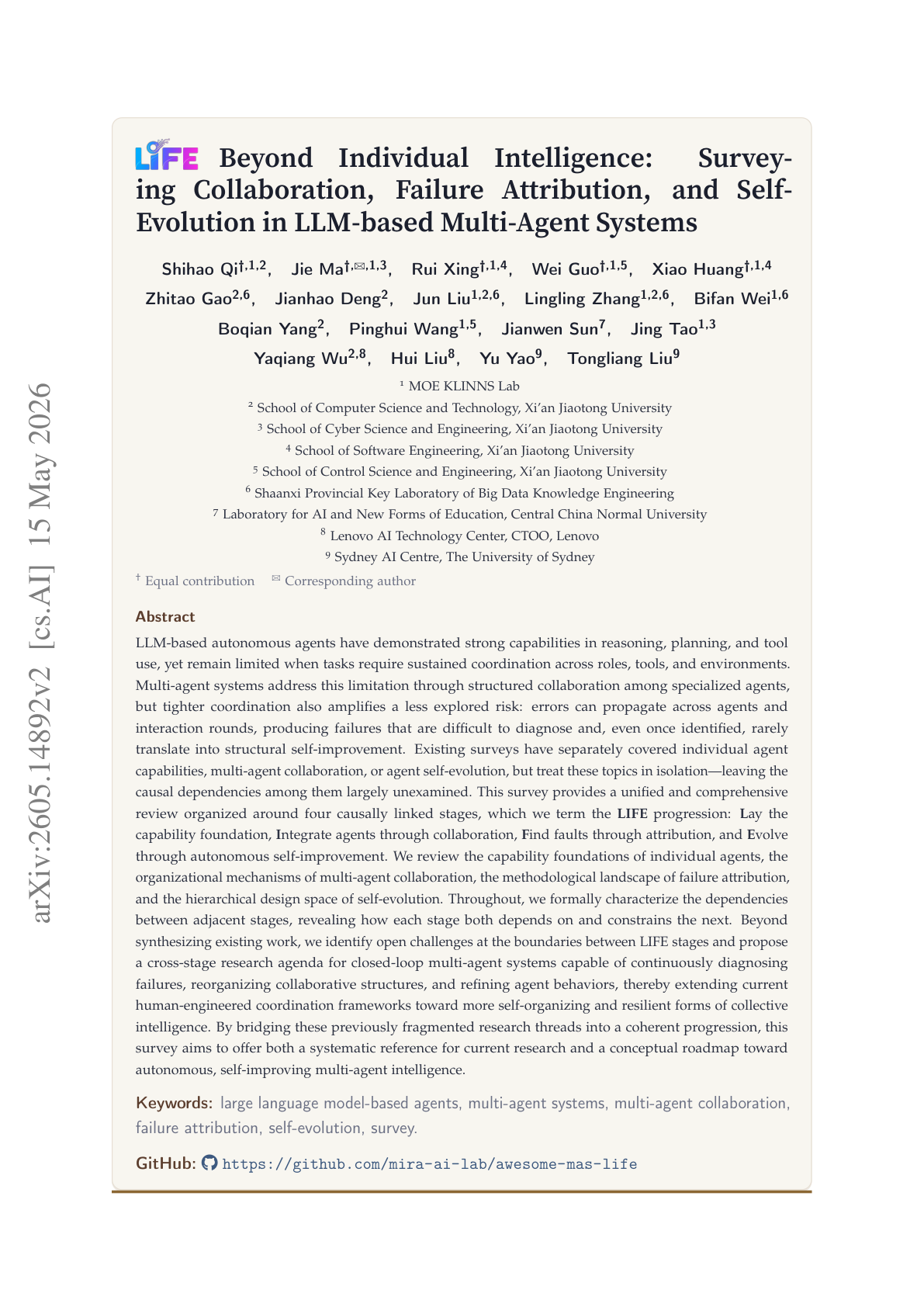
Beyond Individual Intelligence
A multi-agent systems survey covering 200+ papers, organized along three axes: collaboration mechanisms, failure attribution, and self-evolution. Each axis is treated as a distinct research line. The self-evolution chapter maps how memory, meta-learning, and procedure-editing approaches intersect.
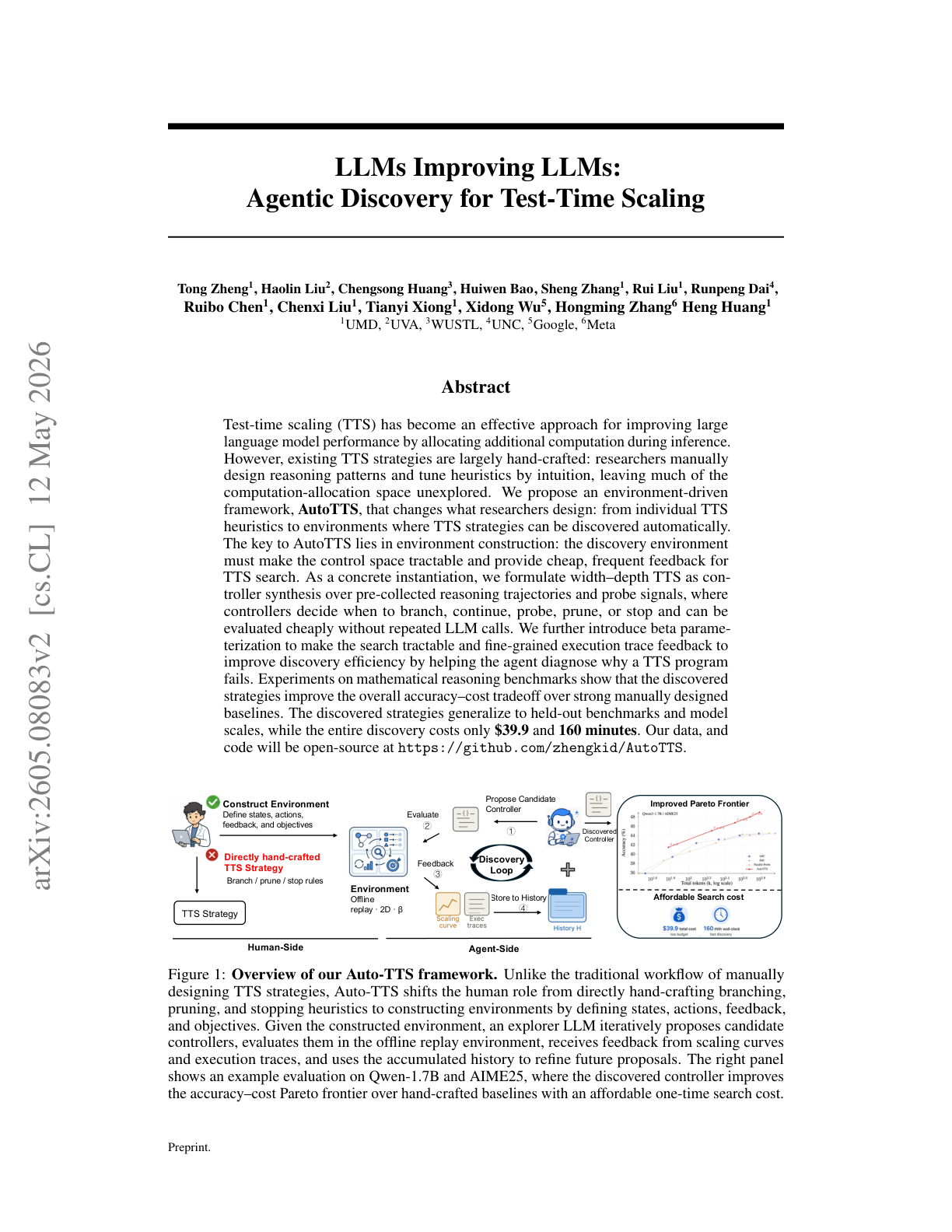
AutoTTS
AutoTTS reframes test-time scaling as a search problem. Instead of designing branching, pruning, and stopping heuristics directly, the user constructs a discovery environment in which TTS strategies are searched automatically. Width-depth TTS is recast as controller synthesis over pre-collected reasoning trajectories and probe signals, so candidate controllers can be evaluated without repeated LLM calls.
AI Co-Mathematician
Google DeepMind presents AI Co-Mathematician, an agentic research workbench for mathematicians. The system is an asynchronous, stateful environment that supports ideation, literature discovery, computational analysis, theorem verification, and knowledge development across long sessions. It reaches 48% on FrontierMath Tier 4, a new high among AI systems evaluated.
AEvo
AEvo separates the iterative self-improvement loop into two roles: a candidate-proposer that generates the next attempt, and a meta-agent that observes traces and edits the procedure used to propose future candidates. Past runs (candidates, feedback, traces, failures) function as memory the meta-agent reads from when revising the procedure. AEvo reports a 26% relative gain over the strongest evolution baseline on agentic and reasoning benchmarks, and SOTA on three open-ended optimization tasks under the same iteration budget. The work demonstrates one way to operationalize accumulated agentic search logs as input to procedure-level updates rather than discarding them after each run.
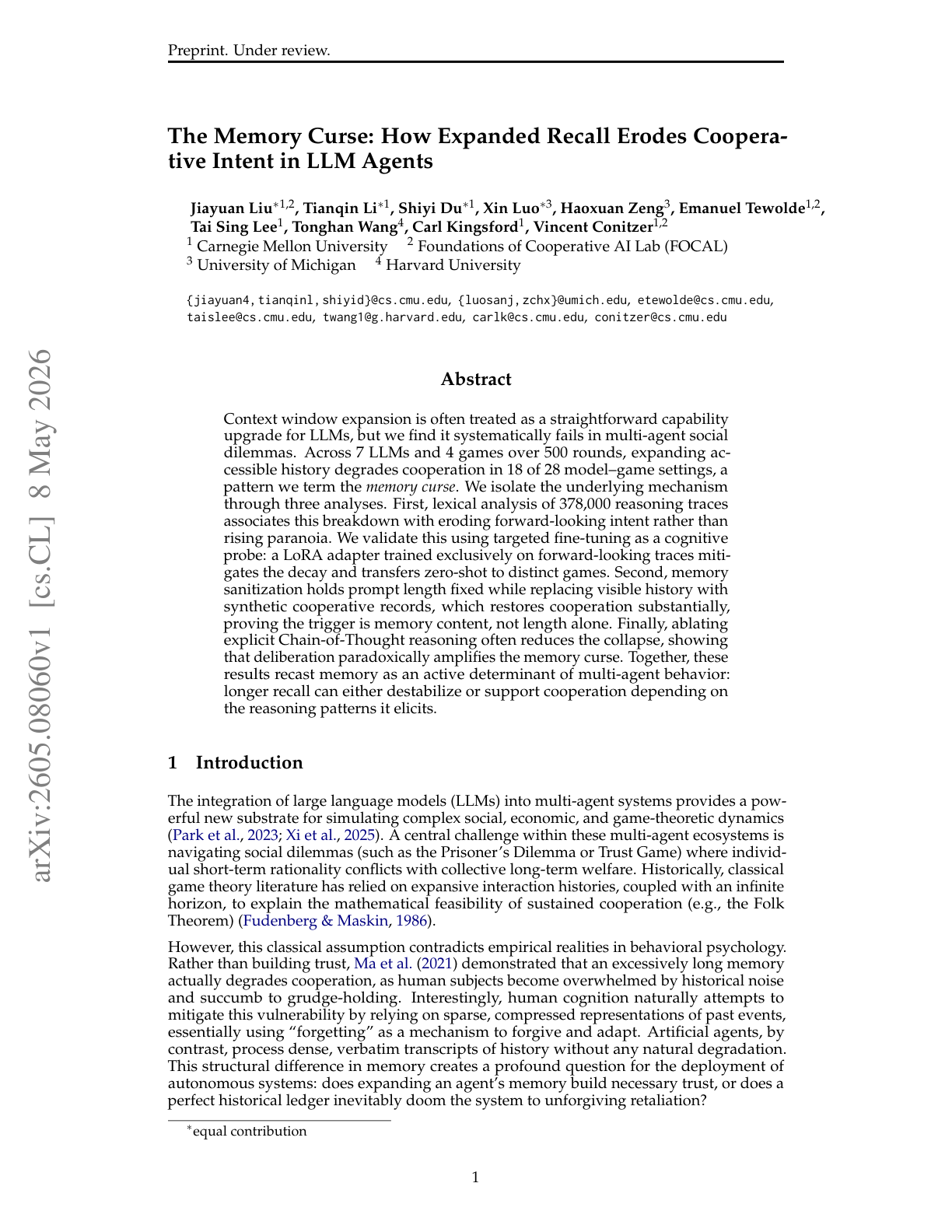
The Memory Curse in LLM Agents
A study of how long histories affect LLM agent behavior. Across 7 LLMs and 4 social dilemma games over 500 rounds, expanding accessible history degraded cooperation in 18 of 28 model-game combinations. Lexical analysis of 378,000 reasoning traces shows the mechanism is erosion of forward-looking intent rather than increased suspicion: long histories pull the model toward reasoning about past interactions rather than future payoffs. A LoRA adapter trained only on forward-looking traces mitigates the decay and transfers zero-shot to new games. Memory sanitization, which keeps prompt length fixed but swaps in synthetic cooperative records, restores cooperation, indicating the trigger is content rather than length. Ablating explicit chain-of-thought often reduces the collapse, suggesting deliberation amplifies the effect. The paper provides a diagnostic plus interventions for long-running agent systems where history quality, not just history length, drives behavior.
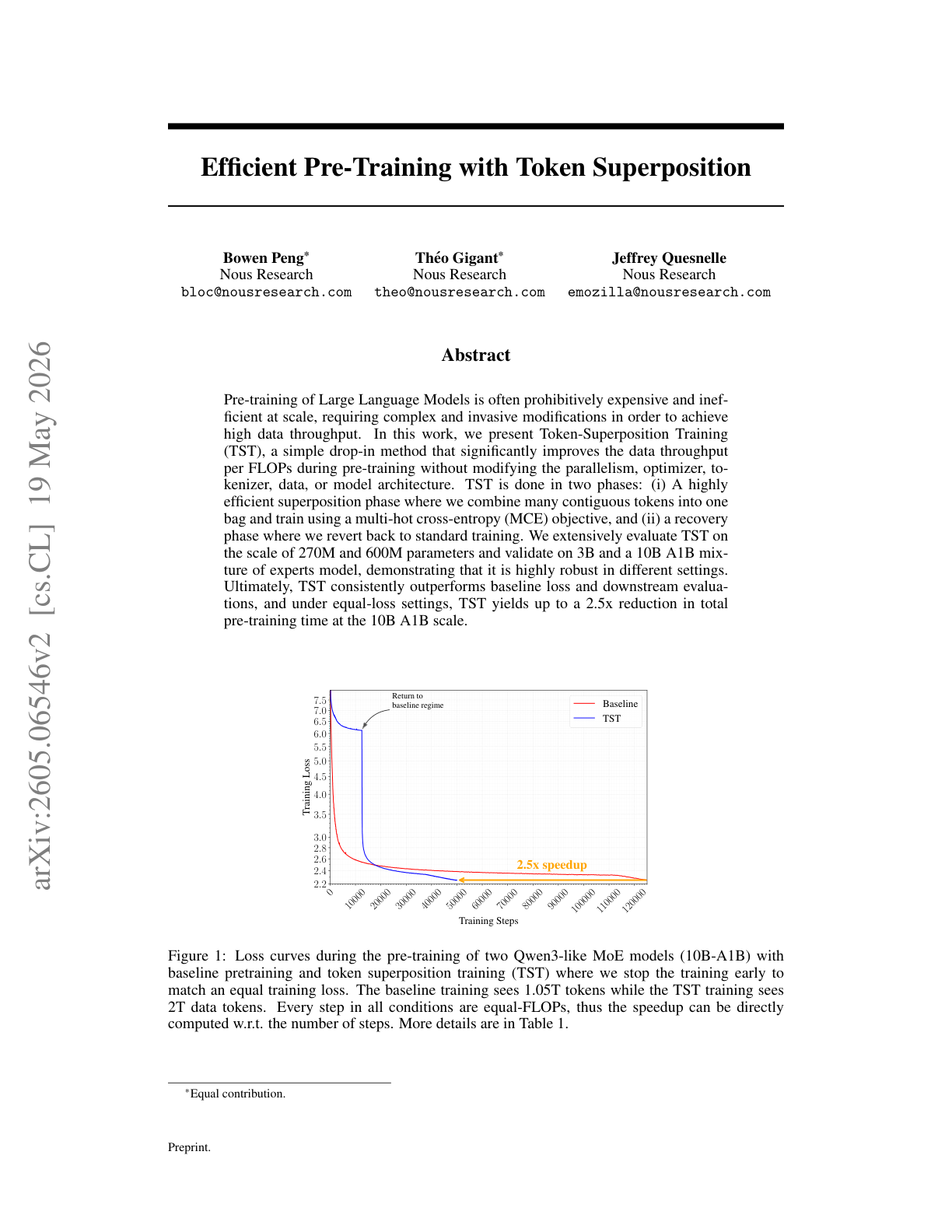
Token Superposition Training
Nous Research's second pretraining paper of the week. Token Superposition Training (TST) is a modification to the standard LLM pretraining loop that produces a 2 to 3x wall-clock speedup at matched FLOPs without changing the model architecture, optimizer, tokenizer, or training data. During the first third of training, the model reads and predicts contiguous bags of tokens, averaging their embeddings on the input side and predicting the next bag with a modified cross-entropy on the output side. For the remainder of the run, training reverts to standard next-token prediction. The inference-time model is identical to one produced by conventional pretraining. TST was validated at 270M, 600M, and 3B dense scales, and at a 10B-A1B mixture-of-experts model where it reaches a lower final loss while consuming 4,768 B200-GPU-hours versus the baseline's 12,311. Together with Lighthouse Attention, this is the second pretraining-loop modification from the same lab this week reporting substantial speedups without architecture changes.