Bias Control and Injection for Multi-Agent Aggregation
Sungjae Lee, Soheil Abbasloo, Jabin Koo and Jungseul Ok (POSTECH and Microsoft Research) aggregate answers from several LLMs by removing style bias in one step and deliberately injecting majority pressure in another, then use the resulting instability as a reliability signal.
Ask this paper
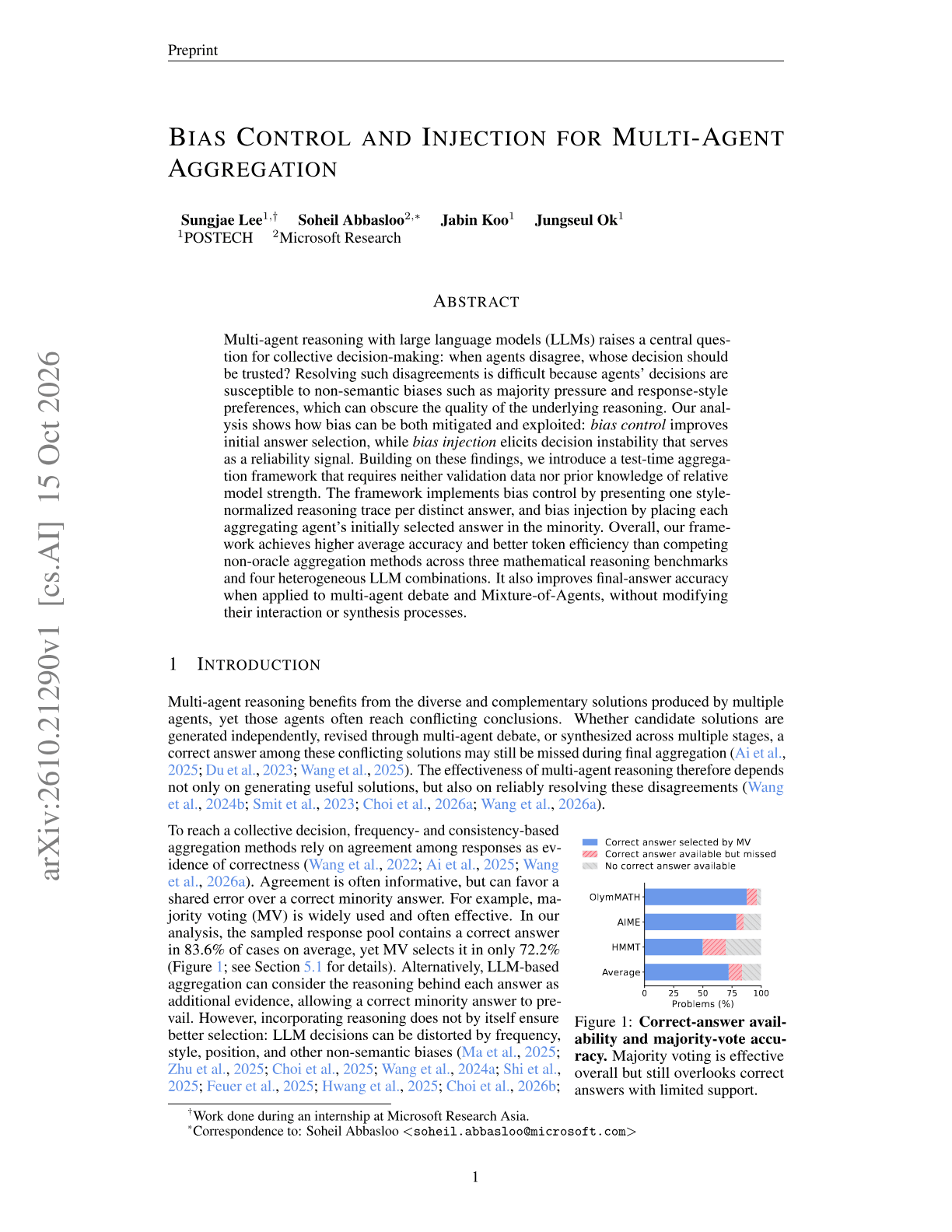
Majority vote loses correct answers. The sampled response pool contains a correct answer 83.6% of the time, but majority vote selects it only 72.2% of the time.
Bias control. The aggregating agent sees one style-normalized reasoning trace per distinct answer, so frequency and formatting do not decide the outcome.
Bias injection. Each aggregator's initially chosen answer is placed in the minority. This flips 59.8% of incorrect decisions but only 19.1% of correct ones, a 40.7-point gap, larger than repeated inference (32.5) or position swap (34.3).
Results. Highest average accuracy in all four model combinations on three math benchmarks, 3.2-6.2 points above the best non-oracle baseline, with no validation data and no knowledge of which model is stronger. It also improves multi-agent debate and Mixture-of-Agents without changing their procedures.
Abstract
Multi-agent reasoning with large language models (LLMs) raises a central question for collective decision-making: when agents disagree, whose decision should be trusted? Resolving such disagreements is difficult because agents' decisions are susceptible to non-semantic biases such as majority pressure and response-style preferences, which can obscure the quality of the underlying reasoning. Our analysis shows how bias can be both mitigated and exploited: bias control improves initial answer selection, while bias injection elicits decision instability that serves as a reliability signal. Building on these findings, we introduce a test-time aggregation framework that requires neither validation data nor prior knowledge of relative model strength. The framework implements bias control by presenting one style-normalized reasoning trace per distinct answer, and bias injection by placing each aggregating agent's initially selected answer in the minority. Overall, our framework achieves higher average accuracy and better token efficiency than competing non-oracle aggregation methods across three mathematical reasoning benchmarks and four heterogeneous LLM combinations. It also improves final-answer accuracy when applied to multi-agent debate and Mixture-of-Agents, without modifying their interaction or synthesis processes.